



 Chat with AI
Exam 28: Communication and Control 2: the Endocrine System

Exam 1: Science As a Way of Learning: a Guide to the Natural World54 Questions
Exam 2: Fundamental Building Blocks: Chemistry, water, and Ph74 Questions
Exam 3: Lifes Components: Biological Molecules79 Questions
Exam 4: Lifes Home: the Cell79 Questions
Exam 5: Lifes Border: the Plasma Membrane88 Questions
Exam 6: Lifes Mainspring: an Introduction to Energy78 Questions
Exam 7: Vital Harvest: Deriving Energy From Food74 Questions
Exam 8: The Green Worlds Gift: Photosynthesis79 Questions
Exam 9: The Links in Lifes Chain: Genetics and Cell Division77 Questions
Exam 10: Preparing for Sexual Reproduction: Meiosis77 Questions
Exam 11: The First Geneticist: Mendel and His Discoveries74 Questions
Exam 12: Units of Heredity: Chromosomes and Inheritance69 Questions
Exam 13: Passing on Lifes Information: Dna Structure and Replication72 Questions
Exam 14: How Proteins Are Made: Genetic Transcription, translation, and Regulation77 Questions
Exam 15: The Future Isnt What It Used to Be: Biotechnology74 Questions
Exam 16: An Introduction to Evolution: Charles Darwin, evolutionary Thought, and the Evidence for Evolution67 Questions
Exam 17: The Means of Evolution: Microevolution71 Questions
Exam 18: The Outcomes of Evolution: Macroevolution69 Questions
Exam 19: A Slow Unfolding: the History of Life on Earth80 Questions
Exam 20: Arriving Late,traveling Far: the Evolution of Human Beings56 Questions
Exam 21: Viruses,bacteria,archaea,and Protists: the Diversity of Life 168 Questions
Exam 22: Fungi: the Diversity of Life 251 Questions
Exam 23: Animals: the Diversity of Life 371 Questions
Exam 24: Plants: the Diversity of Life 453 Questions
Exam 25: The Angiosperms: Form and Function in Flowering Plants72 Questions
Exam 26: Body Support and Movement: the Integumentary, skeletal, and Muscular Systems71 Questions
Exam 27: Communication and Control 1: the Nervous System70 Questions
Exam 28: Communication and Control 2: the Endocrine System49 Questions
Exam 29: Defending the Body: the Immune System76 Questions
Exam 30: Transport and Exchange 1: Blood and Breath77 Questions
Exam 31: Transport and Exchange 2: Digestion, nutrition, and Elimination76 Questions
Exam 32: An Amazingly Detailed Script: Animal Development74 Questions
Exam 33: How the Baby Came to Be: Human Reproduction78 Questions
Exam 34: An Interactive Living World 1: Populations in Ecology76 Questions
Exam 35: An Interactive Living World 2: Communities in Ecology75 Questions
Exam 36: An Interactive Living World 3: Ecosystems and Biomes82 Questions
Select questions type


Which endocrine gland is associated with proper development of certain white blood cells?

Free
(Short Answer)
4.9/5  (79)
(79) Correct Answer: Verified
thymus
Insulin and glucagon are produced by a:
Free
(Multiple Choice)
4.8/5 (74)
(74) Correct Answer:Verified
VerifiedC
A diabetic friend of yours passes out shortly after taking her insulin injection.She regains consciousness and asks you to give her one of the glucose tablets she carries in her purse.Another friend steps in and says,"Wait! You shouldn't give sugar to a diabetic!" Recalling what you learned about the endocrine system,you give your diabetic friend the glucose tablet she asked for.Why did you trust the request of your diabetic friend for the glucose tablet and not the other friend who thought he was being helpful (but wasn't)?
Free
(Essay)
4.8/5 (76)
(76) Correct Answer:Verified
VerifiedInsulin reduces blood sugar and probably reduced it too much this time.The low blood sugar made her faint,and the glucose tablet would help raise blood sugar to normal levels.
A friend tells you that his Aunt Jane is being treated for a brain disorder that is causing her to produce too much of the glucocorticoid hormones.Your friend looked up the hormone and (correctly)found it to be produced by the adrenal glands.He says he doesn't understand why a brain disorder should have anything to do with the adrenal glands.What do you tell your friend to help him understand the connection between the two?
(Essay)
4.7/5 (79)
(79) As you may have heard before,stress can kill you! Explain the connection between the deleterious effects of stress and the endocrine system.
(Essay)
4.9/5 (92)
(92) The hypothalamus makes the hormones that are released from the posterior pituitary.
(True/False)
4.8/5 (74)
(74) In order to maintain homeostasis,parathyroid hormone would stimulate what response to low blood calcium levels?
(Multiple Choice)
4.8/5 (80)
(80) What would be the logical consequences of hormones traveling via the circulatory system as compared to the action-potential-based stimuli of the nervous system? Are these consequences necessarily a disadvantage?
(Essay)
4.8/5 (76)
(76) Small amounts of testosterone are made in the ovaries and adrenal glands of females.
(True/False)
4.8/5 (75)
(75) The endocrine system helps maintain homeostasis through positive feedback.
(True/False)
4.7/5 (69)
(69) Hypothalamic neurons directly control the anterior pituitary with neural stimuli at a synapse.
(True/False)
4.9/5 (81)
(81) Human growth hormone is composed of 191 amino acids.This would place it in which class of hormone?
(Short Answer)
4.7/5 (78)
(78) Match the following. Answers may be used more than once.
Correct Answer:Verified
VerifiedPremises:
Responses:
(Matching)
4.9/5 (78)
(78) Refer to the figure below, and then answer the following question(s).
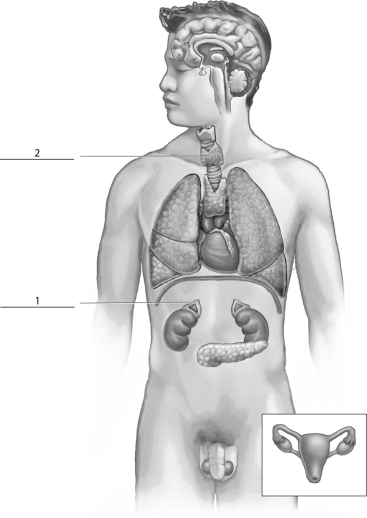 -The endocrine gland indicated by a "1" corresponds to the:
 (Multiple Choice)
4.8/5 (75)
(75) Which organ that is a target of insulin plays the most significant role in regulating sugar levels in circulation?
(Multiple Choice)
4.8/5 (79)
(79) Insulin stimulates liver cells to store glucose in the form of glycogen.
(True/False)
4.8/5 (68)
(68) A bunch of hormone molecules travel by one cell and have no effect but quickly stimulate the next cell.What did the second cell have that the first did not?
(Multiple Choice)
4.9/5 (74)
(74) 
Filters
- Essay(0)
- Multiple Choice(0)
- Short Answer(0)
- True False(0)
- Matching(0)