



 Chat with AI
Exam 28: Communication and Control 2: the Endocrine System

Exam 1: Science As a Way of Learning: a Guide to the Natural World54 Questions
Exam 2: Fundamental Building Blocks: Chemistry, water, and Ph74 Questions
Exam 3: Lifes Components: Biological Molecules79 Questions
Exam 4: Lifes Home: the Cell79 Questions
Exam 5: Lifes Border: the Plasma Membrane88 Questions
Exam 6: Lifes Mainspring: an Introduction to Energy78 Questions
Exam 7: Vital Harvest: Deriving Energy From Food74 Questions
Exam 8: The Green Worlds Gift: Photosynthesis79 Questions
Exam 9: The Links in Lifes Chain: Genetics and Cell Division77 Questions
Exam 10: Preparing for Sexual Reproduction: Meiosis77 Questions
Exam 11: The First Geneticist: Mendel and His Discoveries74 Questions
Exam 12: Units of Heredity: Chromosomes and Inheritance69 Questions
Exam 13: Passing on Lifes Information: Dna Structure and Replication72 Questions
Exam 14: How Proteins Are Made: Genetic Transcription, translation, and Regulation77 Questions
Exam 15: The Future Isnt What It Used to Be: Biotechnology74 Questions
Exam 16: An Introduction to Evolution: Charles Darwin, evolutionary Thought, and the Evidence for Evolution67 Questions
Exam 17: The Means of Evolution: Microevolution71 Questions
Exam 18: The Outcomes of Evolution: Macroevolution69 Questions
Exam 19: A Slow Unfolding: the History of Life on Earth80 Questions
Exam 20: Arriving Late,traveling Far: the Evolution of Human Beings56 Questions
Exam 21: Viruses,bacteria,archaea,and Protists: the Diversity of Life 168 Questions
Exam 22: Fungi: the Diversity of Life 251 Questions
Exam 23: Animals: the Diversity of Life 371 Questions
Exam 24: Plants: the Diversity of Life 453 Questions
Exam 25: The Angiosperms: Form and Function in Flowering Plants72 Questions
Exam 26: Body Support and Movement: the Integumentary, skeletal, and Muscular Systems71 Questions
Exam 27: Communication and Control 1: the Nervous System70 Questions
Exam 28: Communication and Control 2: the Endocrine System49 Questions
Exam 29: Defending the Body: the Immune System76 Questions
Exam 30: Transport and Exchange 1: Blood and Breath77 Questions
Exam 31: Transport and Exchange 2: Digestion, nutrition, and Elimination76 Questions
Exam 32: An Amazingly Detailed Script: Animal Development74 Questions
Exam 33: How the Baby Came to Be: Human Reproduction78 Questions
Exam 34: An Interactive Living World 1: Populations in Ecology76 Questions
Exam 35: An Interactive Living World 2: Communities in Ecology75 Questions
Exam 36: An Interactive Living World 3: Ecosystems and Biomes82 Questions
Select questions type


A consequence of the way hormones,as compared to neurotransmitters,get to their target cells is that hormones:
(Multiple Choice)
4.9/5  (77)
(77) Release of thyroid-stimulating hormone (TSH)from the pituitary is inhibited when:
(Multiple Choice)
4.7/5 (62)
(62) Most peptide hormones enter the target cell through large channels.
(True/False)
5.0/5 (87)
(87) 
Which hormones stimulate the kidneys to retain sodium and excrete potassium?
(Short Answer)
4.9/5 (80)
(80) "Releasing hormones" and "inhibiting hormones" produced by the hypothalamus target the:
(Multiple Choice)
4.8/5 (80)
(80) The hormone that stimulates mammary gland development and milk production is ________.
(Short Answer)
4.9/5 (80)
(80) Hormones that are released by the posterior pituitary were made in the:
(Multiple Choice)
4.7/5 (68)
(68) When blood sugar levels are running low,the body would produce more:
(Multiple Choice)
4.9/5 (69)
(69) Refer to the figure below, and then answer the following question(s).
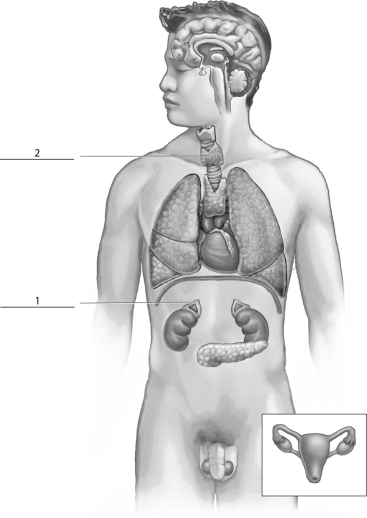 -The endocrine gland indicated by a "2" corresponds to the:
 (Multiple Choice)
4.9/5 (93)
(93) Which hormone controls water retention by the kidneys and is also known as antidiuretic hormone?
(Multiple Choice)
4.7/5 (95)
(95) Hormones made from variations on the cholesterol molecule are:
(Multiple Choice)
4.7/5 (64)
(64) 
Filters
- Essay(0)
- Multiple Choice(0)
- Short Answer(0)
- True False(0)
- Matching(0)