



 Chat with AI
Exam 4: Economic Efficiency, Government Price Setting, and Taxes

Exam 1: Economics: Foundations and Models145 Questions
Exam 2: Trade-Offs, Comparative Advantage, and the Market System151 Questions
Exam 3: Where Prices Come From: the Interaction of Demand and Supply159 Questions
Exam 4: Economic Efficiency, Government Price Setting, and Taxes127 Questions
Exam 5: Externalities, Environmental Policy, and Public Goods141 Questions
Exam 6: Elasticity: the Responsiveness of Demand and Supply149 Questions
Exam 7: Comparative Advantage and the Gains From International Trade125 Questions
Exam 8: Consumer Choice and Behavioral Economics154 Questions
Exam 9: Technology, Production, and Costs169 Questions
Exam 10: Firms in Perfectly Competitive Markets153 Questions
Exam 11: Monopolistic Competition140 Questions
Exam 12: Oligopoly: Firms in Less Competitive Markets130 Questions
Exam 13: Monopoly and Antitrust Policy146 Questions
Exam 14: The Markets for Labour and Other Factors of Production149 Questions
Exam 15: Public Choice, Taxes, and the Distribution of Income134 Questions
Exam 16: Pricing Strategy132 Questions
Exam 17: Firms, the Stock Market, and Corporate Governance137 Questions
Select questions type


Figure 4.3
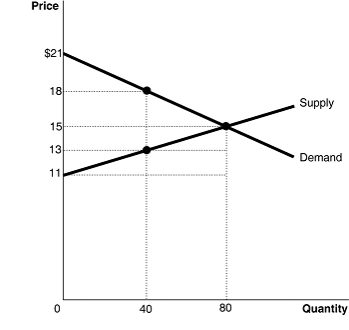 Figure 4.3 shows the market for tiger shrimp. The market is initially in equilibrium at a price of $15 and a quantity of 80. Now suppose producers decide to cut output to 40 in order to raise the price to $18.
-Refer to Figure 4.3.What is the value of consumer surplus at a price of $18?
Figure 4.3 shows the market for tiger shrimp. The market is initially in equilibrium at a price of $15 and a quantity of 80. Now suppose producers decide to cut output to 40 in order to raise the price to $18.
-Refer to Figure 4.3.What is the value of consumer surplus at a price of $18? (Multiple Choice)
4.9/5  (89)
(89) Figure 4.6
 Figure 4.6 shows the demand and supply curves for the almond market. The government believes that the equilibrium price is too low and tries to help almond growers by setting a price floor at Pf.
-Refer to Figure 4.6.What area represents the deadweight loss after the imposition of the price floor?
Figure 4.6 shows the demand and supply curves for the almond market. The government believes that the equilibrium price is too low and tries to help almond growers by setting a price floor at Pf.
-Refer to Figure 4.6.What area represents the deadweight loss after the imposition of the price floor? (Multiple Choice)
5.0/5 (81)
(81) Figure 4.5
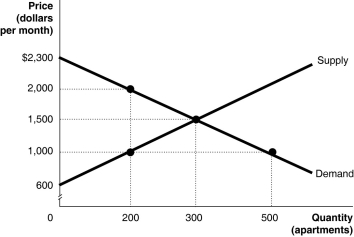 Figure 4.5 shows the market for apartments in Springfield. Recently, the government imposed a rent ceiling of $1,000 per month.
-Refer to Figure 4.5.What is the value of the portion of producer surplus transferred to consumers as a result of the rent ceiling?
Figure 4.5 shows the market for apartments in Springfield. Recently, the government imposed a rent ceiling of $1,000 per month.
-Refer to Figure 4.5.What is the value of the portion of producer surplus transferred to consumers as a result of the rent ceiling? (Multiple Choice)
4.7/5 (82)
(82) Figure 4.9
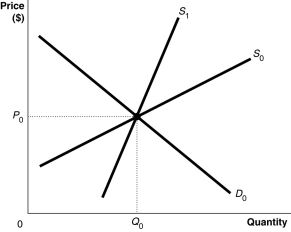 -Refer to Figure 4.9.Suppose the market is initially in equilibrium at price P₀ and now the government imposes a tax on every unit sold.Which of the following statements best describes the impact of the tax? For demand curve D₀
 (Multiple Choice)
4.9/5 (75)
(75) Figure 4.6
Figure 4.6 shows the demand and supply curves for the almond market. The government believes that the equilibrium price is too low and tries to help almond growers by setting a price floor at Pf.
-Refer to Figure 4.6.What is the area that represents producer surplus after the imposition of the price floor?
Figure 4.6 shows the demand and supply curves for the almond market. The government believes that the equilibrium price is too low and tries to help almond growers by setting a price floor at Pf.
-Refer to Figure 4.6.What is the area that represents producer surplus after the imposition of the price floor? (Multiple Choice)
4.7/5 (74)
(74) The marginal cost for Java Joe's to produce its first cup of coffee is $0.75.Its marginal cost to produce its second cup of coffee is $1.25.Its marginal cost increases by $0.50 for each additional cup of coffee it produces.Suppose the market price for coffee is $2.25.Construct a graph showing the producer surplus for each cup of coffee Java Joe's will sell.How many cups of coffee will Java Joe's sell? What is the value of the producer surplus Java Joe's receives for each cup of coffee it sells?
(Essay)
5.0/5 (80)
(80) ________ is maximized in a competitive market when marginal benefit equals marginal cost.
(Multiple Choice)
4.8/5 (90)
(90) If there is a market outcome in which the marginal benefit to consumers of the last unit produced is equal to its marginal cost of production and consumer surplus plus producer surplus is maximized, then
(Multiple Choice)
4.8/5 (81)
(81) Table 4.3
Hourly Wage (dollars) Quantity of Labour Supplied Quantity of Labour Demanded \ 7.50 530,000 650,000 8.50 550,000 630,000 9.50 570,000 610,000 10.50 590,000 590,000 11.50 610,000 570,000 12.50 630,000 550,000
Table 4.3 shows the demand and supply schedules for the labour market in the city of Oshawa.
-Refer to Table 4.3.Suppose that the quantity of labour demanded decreases by 80,000 at each wage level.What are the new free market equilibrium hourly wage and the new equilibrium quantity of labour?
(Multiple Choice)
4.8/5 (80)
(80) Table 4.3
Hourly Wage (dollars) Quantity of Labour Supplied Quantity of Labour Demanded \ 7.50 530,000 650,000 8.50 550,000 630,000 9.50 570,000 610,000 10.50 590,000 590,000 11.50 610,000 570,000 12.50 630,000 550,000
Table 4.3 shows the demand and supply schedules for the labour market in the city of Oshawa.
-Refer to Table 4.3.If a minimum wage of $9.50 an hour is mandated, what is the quantity of labour demanded?
(Multiple Choice)
4.9/5 (64)
(64) Figure 4.2
 -Refer to Figure 4.2.What area represents the increase in producer surplus when the market price rises from P₁ to P₂?
 (Multiple Choice)
4.8/5 (75)
(75) Marginal cost is the additional cost to a firm of producing one more unit of a good or service.
(True/False)
4.8/5 (72)
(72) The graph below represents the market for lychee nuts.The equilibrium price is $7.00 per bushel, but the market price is $5.00 per bushel.Identify the areas representing consumer surplus, producer surplus, and deadweight loss at the equilibrium price of $7.00 and at the market price of $5.00.

(Essay)
4.9/5 (81)
(81) Suppose that the federal government places a $1,500 tax on the buyers of new snowmobiles.After the purchase of a new snowmobile, a buyer must pay the government $1,500.How would the imposition of the tax on buyers be illustrated in a graph?
(Multiple Choice)
4.8/5 (91)
(91) The government proposes a tax on e-cigarettes.Buyers will bear the entire burden of the tax if the
(Multiple Choice)
4.7/5 (79)
(79) Figure 4.6
Figure 4.6 shows the demand and supply curves for the almond market. The government believes that the equilibrium price is too low and tries to help almond growers by setting a price floor at Pf.
-Refer to Figure 4.6.What area represents the portion of consumer surplus that has been transferred to producer surplus as a result of the price floor?
Figure 4.6 shows the demand and supply curves for the almond market. The government believes that the equilibrium price is too low and tries to help almond growers by setting a price floor at Pf.
-Refer to Figure 4.6.What area represents the portion of consumer surplus that has been transferred to producer surplus as a result of the price floor? (Multiple Choice)
4.9/5 (91)
(91) Table 4.1
Consumer Willingness to Pay Tom \ 40 Dick 30 Harriet 25
-Refer to Table 4.1.The table above lists the highest prices three consumers, Tom, Dick and Harriet, are willing to pay for a short-sleeved polo shirt.If the price of one of the shirts is $28 dollars
(Multiple Choice)
4.7/5 (72)
(72) 
Filters
- Essay(0)
- Multiple Choice(0)
- Short Answer(0)
- True False(0)
- Matching(0)