



 Chat with AI
Exam 18: Gaining From International Trade

Exam 1: The Economic Approach210 Questions
Exam 2: Asome Tools of the Economist257 Questions
Exam 3: Asupply,demand,and the Market Process405 Questions
Exam 4: Asupply and Demand: Applications and Extensions331 Questions
Exam 5: Difficult Cases for the Market and the Role of Government168 Questions
Exam 6: The Economics of Collective Decision-Making180 Questions
Exam 7: Ataking the Nations Economic Pulse288 Questions
Exam 8: Economic Fluctuations, unemployment, and Inflation242 Questions
Exam 9: Aan Introduction to Basic Macroeconomic Markets261 Questions
Exam 10: Dynamic Change, economic Fluctuations, and the Ad-As Model224 Questions
Exam 11: Fiscal Policy: the Keynesian View and Historical Perspective139 Questions
Exam 12: Fiscal Policy, incentives, and Secondary Effects171 Questions
Exam 13: Amoney and the Banking System260 Questions
Exam 14: Modern Macroeconomics and Monetary Policy220 Questions
Exam 15: Stabilization Policy, output, and Employment177 Questions
Exam 16: Creating an Environment for Growth and Prosperity142 Questions
Exam 17: Institutions,policies,and Cross-Country Differences in Income and Growth153 Questions
Exam 18: Gaining From International Trade222 Questions
Exam 19: International Finance and the Foreign Exchange Market162 Questions
Exam 20: Consumer Choice and Elasticity223 Questions
Exam 21: Acosts and the Supply of Goods231 Questions
Exam 22: Aprice Takers and the Competitive Process260 Questions
Exam 23: Price-Searcher Markets With Low Entry Barriers216 Questions
Exam 24: Aprice-Searcher Markets With High Entry Barriers254 Questions
Exam 25: The Supply of and Demand for Productive Resources200 Questions
Exam 26: Earnings, productivity, and the Job Market109 Questions
Exam 27: Investment, the Capital Market, and the Wealth of Nations129 Questions
Exam 28: Income Inequality and Poverty136 Questions
Exam 29: Government Spending and Taxation79 Questions
Exam 30: The Economics of Social Security54 Questions
Exam 31: The Stock Market: Its Function, Performance, and Potential As an Investment Opportunity70 Questions
Exam 32: Great Debates in Economics: Keynes Versus Hayek8 Questions
Exam 33: The Crisis of 2008: Causes and Lessons for the Future64 Questions
Exam 34: Lessons From the Great Depression60 Questions
Exam 35: Lessons From Japan and Canada72 Questions
Exam 36: The Federal Budget and the National Debt97 Questions
Exam 37: The Economics of Healthcare68 Questions
Exam 38: Education: Problems and Performance60 Questions
Exam 39: Earnings Differences Between Men and Women47 Questions
Exam 40: Do Labor Unions Increase the Wages of Workers74 Questions
Exam 41: The Question of Resource Exhaustion61 Questions
Exam 42: Difficult Environmental Cases and the Role of Government63 Questions
Select questions type


The following question(s)refer to the figure below,which shows the effect of a country imposing a tariff on an imported product.
Figure 17-14
 -Refer to Figure 17-14.Suppose that a tariff of t is imposed upon this good,raising the price to PW + t.As a result,
 (Multiple Choice)
4.7/5  (69)
(69) Figure 17-10
 -Refer to Figure 17-10.With the tariff,the quantity of saddles imported is
 (Multiple Choice)
4.8/5 (74)
(74) If nation A has an absolute advantage over nation B in the production of a product,this implies that
(Multiple Choice)
5.0/5 (81)
(81) Which of the following restricts the volume of international trade?
(Multiple Choice)
4.9/5 (73)
(73) Assume the United States can use a given amount of its resources to produce either 20 airplanes or 8 automobiles and Japan can employ the same amount of its resources to produce either 20 airplanes or 10 automobiles.The U.S.should specialize in
(Multiple Choice)
4.9/5 (80)
(80) The main problem with using the infant industries argument to justify protecting an industry from foreign competition is that
(Multiple Choice)
4.7/5 (82)
(82) The following question(s)refer to the figure below,which shows the effect of a country imposing a tariff on an imported product.
Figure 17-14
-Refer to Figure 17-14.The same price and quantity outcomes under the tariff above could have also been produced by the imposition of a quota of
-Refer to Figure 17-14.The same price and quantity outcomes under the tariff above could have also been produced by the imposition of a quota of (Multiple Choice)
4.9/5 (80)
(80) Many products consumed by Americans are imported.Imports account for the largest share of which of the following products consumed by Americans?
(Multiple Choice)
4.7/5 (84)
(84) International trade can be mutually advantageous because it
(Multiple Choice)
4.7/5 (89)
(89) Suppose that in the absence of trade,the U.S.price for bicycles was higher than the world price for bicycles.Would allowing international trade mean that the United States would import or export bicycles? Who in the United States would benefit and who would lose with a free trade policy,and would the gains be greater than the losses?
(Essay)
4.7/5 (85)
(85)  -At a world price of $1.00 in Figure 17-12,
The figure below illustrates a tariff.On the graph,Q represents quantity and P represents price.
Figure 17-11
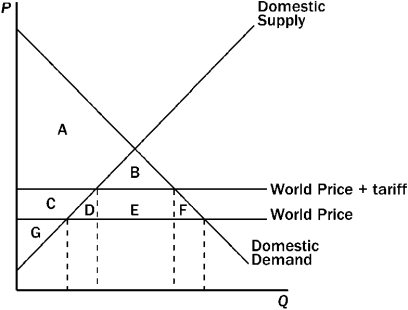 -Refer to Figure 17-11.Government revenue raised by the tariff is represented by the area
 (Multiple Choice)
5.0/5 (80)
(80) The primary benefits derived from tariffs usually accrue to the
(Multiple Choice)
4.9/5 (63)
(63) Which of the following would be expected if the tariff on foreign-produced shoes were decreased?
(Multiple Choice)
4.7/5 (78)
(78) Figure 17-6
The domestic country is China.
 -Refer to Figure 17-6.With trade,China will
 (Multiple Choice)
4.8/5 (87)
(87) In 1993 the negotiations over the North American Free Trade Agreement and the General Agreement on Tariffs and Trade were frequently characterized by comments such as,"Free trade with low-wage countries will cause the wages of U.S.workers to fall." Identify the errors in statements such as this.
(Essay)
4.9/5 (90)
(90) 
Filters
- Essay(0)
- Multiple Choice(0)
- Short Answer(0)
- True False(0)
- Matching(0)