



 Chat with AI
Exam 16: Exploring Various Aspects of Pension Funds, Finance Companies, and Insurance Industry

Exam 1: Understanding the Financial System and Its Impact on the Economy and Markets137 Questions
Exam 2: Financial Systems, Monetary Units, and the Role of Money in the Economy133 Questions
Exam 3: Financial Indices, Market Information, and Economic Data141 Questions
Exam 4: The Financial Crisis and Its Impact on the Mortgage Market and Economy128 Questions
Exam 5: Understanding Interest Rates, Savings, and the Wealth Effect133 Questions
Exam 6: Financial Concepts and Interest Rates137 Questions
Exam 7: Effects of Inflation and Yield Curves on Stock Prices and Investments122 Questions
Exam 8: Understanding Risk and Market Factors in Financial Securities128 Questions
Exam 9: Exploring Financial Markets and Hedging Strategies138 Questions
Exam 10: Factors Affecting the Volume of CDs117 Questions
Exam 11: Exploring the Reserve Accounting System, Money Markets, and Financial Instruments124 Questions
Exam 12: Exploring Central Banks and Their Impact on the Economy and Financial System122 Questions
Exam 13: Central Banking and Monetary Policy: Exploring Tools and Strategies146 Questions
Exam 14: Banking and Financial Services: Regulations, Operations, and Trends138 Questions
Exam 15: Comparative Analysis of Financial Institutions and Their Operations104 Questions
Exam 16: Exploring Various Aspects of Pension Funds, Finance Companies, and Insurance Industry135 Questions
Exam 17: The Impact of Deregulation and Regulation on Financial Institutions and Banking Industry in the United States116 Questions
Exam 18: Treasury Auctions, Public Debt, and Government Borrowing: Exploring the Us Treasury System135 Questions
Exam 19: Corporate Bond Pricing, Market Development, and Financing Strategies98 Questions
Exam 20: The Truth About Regulation Fd and Stock Holdings: Debunking Common Myths in the Financial Market131 Questions
Exam 21: Flexible Savings Account Options104 Questions
Exam 22: Mortgage Market and Mortgage Instruments109 Questions
Exam 23: International Financial Transactions and Balance of Payments120 Questions
Exam 24: International Banking and Financial Regulations76 Questions
Exam 25: Exploring the Complexities of Financial Services and Regulation118 Questions
Select questions type


Insurance companies invest in long-term securities due to their high predictability of cash inflows and outflows.
(True/False)
4.8/5  (75)
(75) Life and property-casualty insurers make most of their net earnings or profits from:
(Multiple Choice)
4.9/5 (63)
(63) Federal reform legislation in 2005 required employers to fully fund their pension plans within seven years.
(True/False)
4.8/5 (71)
(71) The prime beneficiary of the cash balance pension plan is the employee.
(True/False)
4.8/5 (81)
(81) Because of their high liquidity needs and safety requirements, most pension funds invest heavily in money market mutual funds.
(True/False)
4.8/5 (84)
(84) For pension funds, defined benefit plans promise a specific monthly or annual payment to workers when they retire based upon how much they contribute each year to the fund.
(True/False)
4.9/5 (83)
(83) The property-casualty insurance business is ____ than the life insurance business.
(Multiple Choice)
4.9/5 (85)
(85) A financial institution reports the following figures in its latest annual report:
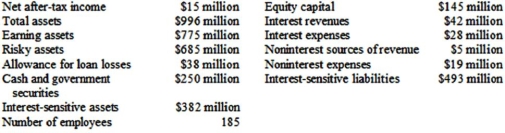 Drawing upon the discussion in this chapter on measuring and evaluating the performance of a financial institution, please calculate as many measures of this firm's performance as you can. Do you notice any performance measures that the management of this institution might wish to investigate for possible problems?
 (Essay)
4.9/5 (63)
(63) Mutual funds investing in shares of mutual funds are known as super-mutuals.
(True/False)
4.8/5 (83)
(83) Assets selected by the pension funds depend heavily upon what one factor, according to the textbook?
(Multiple Choice)
4.9/5 (69)
(69) Because property-casualty insurance companies are taxed virtually the same as other corporations, tax-exempt bonds are very attractive to them.
(True/False)
4.9/5 (80)
(80) What measures of a financial institution's performance are the most widely used?
(Multiple Choice)
4.7/5 (85)
(85) The approximate number of property-casualty insurance companies headquartered in the United States is:
(Multiple Choice)
4.8/5 (78)
(78) The Financial Accounting Standards Board requires businesses to make projections of their future pension obligations.
(True/False)
4.9/5 (63)
(63) Recent trends in the aggressive management of some hedge funds have led to calls for more extensive regulation of the industry, especially as these funds have begun to pursue smaller, more vulnerable and busters.
(True/False)
4.9/5 (74)
(74) One of the most prominent changes in mutual funds is greater use of derivatives, including financial futures, options and both credit and interest rate swap contracts.
(True/False)
4.8/5 (77)
(77) Hedge funds often ask for minimal investments of at least:
(Multiple Choice)
4.7/5 (81)
(81) In order to increase their yield and, therefore, their income most life insurance companies turn over their portfolios frequently.
(True/False)
4.8/5 (72)
(72) The assets of an investment company are managed by its board of directors.
(True/False)
4.9/5 (77)
(77) What is a REIT? A mortgage bank? A leasing company? Why do you think these specialized financial institutions came into being? Have they faced any serious problems of late?
(Short Answer)
4.8/5 (80)
(80) 
Filters
- Essay(0)
- Multiple Choice(0)
- Short Answer(0)
- True False(0)
- Matching(0)