



 Chat with AI
Exam 8: Understanding Risk and Market Factors in Financial Securities

Exam 1: Understanding the Financial System and Its Impact on the Economy and Markets137 Questions
Exam 2: Financial Systems, Monetary Units, and the Role of Money in the Economy133 Questions
Exam 3: Financial Indices, Market Information, and Economic Data141 Questions
Exam 4: The Financial Crisis and Its Impact on the Mortgage Market and Economy128 Questions
Exam 5: Understanding Interest Rates, Savings, and the Wealth Effect133 Questions
Exam 6: Financial Concepts and Interest Rates137 Questions
Exam 7: Effects of Inflation and Yield Curves on Stock Prices and Investments122 Questions
Exam 8: Understanding Risk and Market Factors in Financial Securities128 Questions
Exam 9: Exploring Financial Markets and Hedging Strategies138 Questions
Exam 10: Factors Affecting the Volume of CDs117 Questions
Exam 11: Exploring the Reserve Accounting System, Money Markets, and Financial Instruments124 Questions
Exam 12: Exploring Central Banks and Their Impact on the Economy and Financial System122 Questions
Exam 13: Central Banking and Monetary Policy: Exploring Tools and Strategies146 Questions
Exam 14: Banking and Financial Services: Regulations, Operations, and Trends138 Questions
Exam 15: Comparative Analysis of Financial Institutions and Their Operations104 Questions
Exam 16: Exploring Various Aspects of Pension Funds, Finance Companies, and Insurance Industry135 Questions
Exam 17: The Impact of Deregulation and Regulation on Financial Institutions and Banking Industry in the United States116 Questions
Exam 18: Treasury Auctions, Public Debt, and Government Borrowing: Exploring the Us Treasury System135 Questions
Exam 19: Corporate Bond Pricing, Market Development, and Financing Strategies98 Questions
Exam 20: The Truth About Regulation Fd and Stock Holdings: Debunking Common Myths in the Financial Market131 Questions
Exam 21: Flexible Savings Account Options104 Questions
Exam 22: Mortgage Market and Mortgage Instruments109 Questions
Exam 23: International Financial Transactions and Balance of Payments120 Questions
Exam 24: International Banking and Financial Regulations76 Questions
Exam 25: Exploring the Complexities of Financial Services and Regulation118 Questions
Select questions type


The market yield on a risky security is equal to the risk-free interest rate plus the risk premium. The higher the degree of default risk, the lower the risk premium.

Free
(True/False)
4.9/5  (69)
(69) Correct Answer: Verified
False
A rise in the junk-bond spread indicates a growing fear among bond market investors that marginal-quality corporate borrowers are more likely to default on their debts.
Free
(True/False)
4.8/5 (83)
(83) Correct Answer:Verified
VerifiedTrue
Credit rating agencies typically release the same rating for securities.
Free
(True/False)
4.8/5 (88)
(88) Correct Answer:Verified
VerifiedFalse
The key factor determining the size of the call premium on callable bonds is the promised call price offered by the security's issuer.
(True/False)
4.8/5 (85)
(85) Nearly all corporate bonds and mortgages and some U.S. government bonds issued in U.S. financial markets carry a call privilege.
(True/False)
4.8/5 (82)
(82) New announcements that reflect decisions by the management of a corporation or other fund-raising unit are associated with a form of risk known as event risk.
(True/False)
4.8/5 (76)
(76) When agency ratings on securities are different, the accepted practice is to take the highest rating and the lowest rating and average the results.
(True/False)
4.9/5 (79)
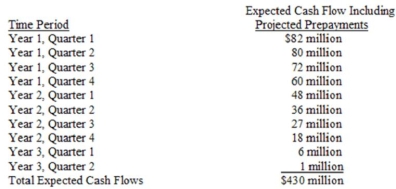
(79) A pool of credit card loans is expected to pay the stream of cash flows for each quarter of the year indicated below. If the yield to maturity on comparable quality instruments is 14 percent, what should be the market value (price) of each security issued against this particular pool of credit-card loans?
(Short Answer)
4.7/5 (77)
(77) Finance theory suggests that yield curves on higher-risk (speculative) corporate bonds tend to have a downward (negative) slope or are humped or bowed in shape. Why this might be true is that:
(Multiple Choice)
4.9/5 (92)
(92) The failures of Argentina and Enron Corporation in 2001 reflect:
(Multiple Choice)
4.9/5 (75)
(75) Marketability influences the yield a security issuer must offer in the secondary market.
(True/False)
4.9/5 (71)
(71) When a company's common stock rises in price, its convertible bonds also tend to rise in price.
(True/False)
4.9/5 (78)
(78) The concept of anticipated loss represents each investor's view of the appropriate risk premium on a security. If an investor faces the following situation, he or she would be inclined to buy the security: anticipated loss 6% risk-free rate 6% current yield to maturity 10%
(True/False)
4.9/5 (72)
(72) Government uses its taxing power to encourage the purchase of certain financial assets and therefore redirects the flow of savings and investment towards areas of critical social need.
(True/False)
4.7/5 (88)
(88) Marketability of a security is affected by the volume of similar securities available.
(True/False)
4.9/5 (99)
(99) The highest marginal tax for individuals (single and married) is:
(Multiple Choice)
4.8/5 (81)
(81) The marginal tax for people making $15,000 a year in taxable income is:
(Multiple Choice)
4.9/5 (83)
(83) Marketability of a security is inversely related to the size and reputation of the institution issuing that security.
(True/False)
4.8/5 (88)
(88) 
Filters
- Essay(0)
- Multiple Choice(0)
- Short Answer(0)
- True False(0)
- Matching(0)