



 Chat with AI
Exam 16: Exploring Various Aspects of Pension Funds, Finance Companies, and Insurance Industry

Exam 1: Understanding the Financial System and Its Impact on the Economy and Markets137 Questions
Exam 2: Financial Systems, Monetary Units, and the Role of Money in the Economy133 Questions
Exam 3: Financial Indices, Market Information, and Economic Data141 Questions
Exam 4: The Financial Crisis and Its Impact on the Mortgage Market and Economy128 Questions
Exam 5: Understanding Interest Rates, Savings, and the Wealth Effect133 Questions
Exam 6: Financial Concepts and Interest Rates137 Questions
Exam 7: Effects of Inflation and Yield Curves on Stock Prices and Investments122 Questions
Exam 8: Understanding Risk and Market Factors in Financial Securities128 Questions
Exam 9: Exploring Financial Markets and Hedging Strategies138 Questions
Exam 10: Factors Affecting the Volume of CDs117 Questions
Exam 11: Exploring the Reserve Accounting System, Money Markets, and Financial Instruments124 Questions
Exam 12: Exploring Central Banks and Their Impact on the Economy and Financial System122 Questions
Exam 13: Central Banking and Monetary Policy: Exploring Tools and Strategies146 Questions
Exam 14: Banking and Financial Services: Regulations, Operations, and Trends138 Questions
Exam 15: Comparative Analysis of Financial Institutions and Their Operations104 Questions
Exam 16: Exploring Various Aspects of Pension Funds, Finance Companies, and Insurance Industry135 Questions
Exam 17: The Impact of Deregulation and Regulation on Financial Institutions and Banking Industry in the United States116 Questions
Exam 18: Treasury Auctions, Public Debt, and Government Borrowing: Exploring the Us Treasury System135 Questions
Exam 19: Corporate Bond Pricing, Market Development, and Financing Strategies98 Questions
Exam 20: The Truth About Regulation Fd and Stock Holdings: Debunking Common Myths in the Financial Market131 Questions
Exam 21: Flexible Savings Account Options104 Questions
Exam 22: Mortgage Market and Mortgage Instruments109 Questions
Exam 23: International Financial Transactions and Balance of Payments120 Questions
Exam 24: International Banking and Financial Regulations76 Questions
Exam 25: Exploring the Complexities of Financial Services and Regulation118 Questions
Select questions type


In making their investment decisions, life insurers pursue:
(Multiple Choice)
4.9/5  (91)
(91) One area of growing insurance needs, according to the text, is small businesses.
(True/False)
4.9/5 (81)
(81) Interest income and capital gains are federal tax-exempt for pension funds.
(True/False)
4.9/5 (77)
(77) By purchasing shares in an investment company small investors can get greater price stability and reduced risk in their investments.
(True/False)
4.9/5 (87)
(87) GICs have helped to reduce insurance company risk in recent years by stabilizing their sources of funds and lowering the average cost of life insurance company funding.
(True/False)
4.7/5 (85)
(85) Loans to policyholders further increase the stability of cash flows for the insurance industry.
(True/False)
4.9/5 (78)
(78) Which of the following institutions is often called the "department store of consumer and business credit?"
(Multiple Choice)
4.8/5 (80)
(80) The gap between what Penny Benny has promised to payout to pension plan members and its available assets has widened significantly, in 2005 exceeding:
(Multiple Choice)
4.9/5 (93)
(93) The principal asset held by state and local government employee retirement funds is corporate bonds.
(True/False)
4.8/5 (75)
(75) A symbiotic is a conglomerate financial firm that offers a variety of financial services under one roof.
(True/False)
4.9/5 (89)
(89) Cash balance pension funds tend to favor young workers, while they may actually reduce older workers benefits.
(True/False)
4.8/5 (75)
(75) You are examining the profitability of five different financial institutions as measured by their ROE (return on equity capital) and ROA (return on assets). The table below reports the ROE and ROA for each of these five institutions. Using the data below can you determine what proportion of each institution's total assets are financed by equity (owners') capital and what proportion are financed by debt?
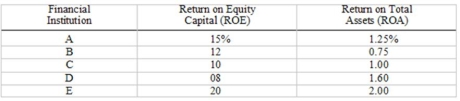 Recall: ROE = Net after-tax income/Total equity capital and ROA = Net after-tax income/Total assets
 (Short Answer)
4.9/5 (84)
(84) Most finance companies are heavy users of debt in financing their operations.
(True/False)
4.9/5 (92)
(92) The gradual aging of the general population in the U.S. and several other nations tends to accelerate the growth of pension funds.
(True/False)
4.8/5 (92)
(92) Because of the aging of the population, pension fund growth is expected to increase.
(True/False)
4.8/5 (78)
(78) Property-casualty insurance firms are relatively unaffected by the business cycle.
(True/False)
4.7/5 (78)
(78) In recent years, U.S. life insurers have increased their holdings of commercial mortgages and reduced their investments in one- to four-family residential mortgages.
(True/False)
4.7/5 (66)
(66) Pension funds have little need for liquidity because their cash inflows and outflows tend to be highly predictable.
(True/False)
4.9/5 (88)
(88) 
Filters
- Essay(0)
- Multiple Choice(0)
- Short Answer(0)
- True False(0)
- Matching(0)