



 Chat with AI
Exam 18: Treasury Auctions, Public Debt, and Government Borrowing: Exploring the Us Treasury System

Exam 1: Understanding the Financial System and Its Impact on the Economy and Markets137 Questions
Exam 2: Financial Systems, Monetary Units, and the Role of Money in the Economy133 Questions
Exam 3: Financial Indices, Market Information, and Economic Data141 Questions
Exam 4: The Financial Crisis and Its Impact on the Mortgage Market and Economy128 Questions
Exam 5: Understanding Interest Rates, Savings, and the Wealth Effect133 Questions
Exam 6: Financial Concepts and Interest Rates137 Questions
Exam 7: Effects of Inflation and Yield Curves on Stock Prices and Investments122 Questions
Exam 8: Understanding Risk and Market Factors in Financial Securities128 Questions
Exam 9: Exploring Financial Markets and Hedging Strategies138 Questions
Exam 10: Factors Affecting the Volume of CDs117 Questions
Exam 11: Exploring the Reserve Accounting System, Money Markets, and Financial Instruments124 Questions
Exam 12: Exploring Central Banks and Their Impact on the Economy and Financial System122 Questions
Exam 13: Central Banking and Monetary Policy: Exploring Tools and Strategies146 Questions
Exam 14: Banking and Financial Services: Regulations, Operations, and Trends138 Questions
Exam 15: Comparative Analysis of Financial Institutions and Their Operations104 Questions
Exam 16: Exploring Various Aspects of Pension Funds, Finance Companies, and Insurance Industry135 Questions
Exam 17: The Impact of Deregulation and Regulation on Financial Institutions and Banking Industry in the United States116 Questions
Exam 18: Treasury Auctions, Public Debt, and Government Borrowing: Exploring the Us Treasury System135 Questions
Exam 19: Corporate Bond Pricing, Market Development, and Financing Strategies98 Questions
Exam 20: The Truth About Regulation Fd and Stock Holdings: Debunking Common Myths in the Financial Market131 Questions
Exam 21: Flexible Savings Account Options104 Questions
Exam 22: Mortgage Market and Mortgage Instruments109 Questions
Exam 23: International Financial Transactions and Balance of Payments120 Questions
Exam 24: International Banking and Financial Regulations76 Questions
Exam 25: Exploring the Complexities of Financial Services and Regulation118 Questions
Select questions type


Retirement of government debt held by the nonbank public is likely to reduce prices and increase unemployment.
(True/False)
4.8/5  (60)
(60) If the U.S. Government runs a small budget deficit, the Treasury could cover the shortfall by:
(Multiple Choice)
4.9/5 (72)
(72) While more state and local government funds are needed as the population continues to grow, it is not clear whether those needed funds can be raised at reasonable cost given:
(Multiple Choice)
4.8/5 (74)
(74) If the Treasury uses a budget surplus to retire Treasury securities and reduces the national debt, national income will ____ and interest rates will ____.
(Multiple Choice)
5.0/5 (79)
(79) From 1970 - 1997, the U.S. federal government's budget was in deficit.
(True/False)
4.9/5 (82)
(82) New US Treasury IOUs around the globe have totaled more than $3 trillion annually in recent years, fueled by close to 500 treasury auctions per year.
(True/False)
4.8/5 (79)
(79) Suppose the public debt of the United States consisted of the following types of security issues (all figures in billions of dollars):
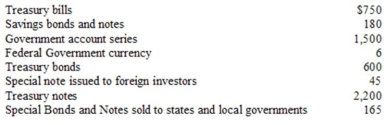 Please calculate the following: the total marketable debt; the total nonmarketable debt; the total interest-bearing debt; and the gross public debt.
 (Short Answer)
4.9/5 (88)
(88) In 1992 the U.S. Congress passed a balanced budget amendment in order to move the United States government closer to equality of revenues and expenditures.
(True/False)
4.9/5 (76)
(76) If the Treasury is compelled by a sizable budget deficit to borrow funds from the Federal Reserve banks, all of the following effects are likely except one. Which effect is not likely to happen?
(Multiple Choice)
4.7/5 (94)
(94) Due to drastic cuts in federal spending and strong economic growth it now appears that the federal government will experience a $10 billion budget surplus during the current fiscal year. If the Treasury plans to retain $2 billion of this surplus in its cash account at the Federal Reserve and to use the balance to retire $5 billion in government securities held by depository institutions and $3 billion held by the general public, use T accounts to show the effects of this debt retirement operation.
(Essay)
4.8/5 (85)
(85) On the run securities tend to be more liquid and trade at __________ than off the run Treasury IOUs.
(Multiple Choice)
4.9/5 (94)
(94) Recent research suggests there is a positive relationship between the size of the net U.S. Government budget deficit and:
(Multiple Choice)
4.8/5 (76)
(76) Smaller financial institutions and individuals account for most of the bids placed in each U.S. Treasury auction.
(True/False)
4.8/5 (74)
(74) Because the interest rates on Treasury note and bonds are fixed, the interest burden on the U.S. taxpayer remains unchanged when market interest rates increase.
(True/False)
4.9/5 (83)
(83) The market for government securities is the anchor of the U.S. financial system. The increasing ratio of government holdings of its own debt is therefore:
(Multiple Choice)
4.8/5 (79)
(79) On the run securities tend to be more liquid and trade at somewhat higher prices than off the run Treasury IOUs.
(True/False)
4.8/5 (89)
(89) 
Filters
- Essay(0)
- Multiple Choice(0)
- Short Answer(0)
- True False(0)
- Matching(0)