



 Chat with AI
Exam 18: Treasury Auctions, Public Debt, and Government Borrowing: Exploring the Us Treasury System

Exam 1: Understanding the Financial System and Its Impact on the Economy and Markets137 Questions
Exam 2: Financial Systems, Monetary Units, and the Role of Money in the Economy133 Questions
Exam 3: Financial Indices, Market Information, and Economic Data141 Questions
Exam 4: The Financial Crisis and Its Impact on the Mortgage Market and Economy128 Questions
Exam 5: Understanding Interest Rates, Savings, and the Wealth Effect133 Questions
Exam 6: Financial Concepts and Interest Rates137 Questions
Exam 7: Effects of Inflation and Yield Curves on Stock Prices and Investments122 Questions
Exam 8: Understanding Risk and Market Factors in Financial Securities128 Questions
Exam 9: Exploring Financial Markets and Hedging Strategies138 Questions
Exam 10: Factors Affecting the Volume of CDs117 Questions
Exam 11: Exploring the Reserve Accounting System, Money Markets, and Financial Instruments124 Questions
Exam 12: Exploring Central Banks and Their Impact on the Economy and Financial System122 Questions
Exam 13: Central Banking and Monetary Policy: Exploring Tools and Strategies146 Questions
Exam 14: Banking and Financial Services: Regulations, Operations, and Trends138 Questions
Exam 15: Comparative Analysis of Financial Institutions and Their Operations104 Questions
Exam 16: Exploring Various Aspects of Pension Funds, Finance Companies, and Insurance Industry135 Questions
Exam 17: The Impact of Deregulation and Regulation on Financial Institutions and Banking Industry in the United States116 Questions
Exam 18: Treasury Auctions, Public Debt, and Government Borrowing: Exploring the Us Treasury System135 Questions
Exam 19: Corporate Bond Pricing, Market Development, and Financing Strategies98 Questions
Exam 20: The Truth About Regulation Fd and Stock Holdings: Debunking Common Myths in the Financial Market131 Questions
Exam 21: Flexible Savings Account Options104 Questions
Exam 22: Mortgage Market and Mortgage Instruments109 Questions
Exam 23: International Financial Transactions and Balance of Payments120 Questions
Exam 24: International Banking and Financial Regulations76 Questions
Exam 25: Exploring the Complexities of Financial Services and Regulation118 Questions
Select questions type


The Treasury most frequently uses the Dutch auction when it issues new securities.
(True/False)
4.8/5  (77)
(77) In a uniform price auction, all successful bidders for federal government securities pay the stop-out price.
(True/False)
4.8/5 (79)
(79) Suppose the Treasury is faced with a budget surplus and chooses to retire debt previously issued. According to your text, several effects are likely to occur if the retired debt was held by the nonbank public. Which effect listed below is not likely to happen in this case?
(Multiple Choice)
5.0/5 (80)
(80) U.S. Treasury borrowing directly from the Federal Reserve is equivalent to printing money and is highly inflationary.
(True/False)
4.7/5 (70)
(70) Suppose the Treasury is faced with a budget surplus and chooses to retire debt previously issued. According to your text, several effects are likely to occur if the retired debt was held by depository institutions. Which effect listed below is not likely to happen in this case?
(Multiple Choice)
5.0/5 (91)
(91) Suppose the U.S. federal government's revenues and expenditure accounts displayed the amounts shown in this fiscal year (each item in billions of U.S. dollars): 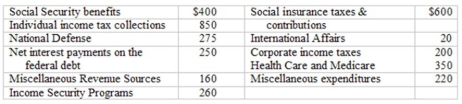 What were the government's total revenues and expenditures in the most recent fiscal year? Was the budget in surplus or deficit? All other factors held constant, what is likely to happen to the economy's level of income and interest rates as a result of this year's government budget position? Please explain the reasoning behind your answer to this last question.
 (Essay)
4.8/5 (63)
(63) If the economy is at full employment and the federal deficit is funded by borrowing from the nonbank public, a likely effect will be increased prices.
(True/False)
4.9/5 (67)
(67) Significant cuts in individual income tax rates as well accelerated depreciation allowances, inflation-adjusted tax rates and income tax deductions were accomplished for the first time in several years with the passage of the:
(Multiple Choice)
4.8/5 (84)
(84) The approximate size of the gross public debt of the United States in 2009 was, according to your text, approximately:
(Multiple Choice)
4.8/5 (71)
(71) Using the the description or the definition below, identify each of the key terms and concepts presented in this chapter.
a. Method by which marketable U.S. Treasury securities are issued and sold.
b. Portion of the government debt that is actively traded each day.
c. A government budget position that tends to expand economic activity and may necessitate the borrowing of money to sustain that position.
(Short Answer)
4.9/5 (83)
(83) Treasury borrowings from the Federal Reserve are equivalent to printing money because there is no offsetting withdrawal of reserves from depositories or from the public's deposit accounts.
(True/False)
4.9/5 (73)
(73) Treasury reverse auctions are likely in a period of economic recession.
(True/False)
5.0/5 (82)
(82) The net effect of retiring government securities held by the nonbank public is a reduction in total spending. This occurs because money is transferred from the general public to investors.
(True/False)
4.8/5 (68)
(68) The taxing and spending programs of the federal government designed to promote national economic goals are known as fiscal policy.
(True/False)
4.9/5 (84)
(84) A U.S. federal budget surplus means that the Treasury will no longer have to borrow.
(True/False)
4.8/5 (67)
(67) Treasury borrowing from the nonbank public has which of the following effects?
(Multiple Choice)
4.8/5 (75)
(75) The marketable public debt in the United States is issued today in book entry form, which means investors receive an engraved certificate and receive a statement of account.
(True/False)
4.9/5 (83)
(83) 
Filters
- Essay(0)
- Multiple Choice(0)
- Short Answer(0)
- True False(0)
- Matching(0)