



 Chat with AI
Exam 28: Unemployment

Exam 1: Ten Principles of Economics237 Questions
Exam 2: Thinking Like an Economist267 Questions
Exam 3: Interdependence and the Gains From Trade217 Questions
Exam 4: The Market Forces of Supply and Demand303 Questions
Exam 5: Elasticity and Its Applications282 Questions
Exam 6: Supply, demand, and Government Policies252 Questions
Exam 7: Consumers, producers, and the Efficiency of Markets248 Questions
Exam 8: Application: the Costs of Taxation245 Questions
Exam 9: Application: International Trade245 Questions
Exam 10: Externalities288 Questions
Exam 11: Public Goods and Common Resources258 Questions
Exam 12: The Design of the Tax System328 Questions
Exam 13: The Costs of Production303 Questions
Exam 14: Firms in Competitive Markets271 Questions
Exam 15: Monopoly306 Questions
Exam 16: Oligopoly291 Questions
Exam 17: Monopolistic Competition257 Questions
Exam 18: The Markets for the Factors of Production284 Questions
Exam 19: Earnings and Discrimination286 Questions
Exam 20: Income Inequality and Poverty247 Questions
Exam 21: The Theory of Consumer Choice238 Questions
Exam 22: Frontiers of Microeconomics199 Questions
Exam 23: Measuring a Nations Income215 Questions
Exam 24: Measuring the Cost of Living208 Questions
Exam 25: Production and Growth240 Questions
Exam 26: Saving, investment, and the Financial System282 Questions
Exam 27: The Basic Tools of Finance249 Questions
Exam 28: Unemployment242 Questions
Exam 29: The Monetary System277 Questions
Exam 30: Money Growth and Inflation224 Questions
Exam 31: Open-Economy Macroeconomics: Basic Concepts256 Questions
Exam 32: A Macroeconomic Theory of the Open Economy217 Questions
Exam 33: Aggregate Demand and Aggregate Supply302 Questions
Exam 34: The Influence of Monetary and Fiscal Policy on Aggregate Demand249 Questions
Exam 35: The Short Run Trade Off Between Inflation and Unemployment246 Questions
Exam 36: Five Debates Over Macroeconomic Policy140 Questions
Select questions type


About one-half of all spells of unemployment end when the unemployed person leaves the labor force.
(True/False)
4.8/5  (79)
(79) Suppose that Krameria is considering policy changes that would affect the number of males age 25-54 who are employed and unemployed according to the following table.Statisticians at the Kramerian Labor Department have computed current labor statistics and estimated what the labor statistics would have been with the policy in place.What are the current unemployment and labor-force participation rates,to the nearest tenth? According to the estimates,what would their values have been if the policy had been in place? 
(Multiple Choice)
4.8/5 (68)
(68) Labor Stats
The Labor Market
This table shows the 2003 data for males and females ages 16 and over in the imaginary country of Meditor.
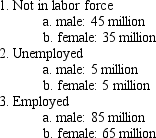 -Refer to Labor Stats.What is the adult male unemployment rate in Meditor?
 (Multiple Choice)
5.0/5 (81)
(81) Which industry has the highest proportion of workers with reported hourly wages at or below the minimum wage rate?
(Multiple Choice)
4.9/5 (76)
(76) Which of the following causes of unemployment is not associated with a continuing excess supply of labor?
(Multiple Choice)
4.9/5 (79)
(79) Rupert is collecting unemployment insurance benefits.To continue to receive his benefits he must be looking for work.Because he'd like to continue collecting benefits rather than take a job,he applies at places that are unlikely to hire him.People like Rupert make the reported unemployment rate less than it would otherwise be.
(True/False)
4.8/5 (84)
(84) Which of the following prevent employers from interfering when workers try to organize a union?
(Multiple Choice)
4.9/5 (86)
(86) In 1914,Henry Ford began paying his workers $5 per day,about twice the going wage.As a result,turnover and absenteeism fell,and productivity and profits rose.
(True/False)
4.9/5 (84)
(84) Rupert is a low-skilled worker who washes dishes in a local restaurant.A proposal to increase the minimum wage may worry him if he knows that price
(Multiple Choice)
4.9/5 (78)
(78) What factors account for the rise in the percentage of noninstitutionalized males ages 25-54 who spent the year without working for pay or attending school?
(Essay)
4.9/5 (72)
(72) Over one-half of the unemployed are recent entrants into the labor force.
(True/False)
4.8/5 (83)
(83) A college student who is not working or looking for a job is counted as
(Multiple Choice)
4.7/5 (77)
(77) Government policy can do nothing about the natural rate of unemployment.
(True/False)
4.9/5 (85)
(85) The unemployment rate is computed as the number of unemployed
(Multiple Choice)
4.9/5 (77)
(77) A typical American worker covered by unemployment insurance receives
(Multiple Choice)
4.8/5 (84)
(84) Suppose the labor-force participation rate of men is greater in Troy than in Sparta.This could be because the men of Troy
(Multiple Choice)
4.7/5 (80)
(80) Meredith is looking for work as a computer programmer.Although her prospects are good she hasn't yet taken a job.Julie is looking for work in a steel mill.Every time she shows up for an interview there are more people looking for work than their are openings.Someone waiting in line with her tells her its been that way a long time.
(Multiple Choice)
4.8/5 (83)
(83) Which of the following causes of unemployment is not associated with a wage rate above the equilibrium level?
(Multiple Choice)
4.9/5 (85)
(85) 
Filters
- Essay(0)
- Multiple Choice(0)
- Short Answer(0)
- True False(0)
- Matching(0)