



 Chat with AI
Exam 28: Unemployment

Exam 1: Ten Principles of Economics237 Questions
Exam 2: Thinking Like an Economist267 Questions
Exam 3: Interdependence and the Gains From Trade217 Questions
Exam 4: The Market Forces of Supply and Demand303 Questions
Exam 5: Elasticity and Its Applications282 Questions
Exam 6: Supply, demand, and Government Policies252 Questions
Exam 7: Consumers, producers, and the Efficiency of Markets248 Questions
Exam 8: Application: the Costs of Taxation245 Questions
Exam 9: Application: International Trade245 Questions
Exam 10: Externalities288 Questions
Exam 11: Public Goods and Common Resources258 Questions
Exam 12: The Design of the Tax System328 Questions
Exam 13: The Costs of Production303 Questions
Exam 14: Firms in Competitive Markets271 Questions
Exam 15: Monopoly306 Questions
Exam 16: Oligopoly291 Questions
Exam 17: Monopolistic Competition257 Questions
Exam 18: The Markets for the Factors of Production284 Questions
Exam 19: Earnings and Discrimination286 Questions
Exam 20: Income Inequality and Poverty247 Questions
Exam 21: The Theory of Consumer Choice238 Questions
Exam 22: Frontiers of Microeconomics199 Questions
Exam 23: Measuring a Nations Income215 Questions
Exam 24: Measuring the Cost of Living208 Questions
Exam 25: Production and Growth240 Questions
Exam 26: Saving, investment, and the Financial System282 Questions
Exam 27: The Basic Tools of Finance249 Questions
Exam 28: Unemployment242 Questions
Exam 29: The Monetary System277 Questions
Exam 30: Money Growth and Inflation224 Questions
Exam 31: Open-Economy Macroeconomics: Basic Concepts256 Questions
Exam 32: A Macroeconomic Theory of the Open Economy217 Questions
Exam 33: Aggregate Demand and Aggregate Supply302 Questions
Exam 34: The Influence of Monetary and Fiscal Policy on Aggregate Demand249 Questions
Exam 35: The Short Run Trade Off Between Inflation and Unemployment246 Questions
Exam 36: Five Debates Over Macroeconomic Policy140 Questions
Select questions type


The BLS reported in 2005 that there were 50.40 million people over age 25 whose highest level of education was some college or an associate degree.33.86 million of them were employed and 1.27 million of them were unemployed.About what were the labor-force participation rate and the unemployment rate for this group?
(Multiple Choice)
4.9/5  (80)
(80) If the wage is kept above the equilibrium wage for any reason,the result is structural unemployment.
(True/False)
4.9/5 (75)
(75) Teenage unemployment is higher than unemployment of people ages 20 and over.Explain why economists would attribute at least part of this difference to minimum-wage laws.(Hint: who is likely to get paid more?)
(Essay)
4.8/5 (75)
(75) Just after World War II,the labor-force participation rate of men was
(Multiple Choice)
4.9/5 (92)
(92) Compared to the United States,Germany historically has had higher unemployment rates.One explanation for this difference could be
(Multiple Choice)
4.9/5 (84)
(84) Suppose that neither textile workers nor shoemakers are unionized.If textile workers unionize and so are able to raise their wages,then the supply of shoemakers
(Multiple Choice)
4.8/5 (88)
(88) Just after World War II,the labor-force participation rate of women was
(Multiple Choice)
4.8/5 (84)
(84) Of women earning an hourly wage,about what percent earn a wage at or below the minimum wage?
(Multiple Choice)
4.9/5 (82)
(82) The sum of which of the following would necessarily be equal to the adult population in the US statistics on labor?
(Multiple Choice)
4.8/5 (64)
(64) Even though most spells of unemployment are short,most unemployment results from long-term unemployment.
(True/False)
4.9/5 (77)
(77) Figure 28-1
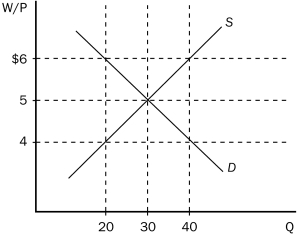 -Refer to Figure 28-1.The equilibrium wage and employment in this market is
 (Multiple Choice)
4.8/5 (75)
(75) Union workers earn what percent more than similar nonunion workers?
(Multiple Choice)
5.0/5 (89)
(89) From time to time the demand for workers has risen in one region of the United States and fallen in another.This illustrates
(Multiple Choice)
4.8/5 (85)
(85) Suppose that butchers and bakers had no unions.Now suppose the butchers form a union.What does this do the labor supply of and wages of bakers?
(Multiple Choice)
4.7/5 (75)
(75) 
Filters
- Essay(0)
- Multiple Choice(0)
- Short Answer(0)
- True False(0)
- Matching(0)