



 Chat with AI
Exam 12: The Design of the Tax System

Exam 1: Ten Principles of Economics237 Questions
Exam 2: Thinking Like an Economist267 Questions
Exam 3: Interdependence and the Gains From Trade217 Questions
Exam 4: The Market Forces of Supply and Demand303 Questions
Exam 5: Elasticity and Its Applications282 Questions
Exam 6: Supply, demand, and Government Policies252 Questions
Exam 7: Consumers, producers, and the Efficiency of Markets248 Questions
Exam 8: Application: the Costs of Taxation245 Questions
Exam 9: Application: International Trade245 Questions
Exam 10: Externalities288 Questions
Exam 11: Public Goods and Common Resources258 Questions
Exam 12: The Design of the Tax System328 Questions
Exam 13: The Costs of Production303 Questions
Exam 14: Firms in Competitive Markets271 Questions
Exam 15: Monopoly306 Questions
Exam 16: Oligopoly291 Questions
Exam 17: Monopolistic Competition257 Questions
Exam 18: The Markets for the Factors of Production284 Questions
Exam 19: Earnings and Discrimination286 Questions
Exam 20: Income Inequality and Poverty247 Questions
Exam 21: The Theory of Consumer Choice238 Questions
Exam 22: Frontiers of Microeconomics199 Questions
Exam 23: Measuring a Nations Income215 Questions
Exam 24: Measuring the Cost of Living208 Questions
Exam 25: Production and Growth240 Questions
Exam 26: Saving, investment, and the Financial System282 Questions
Exam 27: The Basic Tools of Finance249 Questions
Exam 28: Unemployment242 Questions
Exam 29: The Monetary System277 Questions
Exam 30: Money Growth and Inflation224 Questions
Exam 31: Open-Economy Macroeconomics: Basic Concepts256 Questions
Exam 32: A Macroeconomic Theory of the Open Economy217 Questions
Exam 33: Aggregate Demand and Aggregate Supply302 Questions
Exam 34: The Influence of Monetary and Fiscal Policy on Aggregate Demand249 Questions
Exam 35: The Short Run Trade Off Between Inflation and Unemployment246 Questions
Exam 36: Five Debates Over Macroeconomic Policy140 Questions
Select questions type


"A $1,000 tax paid by a poor person may be a larger sacrifice than a $10,000 tax paid by a wealthy person" is an argument based on
(Multiple Choice)
4.8/5  (93)
(93) In the 1980s,President Ronald Reagan argued that high tax rates distorted economic incentives to work and save.In the 1990s,President Bill Clinton argued that the rich were not paying their fair share of taxes.Which of the following statements best summarizes the economic theories behind the differing philosophies?
(Multiple Choice)
4.9/5 (76)
(76) Table 12-3
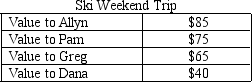 -Refer to Table 12-3.Assume that the price of a weekend ski pass is $38 and that the price reflects the actual unit cost of providing a weekend of skiing.What is the value of the surplus that accrues to all four skiers from their weekend trip?
 (Multiple Choice)
4.8/5 (71)
(71) A budget surplus occurs when government receipts exceed government spending.
(True/False)
4.8/5 (95)
(95) Suppose the government imposes a tax of 10 percent on the first $40,000 of income and 20 percent on all income above $40,000.What is the average tax rate when income is $50,000?
(Multiple Choice)
4.9/5 (97)
(97) Table 12-6
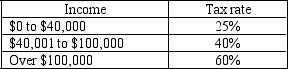 -Refer to Table 12-6.What is the marginal tax rate for a person who makes $50,000?
 (Multiple Choice)
4.9/5 (78)
(78) If the government were to impose a tax that assigned everyone the same tax liability,it would be
(Multiple Choice)
4.8/5 (65)
(65) State and local governments generate revenue from all of the following sources except
(Multiple Choice)
4.9/5 (87)
(87) Table 12-4
 -Refer to Table 12-4.Suppose that the government imposes a $2 tax on delights,causing the price to increase from $5.00 to $7.00.Total consumer surplus
 (Multiple Choice)
5.0/5 (90)
(90) If a tax takes a smaller fraction of income as income rises,it is
(Multiple Choice)
5.0/5 (79)
(79) The U.S.federal government collects about one-half of the taxes in our economy.
(True/False)
4.7/5 (85)
(85) If we want to gauge the sacrifice made by a taxpayer,we should use the
(Multiple Choice)
4.8/5 (76)
(76) Rank the following state and local government expenditure categories from largest to smallest.
(Multiple Choice)
4.9/5 (80)
(80) Which of the following is true about the percent of total income the U.S.government takes as taxes?
(Multiple Choice)
4.7/5 (66)
(66) Which of the following countries has the largest tax burden?
(Multiple Choice)
4.8/5 (83)
(83) The most important revenue-generating taxes for the federal government are individual income taxes and payroll taxes for social insurance.
(True/False)
4.7/5 (71)
(71) 
Filters
- Essay(0)
- Multiple Choice(0)
- Short Answer(0)
- True False(0)
- Matching(0)