



 Chat with AI
Exam 12: The Design of the Tax System

Exam 1: Ten Principles of Economics237 Questions
Exam 2: Thinking Like an Economist267 Questions
Exam 3: Interdependence and the Gains From Trade217 Questions
Exam 4: The Market Forces of Supply and Demand303 Questions
Exam 5: Elasticity and Its Applications282 Questions
Exam 6: Supply, demand, and Government Policies252 Questions
Exam 7: Consumers, producers, and the Efficiency of Markets248 Questions
Exam 8: Application: the Costs of Taxation245 Questions
Exam 9: Application: International Trade245 Questions
Exam 10: Externalities288 Questions
Exam 11: Public Goods and Common Resources258 Questions
Exam 12: The Design of the Tax System328 Questions
Exam 13: The Costs of Production303 Questions
Exam 14: Firms in Competitive Markets271 Questions
Exam 15: Monopoly306 Questions
Exam 16: Oligopoly291 Questions
Exam 17: Monopolistic Competition257 Questions
Exam 18: The Markets for the Factors of Production284 Questions
Exam 19: Earnings and Discrimination286 Questions
Exam 20: Income Inequality and Poverty247 Questions
Exam 21: The Theory of Consumer Choice238 Questions
Exam 22: Frontiers of Microeconomics199 Questions
Exam 23: Measuring a Nations Income215 Questions
Exam 24: Measuring the Cost of Living208 Questions
Exam 25: Production and Growth240 Questions
Exam 26: Saving, investment, and the Financial System282 Questions
Exam 27: The Basic Tools of Finance249 Questions
Exam 28: Unemployment242 Questions
Exam 29: The Monetary System277 Questions
Exam 30: Money Growth and Inflation224 Questions
Exam 31: Open-Economy Macroeconomics: Basic Concepts256 Questions
Exam 32: A Macroeconomic Theory of the Open Economy217 Questions
Exam 33: Aggregate Demand and Aggregate Supply302 Questions
Exam 34: The Influence of Monetary and Fiscal Policy on Aggregate Demand249 Questions
Exam 35: The Short Run Trade Off Between Inflation and Unemployment246 Questions
Exam 36: Five Debates Over Macroeconomic Policy140 Questions
Select questions type


Changing the basis of taxation from income earned to amount spent will
(Multiple Choice)
4.8/5  (74)
(74) According to the benefits principle,it is fair for people to pay taxes based on their ability to shoulder the tax burden.
(True/False)
4.9/5 (77)
(77) State and local government spending on public welfare includes
(Multiple Choice)
4.9/5 (85)
(85) Senator Foghorn promised during his campaign for re-election that he would support family values and end the marriage tax.He also promised to make the rich pay their fair share in taxes,so he would make the income tax more progressive.In addition,he promised that all couples with the same income would pay the same tax and that people with no income would not be taxed.Can Senator Foghorn keep all of his promises?
(Multiple Choice)
4.7/5 (68)
(68) Table 12-5
 -Refer to Table 12-5.What is the marginal tax rate for a person who makes $60,000?
 (Multiple Choice)
4.8/5 (75)
(75) A tax system with little deadweight loss and a small administrative burden would be described as
(Multiple Choice)
4.7/5 (79)
(79) Sue earns income of $80,000 per year.Her average tax rate is 40 percent.Sue paid $4,500 in taxes on the first $30,000 she earned.What was the marginal tax rate on the rest of her income?
(Multiple Choice)
4.8/5 (82)
(82) A budget deficit occurs when government receipts fall short of government spending.
(True/False)
4.8/5 (81)
(81) In practice,the U.S.income tax system is filled with special provisions that alter a family's tax based on its specific circumstances.
(True/False)
4.8/5 (82)
(82) Why do some policymakers support a consumption tax rather than an earnings tax?
(Multiple Choice)
4.8/5 (83)
(83) Table 12-2
United States Income Tax Rates for a Single Individual, 2002 and 2003.
 -Refer to Table 12-2.What type of tax structure did the United States have in 2002 for single individuals?
 (Multiple Choice)
4.8/5 (94)
(94) The idea that people in equal conditions should pay equal taxes is referred to as
(Multiple Choice)
4.7/5 (65)
(65) Kyle places a $10 value on a glass of red wine,and Keith places an $8 value on it.If there is no tax on glasses of red wine,the price of a glass of red wine reflects the cost of making it.The equilibrium price for a glass of red wine is $6.Suppose the government levies a tax of $2 on each glass of red wine,and the equilibrium price of a glass of red wine increases to $8.How much tax revenue is collected?
(Multiple Choice)
4.9/5 (87)
(87) The administrative burden of any tax system is part of the inefficiency it creates.
(True/False)
4.9/5 (72)
(72) Table 12-7
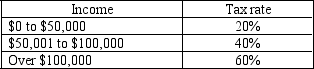 -Refer to Table 12-7.What is the marginal tax rate for a person who makes $120,000?
 (Multiple Choice)
4.7/5 (86)
(86) 
Filters
- Essay(0)
- Multiple Choice(0)
- Short Answer(0)
- True False(0)
- Matching(0)