



 Chat with AI
Exam 8: Application: the Costs of Taxation

Exam 1: Ten Principles of Economics237 Questions
Exam 2: Thinking Like an Economist267 Questions
Exam 3: Interdependence and the Gains From Trade217 Questions
Exam 4: The Market Forces of Supply and Demand303 Questions
Exam 5: Elasticity and Its Applications282 Questions
Exam 6: Supply, demand, and Government Policies252 Questions
Exam 7: Consumers, producers, and the Efficiency of Markets248 Questions
Exam 8: Application: the Costs of Taxation245 Questions
Exam 9: Application: International Trade245 Questions
Exam 10: Externalities288 Questions
Exam 11: Public Goods and Common Resources258 Questions
Exam 12: The Design of the Tax System328 Questions
Exam 13: The Costs of Production303 Questions
Exam 14: Firms in Competitive Markets271 Questions
Exam 15: Monopoly306 Questions
Exam 16: Oligopoly291 Questions
Exam 17: Monopolistic Competition257 Questions
Exam 18: The Markets for the Factors of Production284 Questions
Exam 19: Earnings and Discrimination286 Questions
Exam 20: Income Inequality and Poverty247 Questions
Exam 21: The Theory of Consumer Choice238 Questions
Exam 22: Frontiers of Microeconomics199 Questions
Exam 23: Measuring a Nations Income215 Questions
Exam 24: Measuring the Cost of Living208 Questions
Exam 25: Production and Growth240 Questions
Exam 26: Saving, investment, and the Financial System282 Questions
Exam 27: The Basic Tools of Finance249 Questions
Exam 28: Unemployment242 Questions
Exam 29: The Monetary System277 Questions
Exam 30: Money Growth and Inflation224 Questions
Exam 31: Open-Economy Macroeconomics: Basic Concepts256 Questions
Exam 32: A Macroeconomic Theory of the Open Economy217 Questions
Exam 33: Aggregate Demand and Aggregate Supply302 Questions
Exam 34: The Influence of Monetary and Fiscal Policy on Aggregate Demand249 Questions
Exam 35: The Short Run Trade Off Between Inflation and Unemployment246 Questions
Exam 36: Five Debates Over Macroeconomic Policy140 Questions
Select questions type


Figure 8-2
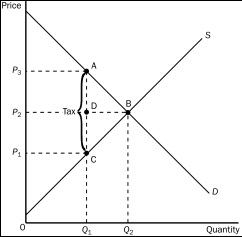 -Refer to Figure 8-2.Which of the following equations is valid for the loss in consumer surplus caused by the tax?
 (Multiple Choice)
5.0/5  (77)
(77) Scenario 8-2
Tom mows Stephanie's lawn for $25. Tom's opportunity cost of mowing Stephanie's lawn is $20, and Stephanie's willingness to pay Tom to mow her lawn is $28.
-Refer to Scenario 8-2.Tom's producer surplus as a result of mowing Stephanie's lawn is
(Multiple Choice)
4.9/5 (80)
(80) Concerning the labor market and taxes on labor,economists disagree about
(Multiple Choice)
5.0/5 (81)
(81) Which of the following would likely have the smallest deadweight loss relative to the tax revenue?
(Multiple Choice)
4.9/5 (78)
(78) The more mothers are pressured by society to be housekeepers and stay out of the labor force,the
(Multiple Choice)
4.9/5 (85)
(85) Suppose that policymakers are considering placing a tax on either of two markets.In Market A,the tax will have a significant effect on the price consumers pay,but it will not affect equilibrium quantity very much.In Market B,the same tax will have only a small effect on the price consumers pay,but it will have a large effect on the equilibrium quantity.Other factors are held constant.In which market will the tax have a larger deadweight loss?
(Multiple Choice)
4.9/5 (88)
(88) The marginal tax rate on labor income for many workers in the United States is almost
(Multiple Choice)
4.8/5 (70)
(70) Figure 8-5
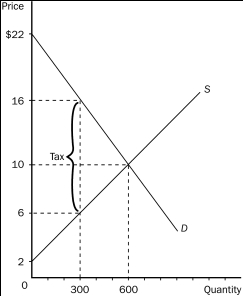 -Refer to Figure 8-5.What happens to consumer surplus when a tax is imposed in this market?
 (Multiple Choice)
4.9/5 (83)
(83) The benefit to sellers of participating in a market is measured by
(Multiple Choice)
4.8/5 (94)
(94) The argument that cutting income tax rates will increase tax revenues
(Multiple Choice)
4.9/5 (89)
(89) Figure 8-4
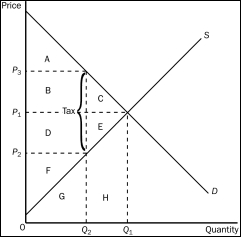 -Refer to Figure 8-4.The loss in total welfare that results from the tax is represented by area
 (Multiple Choice)
4.9/5 (77)
(77) Which of the following statements is correct regarding the imposition of a tax on gasoline?
(Multiple Choice)
4.9/5 (92)
(92) Scenario 8-1
Ryan would be willing to pay as much as $100 per week to have his house cleaned. Tammy's opportunity cost of cleaning Ryan's house is $70 per week.
-Refer to Scenario 8-1.If Ryan pays Tammy $80 to clean his house,Ryan's consumer surplus is
(Multiple Choice)
4.8/5 (80)
(80) It does not matter whether a tax is levied on the buyers or the sellers of a good because
(Multiple Choice)
4.8/5 (71)
(71) Figure 8-6
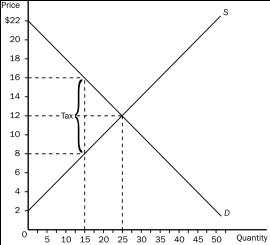 -Refer to Figure 8-6.Which of the following statements is correct?
 (Multiple Choice)
4.8/5 (81)
(81) The benefit to buyers of participating in a market is measured by
(Multiple Choice)
4.8/5 (72)
(72) Which of the following events is consistent with an increase in the deadweight loss of the gasoline tax from $30 million to $120 million?
(Multiple Choice)
4.8/5 (75)
(75) 
Filters
- Essay(0)
- Multiple Choice(0)
- Short Answer(0)
- True False(0)
- Matching(0)