



 Chat with AI
Exam 8: Application: the Costs of Taxation

Exam 1: Ten Principles of Economics237 Questions
Exam 2: Thinking Like an Economist267 Questions
Exam 3: Interdependence and the Gains From Trade217 Questions
Exam 4: The Market Forces of Supply and Demand303 Questions
Exam 5: Elasticity and Its Applications282 Questions
Exam 6: Supply, demand, and Government Policies252 Questions
Exam 7: Consumers, producers, and the Efficiency of Markets248 Questions
Exam 8: Application: the Costs of Taxation245 Questions
Exam 9: Application: International Trade245 Questions
Exam 10: Externalities288 Questions
Exam 11: Public Goods and Common Resources258 Questions
Exam 12: The Design of the Tax System328 Questions
Exam 13: The Costs of Production303 Questions
Exam 14: Firms in Competitive Markets271 Questions
Exam 15: Monopoly306 Questions
Exam 16: Oligopoly291 Questions
Exam 17: Monopolistic Competition257 Questions
Exam 18: The Markets for the Factors of Production284 Questions
Exam 19: Earnings and Discrimination286 Questions
Exam 20: Income Inequality and Poverty247 Questions
Exam 21: The Theory of Consumer Choice238 Questions
Exam 22: Frontiers of Microeconomics199 Questions
Exam 23: Measuring a Nations Income215 Questions
Exam 24: Measuring the Cost of Living208 Questions
Exam 25: Production and Growth240 Questions
Exam 26: Saving, investment, and the Financial System282 Questions
Exam 27: The Basic Tools of Finance249 Questions
Exam 28: Unemployment242 Questions
Exam 29: The Monetary System277 Questions
Exam 30: Money Growth and Inflation224 Questions
Exam 31: Open-Economy Macroeconomics: Basic Concepts256 Questions
Exam 32: A Macroeconomic Theory of the Open Economy217 Questions
Exam 33: Aggregate Demand and Aggregate Supply302 Questions
Exam 34: The Influence of Monetary and Fiscal Policy on Aggregate Demand249 Questions
Exam 35: The Short Run Trade Off Between Inflation and Unemployment246 Questions
Exam 36: Five Debates Over Macroeconomic Policy140 Questions
Select questions type


Suppose a tax of $4 per unit is imposed on a good,and the tax causes the equilibrium quantity of the good to decrease from 2,000 units to 1,700 units.The tax decreases consumer surplus by $3,000 and it decreases producer surplus by $4,400.The deadweight loss of the tax is
(Multiple Choice)
4.9/5  (77)
(77) Figure 8-2
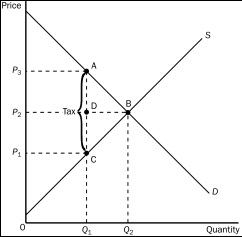 -Refer to Figure 8-2.The amount of deadweight loss associated with the tax is equal to
 (Multiple Choice)
5.0/5 (80)
(80) Suppose the equilibrium quantity in the market for widgets is 200 per month when there is no tax.Then a tax of $5 per widget is imposed.As a result,the government is able to raise $750 per month in tax revenue.We can conclude that the equilibrium quantity of widgets has fallen by
(Multiple Choice)
4.9/5 (79)
(79) Figure 8-5
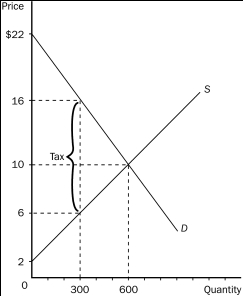 -Refer to Figure 8-5.Total surplus with the tax in place is
 (Multiple Choice)
4.8/5 (85)
(85) If a tax did not induce buyers or sellers to change their behavior,it would not cause a deadweight loss.
(True/False)
4.9/5 (74)
(74) Figure 8-3
 -Refer to Figure 8-3.The equilibrium price before the tax is imposed is
 (Multiple Choice)
4.9/5 (84)
(84) If the tax on a good is increased from $0.10 per unit to $0.40 per unit,the deadweight loss from the tax
(Multiple Choice)
4.8/5 (85)
(85) Scenario 8-2
Tom mows Stephanie's lawn for $25. Tom's opportunity cost of mowing Stephanie's lawn is $20, and Stephanie's willingness to pay Tom to mow her lawn is $28.
-Refer to Scenario 8-2.Assume Ryan is required to pay a tax of $3 each time he mows a lawn.Which of the following results is most likely?
(Multiple Choice)
4.9/5 (61)
(61) Figure 8-7 The graph below represents a $10 per unit tax on a good. On the graph, Q represents quantity and P represents price.
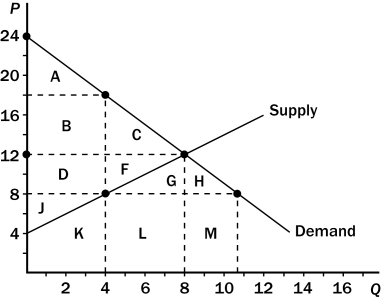 -Refer to Figure 8-7.The deadweight loss of the tax is represented by the area
 (Multiple Choice)
4.8/5 (86)
(86) Figure 8-5
-Refer to Figure 8-5.What happens to producer surplus when a tax is imposed in this market?
-Refer to Figure 8-5.What happens to producer surplus when a tax is imposed in this market? (Multiple Choice)
5.0/5 (86)
(86) When the price of a good is measured in dollars,then the size of the deadweight loss that results from taxing that good is measured in
(Multiple Choice)
4.7/5 (75)
(75) The result of the large tax cuts in the first Reagan Administration demonstrated very convincingly that Arthur Laffer was correct when he asserted that cuts in tax rates would increase tax revenue.
(True/False)
4.9/5 (88)
(88) Scenario 8-2
Tom mows Stephanie's lawn for $25. Tom's opportunity cost of mowing Stephanie's lawn is $20, and Stephanie's willingness to pay Tom to mow her lawn is $28.
-Refer to Scenario 8-2.Assume Ryan is required to pay a tax of $10 each time he mows a lawn.Which of the following results is most likely?
(Multiple Choice)
4.9/5 (90)
(90) Studies indicate that if income tax rates in Sweden had been reduced from their high 1980s levels,income tax collections would have
(Multiple Choice)
4.9/5 (80)
(80) Figure 8-5
-Refer to Figure 8-5.Without a tax,total surplus in this market is
-Refer to Figure 8-5.Without a tax,total surplus in this market is (Multiple Choice)
5.0/5 (73)
(73) Anger over British taxes played a significant role in bringing about
(Multiple Choice)
4.9/5 (85)
(85) 
Filters
- Essay(0)
- Multiple Choice(0)
- Short Answer(0)
- True False(0)
- Matching(0)