



 Chat with AI
Exam 2: Thinking Like an Economist

Exam 1: Ten Principles of Economics237 Questions
Exam 2: Thinking Like an Economist267 Questions
Exam 3: Interdependence and the Gains From Trade217 Questions
Exam 4: The Market Forces of Supply and Demand303 Questions
Exam 5: Elasticity and Its Applications282 Questions
Exam 6: Supply, demand, and Government Policies252 Questions
Exam 7: Consumers, producers, and the Efficiency of Markets248 Questions
Exam 8: Application: the Costs of Taxation245 Questions
Exam 9: Application: International Trade245 Questions
Exam 10: Externalities288 Questions
Exam 11: Public Goods and Common Resources258 Questions
Exam 12: The Design of the Tax System328 Questions
Exam 13: The Costs of Production303 Questions
Exam 14: Firms in Competitive Markets271 Questions
Exam 15: Monopoly306 Questions
Exam 16: Oligopoly291 Questions
Exam 17: Monopolistic Competition257 Questions
Exam 18: The Markets for the Factors of Production284 Questions
Exam 19: Earnings and Discrimination286 Questions
Exam 20: Income Inequality and Poverty247 Questions
Exam 21: The Theory of Consumer Choice238 Questions
Exam 22: Frontiers of Microeconomics199 Questions
Exam 23: Measuring a Nations Income215 Questions
Exam 24: Measuring the Cost of Living208 Questions
Exam 25: Production and Growth240 Questions
Exam 26: Saving, investment, and the Financial System282 Questions
Exam 27: The Basic Tools of Finance249 Questions
Exam 28: Unemployment242 Questions
Exam 29: The Monetary System277 Questions
Exam 30: Money Growth and Inflation224 Questions
Exam 31: Open-Economy Macroeconomics: Basic Concepts256 Questions
Exam 32: A Macroeconomic Theory of the Open Economy217 Questions
Exam 33: Aggregate Demand and Aggregate Supply302 Questions
Exam 34: The Influence of Monetary and Fiscal Policy on Aggregate Demand249 Questions
Exam 35: The Short Run Trade Off Between Inflation and Unemployment246 Questions
Exam 36: Five Debates Over Macroeconomic Policy140 Questions
Select questions type


An efficient outcome is one in which the economy is conserving the largest possible amount of resources,while still meeting the basic needs of society.
(True/False)
4.9/5  (85)
(85) Among economic models,the circular-flow diagram is unusual in that it
(Multiple Choice)
4.7/5 (79)
(79) Figure 2-6
 -Refer to Figure 2-6.If the economy moves from point C to point B,then which of the following statements is correct?
 (Multiple Choice)
4.9/5 (82)
(82) Which of the following statements about economic models is valid?
(Multiple Choice)
4.9/5 (79)
(79) Which of these statements is a normative statement (as opposed to a positive statement)?
(Multiple Choice)
4.9/5 (74)
(74) Which of the following items is not a factor of production?
(Multiple Choice)
4.7/5 (79)
(79) Figure 2-6
-Refer to Figure 2-6.If the economy moves from point A to point B,then which of the following statements is correct?
-Refer to Figure 2-6.If the economy moves from point A to point B,then which of the following statements is correct? (Multiple Choice)
4.9/5 (85)
(85) Bill has noticed that increases in unemployment insurance claims are associated with recessions,and therefore he advocates limits on unemployment insurance so as to prevent recessions.Martha has noticed that most drug addicts once attended schools,and therefore she advocates getting rid of schools so as to prevent drug addiction.
(Multiple Choice)
4.9/5 (80)
(80) The author of your textbook for this course,N.Gregory Mankiw,worked in the administration of President George W.Bush from 2003 to 2005.Specifically,he served as the
(Multiple Choice)
4.8/5 (82)
(82) A survey which sought the opinion of academic,business,and government economists on ten propositions about economic policy found that
(Multiple Choice)
4.8/5 (72)
(72) Figure 2-1
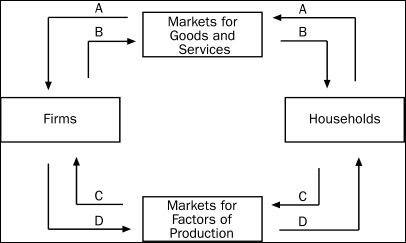 -Refer to Figure 2-1.Juan buys a new pair of shoes at a shoe store.To which of the arrows does this purchase directly contribute?
 (Multiple Choice)
4.7/5 (78)
(78) Figure 2-6
-Refer to Figure 2-6.If this economy put one-half of its available resources into the production of baseballs and the other half into the production of bananas,it could produce
-Refer to Figure 2-6.If this economy put one-half of its available resources into the production of baseballs and the other half into the production of bananas,it could produce (Multiple Choice)
4.7/5 (90)
(90) Figure 2-8
 -Refer to Figure 2-8.Which of the following combinations can this economy not produce?
 (Multiple Choice)
4.8/5 (80)
(80) In a circular-flow diagram,one loop shows the flow of goods,services and factors of production,and the other loop shows the corresponding flow of dollars.
(True/False)
4.9/5 (84)
(84) President Ronald Reagan once joked that a Trivial Pursuit game for economists would
(Multiple Choice)
4.9/5 (76)
(76) Figure 2-4
 -Refer to Figure 2-4.The opportunity cost of obtaining 10 additional toasters by moving from point B to point A is
 (Multiple Choice)
4.9/5 (85)
(85) Which of the following transactions does not take place in a market for a factor of production?
(Multiple Choice)
4.9/5 (73)
(73) Which of the following would be considered a topic of study in macroeconomics?
(Multiple Choice)
4.9/5 (67)
(67) 
Filters
- Essay(0)
- Multiple Choice(0)
- Short Answer(0)
- True False(0)
- Matching(0)