



 Chat with AI
Exam 2: Thinking Like an Economist

Exam 1: Ten Principles of Economics237 Questions
Exam 2: Thinking Like an Economist267 Questions
Exam 3: Interdependence and the Gains From Trade217 Questions
Exam 4: The Market Forces of Supply and Demand303 Questions
Exam 5: Elasticity and Its Applications282 Questions
Exam 6: Supply, demand, and Government Policies252 Questions
Exam 7: Consumers, producers, and the Efficiency of Markets248 Questions
Exam 8: Application: the Costs of Taxation245 Questions
Exam 9: Application: International Trade245 Questions
Exam 10: Externalities288 Questions
Exam 11: Public Goods and Common Resources258 Questions
Exam 12: The Design of the Tax System328 Questions
Exam 13: The Costs of Production303 Questions
Exam 14: Firms in Competitive Markets271 Questions
Exam 15: Monopoly306 Questions
Exam 16: Oligopoly291 Questions
Exam 17: Monopolistic Competition257 Questions
Exam 18: The Markets for the Factors of Production284 Questions
Exam 19: Earnings and Discrimination286 Questions
Exam 20: Income Inequality and Poverty247 Questions
Exam 21: The Theory of Consumer Choice238 Questions
Exam 22: Frontiers of Microeconomics199 Questions
Exam 23: Measuring a Nations Income215 Questions
Exam 24: Measuring the Cost of Living208 Questions
Exam 25: Production and Growth240 Questions
Exam 26: Saving, investment, and the Financial System282 Questions
Exam 27: The Basic Tools of Finance249 Questions
Exam 28: Unemployment242 Questions
Exam 29: The Monetary System277 Questions
Exam 30: Money Growth and Inflation224 Questions
Exam 31: Open-Economy Macroeconomics: Basic Concepts256 Questions
Exam 32: A Macroeconomic Theory of the Open Economy217 Questions
Exam 33: Aggregate Demand and Aggregate Supply302 Questions
Exam 34: The Influence of Monetary and Fiscal Policy on Aggregate Demand249 Questions
Exam 35: The Short Run Trade Off Between Inflation and Unemployment246 Questions
Exam 36: Five Debates Over Macroeconomic Policy140 Questions
Select questions type


In a simple circular-flow diagram,firms own the factors of production and use them to produce goods and services.
(True/False)
4.8/5  (75)
(75) The Council of Economic Advisors has as its duties both advising the President of the United States and formulating monetary policy.
(True/False)
4.9/5 (64)
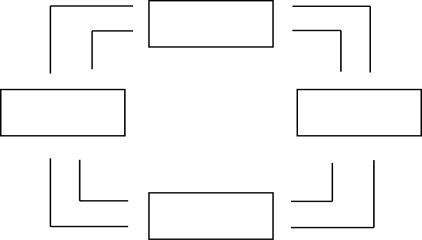
(64) Using this outline,draw a circular-flow diagram representing the interactions between households and firms in a simple economy.Explain briefly the various parts of the diagram.
(Essay)
4.9/5 (77)
(77) The prairie dog has always been considered a problem for American cattle ranchers.They dig holes that cattle and horses can step in and they eat grass necessary for cattle.Recently,ranchers have discovered that there is a demand for prairie dogs as pets.In some areas prairie dogs can sell for as high as $150.Cattlemen are now fencing off prairie dog towns on their land so these towns will not be disturbed by their cattle.
Draw a production possibilities frontier showing a rancher's production option between cattle production and prairie dog production showing increasing opportunity cost and show what would happen in each of the following situations.(Use a separate graph for each situation.)
a.The outcome is efficient, with ranchers choosing to produce equal numbers of cattle and prairie dogs.
b.As a protest against the government introducing the gray wolf back into the wild in their state, ranchers decide to withhold 25 percent of the available grassland for grazing.
c.The price of prairie dogs increases to $200 each, so ranchers decide to allot additional land for prairie dogs.
d.The government grants new leases to ranchers, giving them 10,000 new acres of grassland each for grazing.
e.A drought destroys most of the available grass for grazing of cattle, but not for prairie dogs since they also eat plant roots.
(Essay)
4.9/5 (72)
(72) Any point on a country's production possibilities frontier represents a combination of two goods that an economy
(Multiple Choice)
4.9/5 (96)
(96) Figure 2-1
 -Refer to Figure 2-1.Which arrow shows the flow of land,labor,and capital?
 (Multiple Choice)
4.8/5 (77)
(77) Which markets are represented in the simple circular-flow diagram?
(Multiple Choice)
4.8/5 (94)
(94) One thing economists do to help them understand how the real world works is as follows:
(Multiple Choice)
4.8/5 (84)
(84) For economists,substitutes for laboratory experiments often come in the form of
(Multiple Choice)
4.9/5 (88)
(88) When an economy is operating at a point on (rather than inside)its production possibilities frontier,then
(Multiple Choice)
4.9/5 (89)
(89) Suppose a nation is currently producing at a point inside its production possibilities frontier.We know that
(Multiple Choice)
4.9/5 (75)
(75) Which of the following statements about the circular-flow diagram is correct?
(Multiple Choice)
4.8/5 (86)
(86) Some,but not all,government economists are employed within the administrative branch of government.Which of the following government agencies employs economists outside of the administrative branch?
(Multiple Choice)
4.8/5 (83)
(83) An economy can produce at any point on or outside the production possibilities frontier,but it cannot produce at points inside the frontier.
(True/False)
4.8/5 (77)
(77) Figure 2-6
 -Refer to Figure 2-6.If this economy put all available resources into the production of bananas,it could produce
 (Multiple Choice)
4.9/5 (80)
(80) 
Filters
- Essay(0)
- Multiple Choice(0)
- Short Answer(0)
- True False(0)
- Matching(0)