



 Chat with AI
Exam 11: Markets for Factors of Production

Exam 1: The Principles and Practice of Economics103 Questions
Exam 2: Economic Methods and Economic Questions94 Questions
Exam 3: Optimization: Doing the Best You Can94 Questions
Exam 4: Demand, supply, and Equilibrium185 Questions
Exam 5: Consumers and Incentives187 Questions
Exam 6: Sellers and Incentives261 Questions
Exam 7: Perfect Competition and the Invisible Hand251 Questions
Exam 8: Trade264 Questions
Exam 9: Externalities and Public Goods223 Questions
Exam 10: The Government in the Economy: Taxation and Regulation244 Questions
Exam 11: Markets for Factors of Production237 Questions
Exam 12: Monopoly295 Questions
Exam 13: Game Theory and Strategic Play199 Questions
Exam 14: Oligopoly and Monopolistic Competition264 Questions
Exam 15: Trade-Offs Involving Time and Risk147 Questions
Exam 16: The Economics of Information119 Questions
Exam 17: Auctions and Bargaining123 Questions
Exam 18: Social Economics111 Questions
Select questions type


Scenario: This problem applies the principle of optimization covered in Chapter 5 to the problem of choosing how many hours to work. Paul has to decide how many hours to work per day. His boss is willing to give Paul whatever hours Paul wants up to 8 hours. All else being equal, he would rather not work, that is, Paul has positive marginal benefit from each hour of leisure. But he is an avid collector of presidential campaign buttons. The more leisure he takes, the fewer buttons he can afford. So Paul faces a trade-off between leisure and buttons. Each button costs $1.00. The table below shows Paul's marginal benefits from leisure (MBlₑᵢsᵤᵣₑ) and buttons (MBbᵤttₒn).
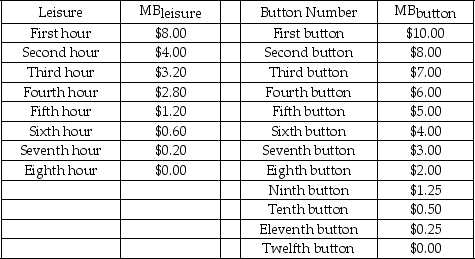 -Refer to the scenario above.If the hourly wage is $1.60,what is the maximum possible number of buttons Paul can afford?
 (Multiple Choice)
4.8/5  (79)
(79) Which of the following correctly identifies the difference between the demand for factors of production and the demand for final goods?
(Multiple Choice)
4.9/5 (91)
(91) The following figure shows price versus demand in a given market.
 -Refer to the figure above.What is the optimal number of machines rented if the market rental price is $8 per month?
 (Multiple Choice)
4.9/5 (80)
(80) Scenario: There are two regional labor markets in a country, X and Y. Workers are equally qualified to perform the same type of job in either region. The labor demand in both markets is identical.
-Refer to the scenario above.Let the cost of living be the same in the two regions,and suppose that workers have no non-monetary preferences with respect to the region in which they work and live.If the current wage in market X is larger than in market Y,how do you expect the markets to react?
(Multiple Choice)
4.8/5 (78)
(78) Paul wants to renovate his home and is accepting bids from different contractors.An African-American contractor bids $5,000 for the job,and a Caucasian contractor bids $5,200 for the job.Paul hires the Caucasian contractor.This is likely due to ________.
(Multiple Choice)
4.9/5 (90)
(90) How are skilled and unskilled workers in an economy likely to be affected if firms adopt skill-biased technologies?
(Essay)
4.8/5 (79)
(79) If leisure is a normal good,how will an increase in the wage rate affect an individual's desired quantity supplied of hours worked?
(Multiple Choice)
4.9/5 (77)
(77) Other things remaining the same,which of the following is likely to increase both the wage rate and the number of workers hired in a steel-producing factory?
(Multiple Choice)
4.7/5 (72)
(72) Scenario: This problem applies the principle of optimization covered in Chapter 5 to the problem of choosing how many hours to work. Paul has to decide how many hours to work per day. His boss is willing to give Paul whatever hours Paul wants up to 8 hours. All else being equal, he would rather not work, that is, Paul has positive marginal benefit from each hour of leisure. But he is an avid collector of presidential campaign buttons. The more leisure he takes, the fewer buttons he can afford. So Paul faces a trade-off between leisure and buttons. Each button costs $1.00. The table below shows Paul's marginal benefits from leisure (MBlₑᵢsᵤᵣₑ) and buttons (MBbᵤttₒn).
-Refer to the scenario above.If the hourly wage is $1.60,how many hours would Paul choose to work? How many buttons would he buy?
-Refer to the scenario above.If the hourly wage is $1.60,how many hours would Paul choose to work? How many buttons would he buy? (Multiple Choice)
4.8/5 (89)
(89) If there is an increase in the price of the final good that an industry produces,the labor demand curve for the industry is likely to ________.
(Multiple Choice)
4.8/5 (74)
(74) Ryan and David are two recent high school graduates with the same GPA who are applying for a job.Ryan has graduated from a public school in inner city,and David has graduated from a public school in the suburbs.David gets the job.This is likely due to ________.
(Multiple Choice)
4.8/5 (85)
(85) The profit-maximizing rule for a competitive firm is to hire labor until ________.
(Multiple Choice)
4.9/5 (88)
(88) Suppose you are a worker and the unemployment rate in your labor market is 25 percent.What is the opportunity cost of leisure in this case?
(Multiple Choice)
4.9/5 (64)
(64) What is the difference between wage differentials caused by differences in human capital and compensating wage differentials?
(Essay)
4.9/5 (78)
(78) Consider a firm that is competitive in both the product and the resource markets.The firm incurs a marginal cost of $5.If the marginal product of an additional worker is 20 units,what is the maximum wage that should be offered to the worker?
(Essay)
4.9/5 (90)
(90) The figure below shows output of a firm at different number of workers. Payment to workers is the only variable cost of the firm.
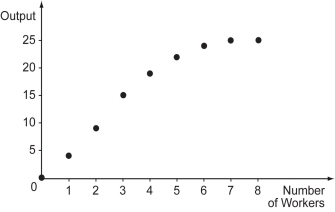 -Refer to the figure above.If the price of the output is $5.00 per unit and the wage is $30 per worker,the firm's optimal choice in the short run is to hire ________ workers.
 (Multiple Choice)
4.8/5 (64)
(64) An employer discriminating against Asian workers is an example of ________.
(Multiple Choice)
4.9/5 (79)
(79) Without any change in the supply of labor,how are the following events likely to change the equilibrium wage and employment level in a firm that manufactures umbrellas?
a) A forecast of higher rainfall this year
b) A decrease in the price of raincoats
c) The introduction of labor-saving technology in the factory
(Essay)
4.9/5 (89)
(89) All of the following are research studies that try to measure discrimination in the job market,except for ________.
(Multiple Choice)
4.9/5 (75)
(75) 
Filters
- Essay(0)
- Multiple Choice(0)
- Short Answer(0)
- True False(0)
- Matching(0)