



 Chat with AI
Exam 11: Markets for Factors of Production

Exam 1: The Principles and Practice of Economics103 Questions
Exam 2: Economic Methods and Economic Questions94 Questions
Exam 3: Optimization: Doing the Best You Can94 Questions
Exam 4: Demand, supply, and Equilibrium185 Questions
Exam 5: Consumers and Incentives187 Questions
Exam 6: Sellers and Incentives261 Questions
Exam 7: Perfect Competition and the Invisible Hand251 Questions
Exam 8: Trade264 Questions
Exam 9: Externalities and Public Goods223 Questions
Exam 10: The Government in the Economy: Taxation and Regulation244 Questions
Exam 11: Markets for Factors of Production237 Questions
Exam 12: Monopoly295 Questions
Exam 13: Game Theory and Strategic Play199 Questions
Exam 14: Oligopoly and Monopolistic Competition264 Questions
Exam 15: Trade-Offs Involving Time and Risk147 Questions
Exam 16: The Economics of Information119 Questions
Exam 17: Auctions and Bargaining123 Questions
Exam 18: Social Economics111 Questions
Select questions type


If an industry introduces labor-saving technology in production,the demand curve for labor in that industry is likely to ________.
(Multiple Choice)
4.9/5  (81)
(81) Scenario: Consider a firm that produces and sells a good for the price of $2 in a perfectly competitive market. The following table shows the relationship between the number of workers and the output of this firm. Suppose the labor market from which this firm hires its employees is competitive.
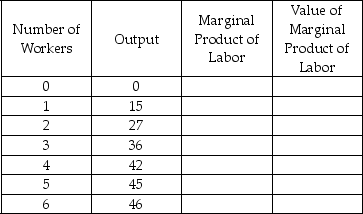 -Refer to the scenario above.If the wage rate in this market is equal to $9,this firm will hire ________ workers.
 (Multiple Choice)
4.9/5 (82)
(82) Scenario: A small apple orchard operates in a perfectly competitive output market (the market for apples) and input or factor market (the market for apple pickers). The market price of apples is $1 per pound, and the market wage for apple pickers is $50 per day. See the following table.
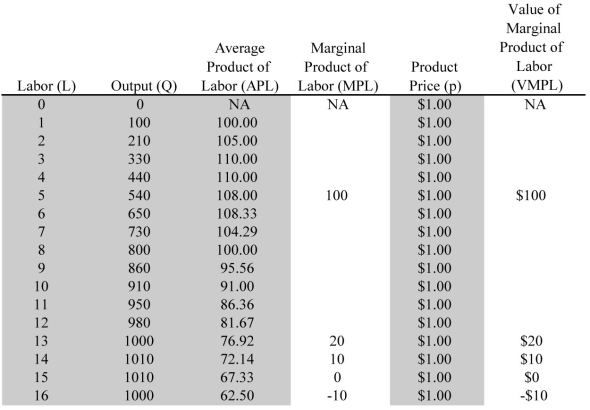 -Refer to the scenario above.What is the value of the marginal product of labor for hiring the tenth worker?
 (Multiple Choice)
4.9/5 (81)
(81) Consider a printing press that operates in a perfectly competitive market.Also,assume that the market for printing press workers is competitive.The following table shows the employment levels and the daily output of notebooks manufactured by the printing press.
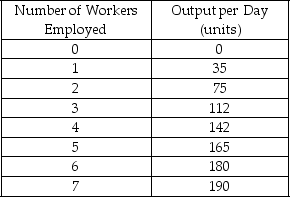 a)Calculate the marginal product of the employees.If the price at which a notebook is sold is $2,calculate the value of the marginal product of the employees.
b)If the market wage rate is $80,how many employees should the firm hire?
c)If the market wage rate is $46,how many employees should the firm hire?
a)Calculate the marginal product of the employees.If the price at which a notebook is sold is $2,calculate the value of the marginal product of the employees.
b)If the market wage rate is $80,how many employees should the firm hire?
c)If the market wage rate is $46,how many employees should the firm hire? (Essay)
4.9/5 (91)
(91) Which of the following is NOT a factor that can cause wage inequality among workers producing the same good?
(Multiple Choice)
4.9/5 (70)
(70) Other things remaining the same,which of the following is likely to happen if all homemakers in an economy start working as paid labor?
(Multiple Choice)
4.8/5 (83)
(83) Scenario: Consider a firm that produces and sells a good for the price of $2 in a perfectly competitive market. The following table shows the relationship between the number of workers and the output of this firm. Suppose the labor market from which this firm hires its employees is competitive.
-Refer to the scenario above.What is the marginal product of labor when the third worker is hired?
-Refer to the scenario above.What is the marginal product of labor when the third worker is hired? (Multiple Choice)
4.9/5 (85)
(85) If the rental price of physical capital falls,the firm's ________.
(Multiple Choice)
4.9/5 (78)
(78) If the value of the marginal product of a worker is $40 and the marginal product of the worker is 8 units,the market price of the good he produces is ________.
(Multiple Choice)
4.8/5 (74)
(74) Suppose that employers engage in statistical discrimination based on the information that,on average,women cost more to employ than men for various reasons.As a result,employers pay women less,on average,than they pay men.Assuming that the information is correct,what would be an effect of the law that requires employers to pay the same wage as men for the same job?
(Multiple Choice)
4.9/5 (91)
(91) Which of the following is likely to cause a fall in the wage rate and an increase in the number of workers hired in a local cotton mill?
(Multiple Choice)
4.9/5 (78)
(78) Which of the following is likely to lead to a leftward shift in the demand curve for labor in the printing ink manufacturing industry?
(Multiple Choice)
4.7/5 (81)
(81) Scenario: Mark grows herbs in his backyard. The following table shows his output as a function of the square feet of land used.
 -Refer to the scenario above.Suppose Mark can sell his herbs at the price of $2.50 per pound,and that the rental price of land is $80 per square foot.How big of an herb garden should Mark maintain?
 (Multiple Choice)
4.8/5 (85)
(85) Scenario: Consider a firm that produces and sells a good for the price of $2 in a perfectly competitive market. The following table shows the relationship between the number of workers and the output of this firm. Suppose the labor market from which this firm hires its employees is competitive.
-Refer to the scenario above.What is the value of the marginal product of labor when the first worker is hired?
-Refer to the scenario above.What is the value of the marginal product of labor when the first worker is hired? (Multiple Choice)
4.7/5 (85)
(85) Scenario: Victoria Corp. makes running shoes by employing a robotics technology that requires at most a few, but highly skilled, workers for monitoring and maintenance of the robots. Each robot costs $240,000. The table below shows the marginal product of capital (MPK) per month when the firm employs one worker versus when it employs two workers. Each pair of Victoria shoes sells for $150.
 -Refer to the scenario above.If the firm decides to employ one worker,how many robots should it use?
 (Multiple Choice)
4.7/5 (86)
(86) Refer to the scenario above.Lydia contends that the increase in female labor force participation was caused by a change in tastes for working among women in the United States after World War II.According to Lydia,________.Explain your answer.
(Multiple Choice)
4.7/5 (81)
(81) All the following are causes of wage inequality except ________.
(Multiple Choice)
4.9/5 (71)
(71) 
Filters
- Essay(0)
- Multiple Choice(0)
- Short Answer(0)
- True False(0)
- Matching(0)