



 Chat with AI
Exam 11: Markets for Factors of Production

Exam 1: The Principles and Practice of Economics103 Questions
Exam 2: Economic Methods and Economic Questions94 Questions
Exam 3: Optimization: Doing the Best You Can94 Questions
Exam 4: Demand, supply, and Equilibrium185 Questions
Exam 5: Consumers and Incentives187 Questions
Exam 6: Sellers and Incentives261 Questions
Exam 7: Perfect Competition and the Invisible Hand251 Questions
Exam 8: Trade264 Questions
Exam 9: Externalities and Public Goods223 Questions
Exam 10: The Government in the Economy: Taxation and Regulation244 Questions
Exam 11: Markets for Factors of Production237 Questions
Exam 12: Monopoly295 Questions
Exam 13: Game Theory and Strategic Play199 Questions
Exam 14: Oligopoly and Monopolistic Competition264 Questions
Exam 15: Trade-Offs Involving Time and Risk147 Questions
Exam 16: The Economics of Information119 Questions
Exam 17: Auctions and Bargaining123 Questions
Exam 18: Social Economics111 Questions
Select questions type


Other things remaining the same,which of the following is likely to happen if an industry introduces labor-complementary technology in production?
(Multiple Choice)
4.8/5  (87)
(87) Sandra has been working as a software engineer for five years,and Jack has been working as a software engineer for two years.Which of the following statements is true of Sandra and Jack?
(Multiple Choice)
4.7/5 (84)
(84) The following figure shows the value of the marginal product of labor curve for a perfectly competitive firm.
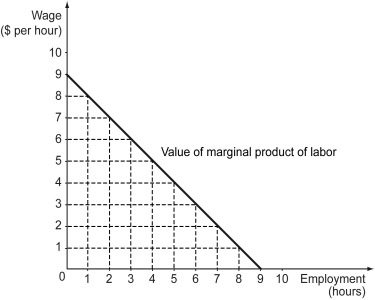 -Refer to the figure above.What is the equilibrium quantity of labor hired by the firm when the wage rate is $6 per hour?
 (Multiple Choice)
4.9/5 (65)
(65) Scenario: A small apple orchard operates in a perfectly competitive output market (the market for apples) and input or factor market (the market for apple pickers). The market price of apples is $1 per pound, and the market wage for apple pickers is $50 per day. See the following table.
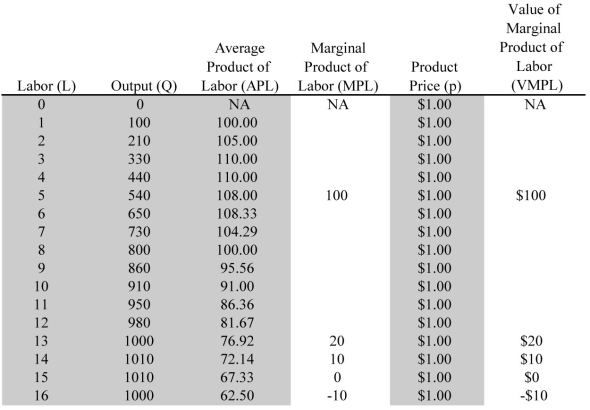 -Refer to the scenario above.Now suppose that apple pickers have the same productivity as they did initially,but the price of apples rises to $1.25 per pound.The profit-maximizing number of workers the orchard should hire is ________.
 (Multiple Choice)
4.9/5 (76)
(76) If the marginal product of capital increases,the firm's ________.
(Multiple Choice)
4.8/5 (93)
(93) Refer to the scenario above.The increase in price of peaches will cause the equilibrium wage rate in this market to ________,and the employment to ________.
(Multiple Choice)
4.7/5 (81)
(81) Which of the following would NOT cause the labor supply schedule to increase (shift right)?
(Multiple Choice)
4.9/5 (74)
(74) Based on research conducted on the productivity of Hispanic and non-Hispanic workers,an employer decides to hire non-Hispanic workers.This is an example of ________.
(Multiple Choice)
4.7/5 (83)
(83) The value of the marginal product of labor is the ________.
(Multiple Choice)
4.8/5 (87)
(87) Other things remaining the same,which of the following is likely to cause a leftward shift in the supply curve of labor?
(Multiple Choice)
5.0/5 (67)
(67) The following table shows the output of chairs produced by a firm at different units of capital rented. The price per chair is $10.
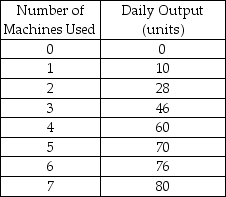 -Refer to the table above.If the price of a chair decreases to $5 and the rental price of machines is $50 per day,how many machines should the firm rent?
 (Multiple Choice)
4.8/5 (79)
(79) Goods that are used for the production of other goods are referred to as ________.
(Multiple Choice)
4.8/5 (73)
(73) Employers engaging in ________ are trying to enhance their profits.
(Multiple Choice)
5.0/5 (94)
(94) The following figure shows the production function for a perfectly competitive firm.
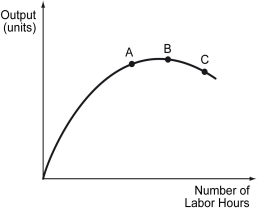 -Refer to the figure above.The slope of the production function between ________ and ________ indicates negative returns to labor.
 (Multiple Choice)
4.9/5 (80)
(80) 
Filters
- Essay(0)
- Multiple Choice(0)
- Short Answer(0)
- True False(0)
- Matching(0)