



 Chat with AI
Exam 15: From Gene to Protein

Exam 1: The Nature of Science and the Characteristics of Life82 Questions
Exam 2: Biological Diversity, Bacteria, and Archaea101 Questions
Exam 3: Protista, Plantae, and Fungi83 Questions
Exam 4: Animalia81 Questions
Exam 5: The Chemistry of Life92 Questions
Exam 6: Cell Structure and Internal Compartments87 Questions
Exam 7: Cell Membranes, Transport, and Communication85 Questions
Exam 8: Energy, Metabolism, and Enzymes81 Questions
Exam 9: Photosynthesis and Cellular Respiration84 Questions
Exam 10: Cell Division89 Questions
Exam 11: Stem Cells, Cancer, and Human Health93 Questions
Exam 12: Patterns of Inheritance75 Questions
Exam 13: Chromosomes and Human Genetics75 Questions
Exam 14: Dna and Genes105 Questions
Exam 15: From Gene to Protein80 Questions
Exam 16: Dna Technology80 Questions
Exam 17: How Evolution Works80 Questions
Exam 18: Evolution of Populations80 Questions
Exam 19: Speciation and the Origins of Biological Diversity80 Questions
Exam 20: The Evolutionary History of Life100 Questions
Exam 21: The Biosphere89 Questions
Exam 22: Growth of Populations69 Questions
Exam 23: Ecological Communities133 Questions
Exam 24: Ecosystems75 Questions
Exam 25: Global Change70 Questions
Exam 26: Internal Organization and Homeostasis79 Questions
Exam 27: Nutrition and Digestion80 Questions
Exam 28: Circulation and Gas Exchange77 Questions
Exam 29: Animal Hormones78 Questions
Exam 30: Nervous and Sensory Systems78 Questions
Exam 31: Skeletons, Muscles, and Movement78 Questions
Exam 32: Defenses Against Disease78 Questions
Exam 33: Reproduction and Development76 Questions
Exam 34: Animal Behavior76 Questions
Exam 35: Plant Structure, Nutrition, and Transport80 Questions
Exam 36: Plant Growth and Reproduction80 Questions
Select questions type


The stop codon is the sequence of bases at which transcription ends.
(True/False)
4.9/5  (89)
(89) If a strand of DNA has the sequence CGTAA, the RNA made from this molecule will have the sequence
(Multiple Choice)
4.8/5 (82)
(82) Research suggests that higher production of aromatase in humans may result in increased feminization of human males.
(True/False)
4.8/5 (84)
(84) The RNA molecule in the figure below could have been translated from the DNA molecule shown in this figure.
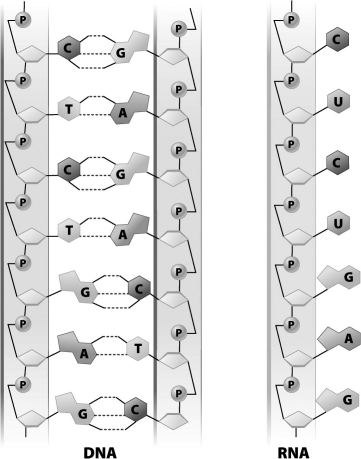
(True/False)
4.9/5 (82)
(82) DNA molecules are double-stranded, whereas most RNA molecules are single-stranded. Which of the following choices is the most likely reason that RNA does not need to be double-stranded?
(Multiple Choice)
4.8/5 (78)
(78) A chemical that causes the formation of a covalent bond between adenine and thymine is added to a cell. How does this drug affect gene expression in the cell?
(Multiple Choice)
4.8/5 (102)
(102) ____________________ is the specific type of nucleic acid found in ribosomes, which are important in protein synthesis.
(Short Answer)
4.9/5 (81)
(81) A mutation occurs in the promoter of a protein-encoding gene. How might this mutation affect the production of the protein encoded by the gene?
(Multiple Choice)
4.8/5 (65)
(65) The figure below depicts a gene and two different ways that gene could be mutated. 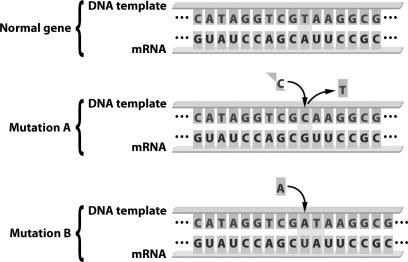 How does Mutation A differ from Mutation B?
 (Multiple Choice)
4.7/5 (73)
(73) It is possible for a mutation to occur and yet not alter the end product of translation if
(Multiple Choice)
4.9/5 (89)
(89) When one base is changed to another at a single position in the DNA sequence of a gene, a(n)_____ mutation has occurred.
(Multiple Choice)
4.8/5 (76)
(76) The position of the start codon is important because every molecule of mRNA can be read by a ribosome in three different ways.
(True/False)
4.8/5 (90)
(90) Use the chart below to determine the chain of amino acids that would be produced by the entire sequence UGUACGAUAGGCUAG. 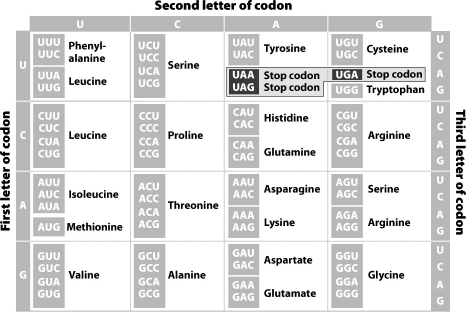
(Multiple Choice)
5.0/5 (74)
(74) If both strands of the DNA of a gene underwent transcription and translation, they would produce the same mRNA and protein.
(True/False)
4.8/5 (65)
(65) 
Filters
- Essay(0)
- Multiple Choice(0)
- Short Answer(0)
- True False(0)
- Matching(0)