



 Chat with AI
Exam 14: Dna and Genes

Exam 1: The Nature of Science and the Characteristics of Life82 Questions
Exam 2: Biological Diversity, Bacteria, and Archaea101 Questions
Exam 3: Protista, Plantae, and Fungi83 Questions
Exam 4: Animalia81 Questions
Exam 5: The Chemistry of Life92 Questions
Exam 6: Cell Structure and Internal Compartments87 Questions
Exam 7: Cell Membranes, Transport, and Communication85 Questions
Exam 8: Energy, Metabolism, and Enzymes81 Questions
Exam 9: Photosynthesis and Cellular Respiration84 Questions
Exam 10: Cell Division89 Questions
Exam 11: Stem Cells, Cancer, and Human Health93 Questions
Exam 12: Patterns of Inheritance75 Questions
Exam 13: Chromosomes and Human Genetics75 Questions
Exam 14: Dna and Genes105 Questions
Exam 15: From Gene to Protein80 Questions
Exam 16: Dna Technology80 Questions
Exam 17: How Evolution Works80 Questions
Exam 18: Evolution of Populations80 Questions
Exam 19: Speciation and the Origins of Biological Diversity80 Questions
Exam 20: The Evolutionary History of Life100 Questions
Exam 21: The Biosphere89 Questions
Exam 22: Growth of Populations69 Questions
Exam 23: Ecological Communities133 Questions
Exam 24: Ecosystems75 Questions
Exam 25: Global Change70 Questions
Exam 26: Internal Organization and Homeostasis79 Questions
Exam 27: Nutrition and Digestion80 Questions
Exam 28: Circulation and Gas Exchange77 Questions
Exam 29: Animal Hormones78 Questions
Exam 30: Nervous and Sensory Systems78 Questions
Exam 31: Skeletons, Muscles, and Movement78 Questions
Exam 32: Defenses Against Disease78 Questions
Exam 33: Reproduction and Development76 Questions
Exam 34: Animal Behavior76 Questions
Exam 35: Plant Structure, Nutrition, and Transport80 Questions
Exam 36: Plant Growth and Reproduction80 Questions
Select questions type


The sequence of DNA differs among individuals within a species. This is the basis for
(Multiple Choice)
4.8/5  (71)
(71) Which of the following is directly involved in the regulation of transcription?
(Multiple Choice)
4.8/5 (72)
(72) During replication, each "old" DNA strand serves as a template for a new strand.
(True/False)
4.9/5 (70)
(70) All cells in an organism contain a full copy of that organism's DNA. Your ears do not produce digestive enzymes because
(Multiple Choice)
4.8/5 (67)
(67) DNA ____________________ results in the copying of a DNA molecule.
(Short Answer)
4.8/5 (75)
(75) Which of the following would not be a required biological property of genetic material?
(Multiple Choice)
4.7/5 (95)
(95) Where in this diagram of the flow of genetic information of the cell would translation occur? 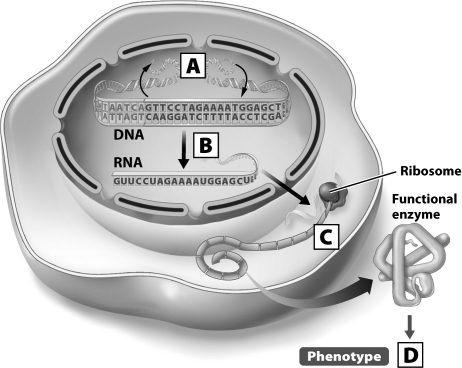
(Multiple Choice)
4.9/5 (73)
(73) The 220 different cell types in the human body each contain all of the same DNA found in every other cell type.
(True/False)
4.9/5 (73)
(73) The most common way for cells to control gene expression is by controlling
(Multiple Choice)
4.9/5 (75)
(75) DNA is often damaged or may be replicated incorrectly. Which of the following is not true?
(Multiple Choice)
4.9/5 (82)
(82) ____________________ DNA consists of stretches of nucleotides that separate genes.
(Short Answer)
4.9/5 (86)
(86) Which of the following are removed from mRNA after transcription?
(Multiple Choice)
4.9/5 (84)
(84) The enzymes involved in ATP synthesis in the mitochondria are likely to be encoded by _____ genes.
(Multiple Choice)
4.9/5 (79)
(79) During DNA replication, the template strands of the original DNA molecule are complementary both to each other and to one of the new strands.
(True/False)
4.8/5 (83)
(83) 
Filters
- Essay(0)
- Multiple Choice(0)
- Short Answer(0)
- True False(0)
- Matching(0)