



 Chat with AI
Exam 14: Dna and Genes

Exam 1: The Nature of Science and the Characteristics of Life82 Questions
Exam 2: Biological Diversity, Bacteria, and Archaea101 Questions
Exam 3: Protista, Plantae, and Fungi83 Questions
Exam 4: Animalia81 Questions
Exam 5: The Chemistry of Life92 Questions
Exam 6: Cell Structure and Internal Compartments87 Questions
Exam 7: Cell Membranes, Transport, and Communication85 Questions
Exam 8: Energy, Metabolism, and Enzymes81 Questions
Exam 9: Photosynthesis and Cellular Respiration84 Questions
Exam 10: Cell Division89 Questions
Exam 11: Stem Cells, Cancer, and Human Health93 Questions
Exam 12: Patterns of Inheritance75 Questions
Exam 13: Chromosomes and Human Genetics75 Questions
Exam 14: Dna and Genes105 Questions
Exam 15: From Gene to Protein80 Questions
Exam 16: Dna Technology80 Questions
Exam 17: How Evolution Works80 Questions
Exam 18: Evolution of Populations80 Questions
Exam 19: Speciation and the Origins of Biological Diversity80 Questions
Exam 20: The Evolutionary History of Life100 Questions
Exam 21: The Biosphere89 Questions
Exam 22: Growth of Populations69 Questions
Exam 23: Ecological Communities133 Questions
Exam 24: Ecosystems75 Questions
Exam 25: Global Change70 Questions
Exam 26: Internal Organization and Homeostasis79 Questions
Exam 27: Nutrition and Digestion80 Questions
Exam 28: Circulation and Gas Exchange77 Questions
Exam 29: Animal Hormones78 Questions
Exam 30: Nervous and Sensory Systems78 Questions
Exam 31: Skeletons, Muscles, and Movement78 Questions
Exam 32: Defenses Against Disease78 Questions
Exam 33: Reproduction and Development76 Questions
Exam 34: Animal Behavior76 Questions
Exam 35: Plant Structure, Nutrition, and Transport80 Questions
Exam 36: Plant Growth and Reproduction80 Questions
Select questions type


During interphase, the genes that are most tightly packed are not being expressed because
(Multiple Choice)
4.8/5  (77)
(77) The backbone of a DNA molecule is made up of sugars and ____________________.
(Short Answer)
4.9/5 (81)
(81) Specific types of proteins can attach to long-lived mRNA molecules to prevent their ____________________ when the cell does not need their protein product.
(Short Answer)
4.9/5 (73)
(73) The table below shows which of these four genes are on or off in three different cell types. 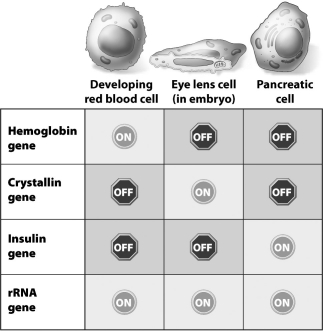 Why is the expression of the rRNA gene so different from the expression of the other genes in the table?
 (Multiple Choice)
4.8/5 (63)
(63) The "rungs" in the DNA "ladder" consist of ____________________ pairs.
(Short Answer)
4.8/5 (64)
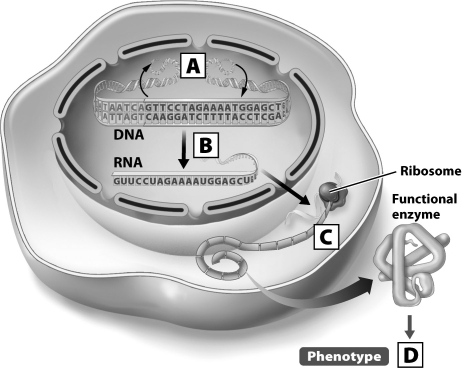
(64) The process labeled with the letter D in this diagram of the process of gene flow in a cell requires ____________________ to convert genetic information into a phenotype.
(Short Answer)
5.0/5 (76)
(76) Exposure to ____________________ light can cause sunburn and massive DNA damage to skin cells.
(Short Answer)
4.9/5 (90)
(90) In eukaryotes, some genes with related functions are found on different chromosomes.
(True/False)
4.8/5 (75)
(75) If the gene of a repressor protein were to be mutated such that its protein no longer functioned, the genes it regulated would not be transcribed.
(True/False)
4.8/5 (86)
(86) A change in an organism's environment generally results in a change in ____________________, leading to the production of different types of proteins.
(Short Answer)
4.8/5 (79)
(79) The cells of organisms control when, where, and how much of each gene product is made.
(True/False)
4.8/5 (70)
(70) At any given time, most of the genes in the genome of an organism are actively undergoing gene expression.
(True/False)
4.8/5 (78)
(78) Transposons can move both within a chromosome and from one chromosome to another.
(True/False)
4.8/5 (76)
(76) The early hypothesis that protein was the genetic material was based in part on the
(Multiple Choice)
4.9/5 (66)
(66) Gene ____________________ is the synthesis of a gene's protein or RNA product.
(Short Answer)
4.8/5 (82)
(82) 
Filters
- Essay(0)
- Multiple Choice(0)
- Short Answer(0)
- True False(0)
- Matching(0)