



 Chat with AI
Exam 13: Chromosomes and Human Genetics

Exam 1: The Nature of Science and the Characteristics of Life82 Questions
Exam 2: Biological Diversity, Bacteria, and Archaea101 Questions
Exam 3: Protista, Plantae, and Fungi83 Questions
Exam 4: Animalia81 Questions
Exam 5: The Chemistry of Life92 Questions
Exam 6: Cell Structure and Internal Compartments87 Questions
Exam 7: Cell Membranes, Transport, and Communication85 Questions
Exam 8: Energy, Metabolism, and Enzymes81 Questions
Exam 9: Photosynthesis and Cellular Respiration84 Questions
Exam 10: Cell Division89 Questions
Exam 11: Stem Cells, Cancer, and Human Health93 Questions
Exam 12: Patterns of Inheritance75 Questions
Exam 13: Chromosomes and Human Genetics75 Questions
Exam 14: Dna and Genes105 Questions
Exam 15: From Gene to Protein80 Questions
Exam 16: Dna Technology80 Questions
Exam 17: How Evolution Works80 Questions
Exam 18: Evolution of Populations80 Questions
Exam 19: Speciation and the Origins of Biological Diversity80 Questions
Exam 20: The Evolutionary History of Life100 Questions
Exam 21: The Biosphere89 Questions
Exam 22: Growth of Populations69 Questions
Exam 23: Ecological Communities133 Questions
Exam 24: Ecosystems75 Questions
Exam 25: Global Change70 Questions
Exam 26: Internal Organization and Homeostasis79 Questions
Exam 27: Nutrition and Digestion80 Questions
Exam 28: Circulation and Gas Exchange77 Questions
Exam 29: Animal Hormones78 Questions
Exam 30: Nervous and Sensory Systems78 Questions
Exam 31: Skeletons, Muscles, and Movement78 Questions
Exam 32: Defenses Against Disease78 Questions
Exam 33: Reproduction and Development76 Questions
Exam 34: Animal Behavior76 Questions
Exam 35: Plant Structure, Nutrition, and Transport80 Questions
Exam 36: Plant Growth and Reproduction80 Questions
Select questions type


A specific gene can be found in several possible places on a given chromosome.
(True/False)
4.8/5  (78)
(78) Because an individual with an XX genotype is a female, is an individual with an XO (no second sex chromosome)a male?
(Multiple Choice)
4.7/5 (86)
(86) The figure below contains a pedigree for cystic fibrosis, an autosomal recessive disorder. Which of the following is true? 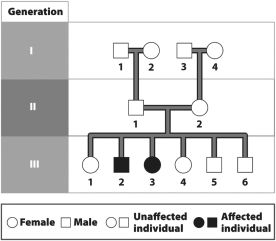
(Multiple Choice)
4.8/5 (90)
(90) What effect does gene linkage have on the overall variety of individuals produced?
(Multiple Choice)
4.9/5 (73)
(73) This pedigree diagrams an X-linked gene. The individual indicated by the question mark is _____ for the gene. 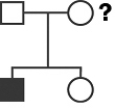
(Multiple Choice)
4.9/5 (73)
(73) 
Which of the following genetic changes would not be heritable?
(Multiple Choice)
4.9/5 (70)
(70) We now know that the gene for flower color and the gene for seed color are both on chromosome 1 of the pea plants once studied by Mendel. According to Mendel's results, flower color and seed color undergo independent assortment. Which of the following explanations is most likely?
(Multiple Choice)
4.8/5 (74)
(74) Which of the following is true of the cross shown in the figure below? 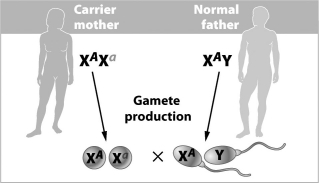
(Multiple Choice)
4.8/5 (63)
(63) "New" chromosomes are generated when homologous chromosomes exchange genetic material during ____________________.
(Short Answer)
4.8/5 (71)
(71) Why are X-linked recessive genetic disorders more commonly seen in males?
(Multiple Choice)
4.7/5 (88)
(88) The gene for a certain sex-linked trait is found only on the Y chromosome. If the male parent carries this gene, which of the following statements about the inheritance of that trait is true?
(Multiple Choice)
4.9/5 (80)
(80) Recessive genetic disorders are quickly eliminated from human populations because people who have them die before they can reproduce.
(True/False)
4.8/5 (84)
(84) If a recessive allele causes a fatal disease that kills the affected individual before he or she can reproduce, why doesn't that allele quickly become extinct in the population?
(Multiple Choice)
4.9/5 (87)
(87) Spontaneous abortions are often due to the addition or deletion of whole ____________________ in the gametes that fused to form the zygote.
(Short Answer)
4.9/5 (78)
(78) If DNA testing reveals that you carry alleles for a particular genetic disorder, you will definitely get that disorder at some point in the future.
(True/False)
4.8/5 (85)
(85) Human males have one chromosome that females do not, known as the ____________________ chromosome.
(Short Answer)
4.8/5 (84)
(84) 
Filters
- Essay(0)
- Multiple Choice(0)
- Short Answer(0)
- True False(0)
- Matching(0)