



 Chat with AI
Exam 13: Chromosomes and Human Genetics

Exam 1: The Nature of Science and the Characteristics of Life82 Questions
Exam 2: Biological Diversity, Bacteria, and Archaea101 Questions
Exam 3: Protista, Plantae, and Fungi83 Questions
Exam 4: Animalia81 Questions
Exam 5: The Chemistry of Life92 Questions
Exam 6: Cell Structure and Internal Compartments87 Questions
Exam 7: Cell Membranes, Transport, and Communication85 Questions
Exam 8: Energy, Metabolism, and Enzymes81 Questions
Exam 9: Photosynthesis and Cellular Respiration84 Questions
Exam 10: Cell Division89 Questions
Exam 11: Stem Cells, Cancer, and Human Health93 Questions
Exam 12: Patterns of Inheritance75 Questions
Exam 13: Chromosomes and Human Genetics75 Questions
Exam 14: Dna and Genes105 Questions
Exam 15: From Gene to Protein80 Questions
Exam 16: Dna Technology80 Questions
Exam 17: How Evolution Works80 Questions
Exam 18: Evolution of Populations80 Questions
Exam 19: Speciation and the Origins of Biological Diversity80 Questions
Exam 20: The Evolutionary History of Life100 Questions
Exam 21: The Biosphere89 Questions
Exam 22: Growth of Populations69 Questions
Exam 23: Ecological Communities133 Questions
Exam 24: Ecosystems75 Questions
Exam 25: Global Change70 Questions
Exam 26: Internal Organization and Homeostasis79 Questions
Exam 27: Nutrition and Digestion80 Questions
Exam 28: Circulation and Gas Exchange77 Questions
Exam 29: Animal Hormones78 Questions
Exam 30: Nervous and Sensory Systems78 Questions
Exam 31: Skeletons, Muscles, and Movement78 Questions
Exam 32: Defenses Against Disease78 Questions
Exam 33: Reproduction and Development76 Questions
Exam 34: Animal Behavior76 Questions
Exam 35: Plant Structure, Nutrition, and Transport80 Questions
Exam 36: Plant Growth and Reproduction80 Questions
Select questions type


Some of the F₂ gametes involved in the cross below formed as a result of crossing-over.
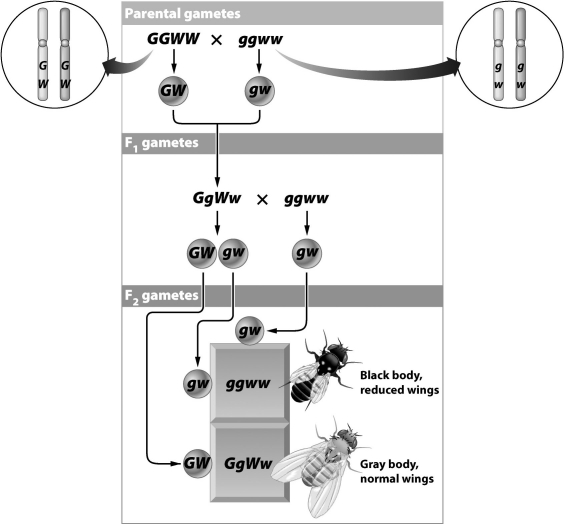
(True/False)
4.9/5  (74)
(74) A ____________________ is an individual with a heterozygous genotype who does not express the recessive trait but can pass it along to offspring.
(Short Answer)
4.9/5 (80)
(80) Which of the following statements is not true with regard to Huntington's disease?
(Multiple Choice)
5.0/5 (78)
(78) Scientists are able to determine what alleles are present in your DNA because every gene in a human occupies a specific position or ____________________ in your chromosomes.
(Short Answer)
4.8/5 (85)
(85) In humans, which of the following chromosomes would probably carry the fewest genes?
(Multiple Choice)
4.9/5 (66)
(66) Two chromosomes that have the same set of genes, but perhaps different versions of those genes, are called ____________________ chromosomes.
(Short Answer)
4.8/5 (75)
(75) A female who is a carrier of the sex-linked gene A has the genotype ____________________.
(Short Answer)
4.9/5 (88)
(88) This chromosomal disorder known as Cri du chat syndrome is the result of missing a part of chromosome 5, an example of chromosome
(Multiple Choice)
4.9/5 (68)
(68) Lethal ____________________ mutations are not eliminated from a population because they can be "hidden" in symptom-free individuals also carrying dominant alleles.
(Short Answer)
4.8/5 (80)
(80) The farther apart on the same chromosome that two genes are located, the more likely they are to undergo ____________________.
(Short Answer)
4.9/5 (75)
(75) An XX individual develops as a male. Which of the following statements offers the most likely explanation?
(Multiple Choice)
4.8/5 (85)
(85) If a genetic disorder is caused by a dominant allele, individuals with which of the following genotypes would be affected by the disorder?
(Multiple Choice)
4.8/5 (69)
(69) The ____________________ gene is responsible for activating many genes involved in "maleness" during embryonic development.
(Short Answer)
4.9/5 (61)
(61) Ichthyosis is a recessive sex-linked disorder that causes a person's skin to flake off like fish scales. A normal man and a normal woman produce a child with ichthyosis. This child cannot be female.
(True/False)
4.9/5 (82)
(82) Which of the following combinations of sex chromosomes would most probably have the most serious effects?
(Multiple Choice)
4.7/5 (77)
(77) The tendency to develop diseases, such as cancer and heart disease, is
(Multiple Choice)
4.9/5 (80)
(80) 
Filters
- Essay(0)
- Multiple Choice(0)
- Short Answer(0)
- True False(0)
- Matching(0)