



 Chat with AI
Exam 9: Photosynthesis and Cellular Respiration

Exam 1: The Nature of Science and the Characteristics of Life82 Questions
Exam 2: Biological Diversity, Bacteria, and Archaea101 Questions
Exam 3: Protista, Plantae, and Fungi83 Questions
Exam 4: Animalia81 Questions
Exam 5: The Chemistry of Life92 Questions
Exam 6: Cell Structure and Internal Compartments87 Questions
Exam 7: Cell Membranes, Transport, and Communication85 Questions
Exam 8: Energy, Metabolism, and Enzymes81 Questions
Exam 9: Photosynthesis and Cellular Respiration84 Questions
Exam 10: Cell Division89 Questions
Exam 11: Stem Cells, Cancer, and Human Health93 Questions
Exam 12: Patterns of Inheritance75 Questions
Exam 13: Chromosomes and Human Genetics75 Questions
Exam 14: Dna and Genes105 Questions
Exam 15: From Gene to Protein80 Questions
Exam 16: Dna Technology80 Questions
Exam 17: How Evolution Works80 Questions
Exam 18: Evolution of Populations80 Questions
Exam 19: Speciation and the Origins of Biological Diversity80 Questions
Exam 20: The Evolutionary History of Life100 Questions
Exam 21: The Biosphere89 Questions
Exam 22: Growth of Populations69 Questions
Exam 23: Ecological Communities133 Questions
Exam 24: Ecosystems75 Questions
Exam 25: Global Change70 Questions
Exam 26: Internal Organization and Homeostasis79 Questions
Exam 27: Nutrition and Digestion80 Questions
Exam 28: Circulation and Gas Exchange77 Questions
Exam 29: Animal Hormones78 Questions
Exam 30: Nervous and Sensory Systems78 Questions
Exam 31: Skeletons, Muscles, and Movement78 Questions
Exam 32: Defenses Against Disease78 Questions
Exam 33: Reproduction and Development76 Questions
Exam 34: Animal Behavior76 Questions
Exam 35: Plant Structure, Nutrition, and Transport80 Questions
Exam 36: Plant Growth and Reproduction80 Questions
Select questions type


Cells use a variety of metabolic pathways to construct ATP, but each concludes with the same step. Which of the following describes the final step by which ADP becomes ATP?
(Multiple Choice)
4.9/5  (89)
(89) The process that produces ATP from sugars begins with glycolysis; when fatty acids are used the process begins with
(Multiple Choice)
4.7/5 (77)
(77) During exercise, the increase in respiration rate and heartbeat speed are driven by the need to replenish the oxygen used to support
(Multiple Choice)
4.8/5 (84)
(84) Most Tibetans do not compensate for the low oxygen of their environment with an increase in red blood cells; perhaps their mitochondria have evolved a less oxygen-dependent method of catabolizing sugar and producing CO₂.
(True/False)
4.9/5 (58)
(58) The conversion of inorganic carbon from air into the carbon atoms found in all living organisms is known as carbon ____________________.
(Short Answer)
4.9/5 (79)
(79) Several energy carriers can be found in eukaryotic cells; the most versatile, as indicated in the illustration below, is 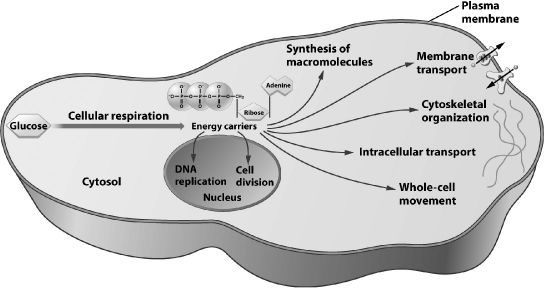
(Multiple Choice)
4.9/5 (105)
(105) The NADH produced by the Krebs cycle donates electrons to the electron transport chain.
(True/False)
4.8/5 (81)
(81) During the process of photosynthesis, plants capture the kinetic energy of moving photons and transform it into potential energy in the form of
(Multiple Choice)
4.9/5 (73)
(73) During alcoholic fermentation, pyruvate is converted to ethanol in order to
(Multiple Choice)
5.0/5 (75)
(75) Fermentation produces more ATP molecules than aerobic respiration does.
(True/False)
4.8/5 (90)
(90) The green pigment most commonly associated with photosynthesis is ____________________.
(Short Answer)
4.7/5 (83)
(83) The muscles of a very active organism would contain fewer mitochondria than the muscles of a less active organism.
(True/False)
4.9/5 (75)
(75) The energy source that makes oxidative phosphorylation possible comes from
(Multiple Choice)
4.9/5 (91)
(91) 
Filters
- Essay(0)
- Multiple Choice(0)
- Short Answer(0)
- True False(0)
- Matching(0)