



 Chat with AI
Exam 9: Photosynthesis and Cellular Respiration

Exam 1: The Nature of Science and the Characteristics of Life82 Questions
Exam 2: Biological Diversity, Bacteria, and Archaea101 Questions
Exam 3: Protista, Plantae, and Fungi83 Questions
Exam 4: Animalia81 Questions
Exam 5: The Chemistry of Life92 Questions
Exam 6: Cell Structure and Internal Compartments87 Questions
Exam 7: Cell Membranes, Transport, and Communication85 Questions
Exam 8: Energy, Metabolism, and Enzymes81 Questions
Exam 9: Photosynthesis and Cellular Respiration84 Questions
Exam 10: Cell Division89 Questions
Exam 11: Stem Cells, Cancer, and Human Health93 Questions
Exam 12: Patterns of Inheritance75 Questions
Exam 13: Chromosomes and Human Genetics75 Questions
Exam 14: Dna and Genes105 Questions
Exam 15: From Gene to Protein80 Questions
Exam 16: Dna Technology80 Questions
Exam 17: How Evolution Works80 Questions
Exam 18: Evolution of Populations80 Questions
Exam 19: Speciation and the Origins of Biological Diversity80 Questions
Exam 20: The Evolutionary History of Life100 Questions
Exam 21: The Biosphere89 Questions
Exam 22: Growth of Populations69 Questions
Exam 23: Ecological Communities133 Questions
Exam 24: Ecosystems75 Questions
Exam 25: Global Change70 Questions
Exam 26: Internal Organization and Homeostasis79 Questions
Exam 27: Nutrition and Digestion80 Questions
Exam 28: Circulation and Gas Exchange77 Questions
Exam 29: Animal Hormones78 Questions
Exam 30: Nervous and Sensory Systems78 Questions
Exam 31: Skeletons, Muscles, and Movement78 Questions
Exam 32: Defenses Against Disease78 Questions
Exam 33: Reproduction and Development76 Questions
Exam 34: Animal Behavior76 Questions
Exam 35: Plant Structure, Nutrition, and Transport80 Questions
Exam 36: Plant Growth and Reproduction80 Questions
Select questions type


The burning pain in your muscles during strenuous exercise is a result of
(Multiple Choice)
4.9/5  (78)
(78) Electrons gain energy as they move through the electron transport chain.
(True/False)
4.8/5 (83)
(83) Most of the oxidation reactions that produce NADH in a cell take place in
(Multiple Choice)
4.7/5 (84)
(84) Photosynthesis and cellular respiration are both complementary and relatively balanced, but early in the history of life on Earth photosynthesis appears to have dominated, as evidenced by the
(Multiple Choice)
4.8/5 (93)
(93) What is the importance of photosynthesis to organisms other than plants?
(Multiple Choice)
4.7/5 (93)
(93) The innermost membrane in a chloroplast is the ____________________ membrane.
(Short Answer)
4.7/5 (78)
(78) The inner membrane of a mitochondrion is highly folded. Which of the following explains why this is the case?
(Multiple Choice)
4.9/5 (89)
(89) Examine the illustration below; which statement best summarizes the contribution of Photosystem I (PSI)during photosynthesis? 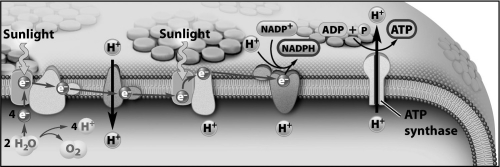
(Multiple Choice)
4.7/5 (86)
(86) Because inorganic carbon cannot be used by living organisms to build biological molecules, carbon fixation may be the most important metabolic process in the biosphere; if so, that would make _____ the most important enzyme in the biosphere.
(Multiple Choice)
4.8/5 (87)
(87) NAD⁺ becomes NADH when it gains two high-energy ____________________ and one proton.
(Short Answer)
4.7/5 (82)
(82) The energetics of photosynthesis often overshadows the importance of carbon fixation, but without this vital process,
(Multiple Choice)
4.9/5 (77)
(77) An electron transport chain is made up of a group of electron-accepting ____________________ embedded in a membrane.
(Short Answer)
4.8/5 (72)
(72) Which of the following statements describe the function of the electron transport chain (ETC)in photosynthesis?
(Multiple Choice)
4.8/5 (97)
(97) You have been shrunk to molecular size and find yourself in a chamber in a chloroplast where protons are being pumped into another chamber. You are in the ____________________.
(Short Answer)
4.9/5 (73)
(73) The photosynthetic reactions that are dependent on light occur in the
(Multiple Choice)
4.7/5 (77)
(77) 
Filters
- Essay(0)
- Multiple Choice(0)
- Short Answer(0)
- True False(0)
- Matching(0)