



 Chat with AI
Exam 2: Biological Diversity, Bacteria, and Archaea

Exam 1: The Nature of Science and the Characteristics of Life82 Questions
Exam 2: Biological Diversity, Bacteria, and Archaea101 Questions
Exam 3: Protista, Plantae, and Fungi83 Questions
Exam 4: Animalia81 Questions
Exam 5: The Chemistry of Life92 Questions
Exam 6: Cell Structure and Internal Compartments87 Questions
Exam 7: Cell Membranes, Transport, and Communication85 Questions
Exam 8: Energy, Metabolism, and Enzymes81 Questions
Exam 9: Photosynthesis and Cellular Respiration84 Questions
Exam 10: Cell Division89 Questions
Exam 11: Stem Cells, Cancer, and Human Health93 Questions
Exam 12: Patterns of Inheritance75 Questions
Exam 13: Chromosomes and Human Genetics75 Questions
Exam 14: Dna and Genes105 Questions
Exam 15: From Gene to Protein80 Questions
Exam 16: Dna Technology80 Questions
Exam 17: How Evolution Works80 Questions
Exam 18: Evolution of Populations80 Questions
Exam 19: Speciation and the Origins of Biological Diversity80 Questions
Exam 20: The Evolutionary History of Life100 Questions
Exam 21: The Biosphere89 Questions
Exam 22: Growth of Populations69 Questions
Exam 23: Ecological Communities133 Questions
Exam 24: Ecosystems75 Questions
Exam 25: Global Change70 Questions
Exam 26: Internal Organization and Homeostasis79 Questions
Exam 27: Nutrition and Digestion80 Questions
Exam 28: Circulation and Gas Exchange77 Questions
Exam 29: Animal Hormones78 Questions
Exam 30: Nervous and Sensory Systems78 Questions
Exam 31: Skeletons, Muscles, and Movement78 Questions
Exam 32: Defenses Against Disease78 Questions
Exam 33: Reproduction and Development76 Questions
Exam 34: Animal Behavior76 Questions
Exam 35: Plant Structure, Nutrition, and Transport80 Questions
Exam 36: Plant Growth and Reproduction80 Questions
Select questions type


In order to determine relationships among different organisms scientists would examine
(Multiple Choice)
5.0/5  (68)
(68) The status of viruses has been controversial but most biologists now agree that the most appropriate description for a virus is a microscopic, ____________________ infective particle.
(Short Answer)
4.9/5 (87)
(87) The chemical composition of ancient sediments suggests that oxygen was essentially absent from the atmosphere of the early Earth; how can its abundance in today's atmosphere be explained?
(Multiple Choice)
4.9/5 (84)
(84) Based on the evolutionary tree shown below, which of the following are thought to be most closely related? 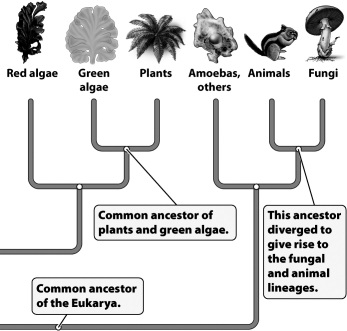
(Multiple Choice)
4.9/5 (80)
(80) All of the following sources of information except _____ can be used to construct evolutionary trees.
(Multiple Choice)
4.8/5 (92)
(92) ____________________ is the science of naming and classifying organisms within the Linnaean hierarchy.
(Short Answer)
4.7/5 (86)
(86) When success is defined as the greatest number of living individuals, Earth's most successful inhabitants are the
(Multiple Choice)
4.9/5 (92)
(92) Canis latrans is the scientific name for the coyote. The term Canis represents the coyotes'
(Multiple Choice)
4.9/5 (77)
(77) In addition to the Bacteria, which other kingdom is comprised exclusively of prokaryotic organisms?
(Multiple Choice)
5.0/5 (84)
(84) The organisms found living inside boiling-hot geysers can be described as thermophiles.
(True/False)
4.8/5 (57)
(57) The photograph below shows Sulfolubus, an archaean that lives in environments with very high temperatures. 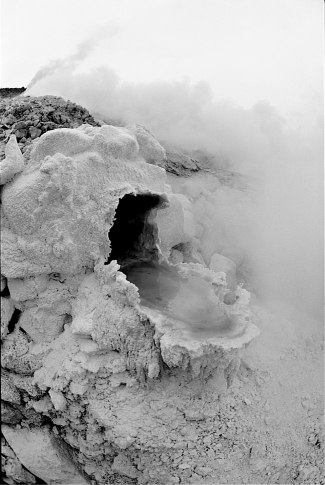 What hypothesis can explain the extreme habitats of the archaeans?
 (Multiple Choice)
5.0/5 (79)
(79) Archaea, Bacteria, and Eukarya are the three biological domains.
(True/False)
4.9/5 (91)
(91) Using the simplest methods to study the composition of intestinal microbial flora, it is necessary to collect a ____________________ sample from the subject.
(Short Answer)
4.9/5 (68)
(68) Examine the evolutionary tree pictured below. 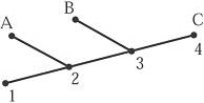 In this evolutionary tree, which number represents the most recent common ancestor of A, B, and C?
 (Multiple Choice)
4.8/5 (67)
(67) Taxonomy is the subdiscipline in biology that classifies living organisms; at the present time
(Multiple Choice)
4.8/5 (76)
(76) Evolutionary tree diagrams representing the relationships between various organisms can be drawn only when those organisms share a
(Multiple Choice)
4.7/5 (67)
(67) Which of the following statements about modern classification is not correct?
(Multiple Choice)
5.0/5 (86)
(86) 
Filters
- Essay(0)
- Multiple Choice(0)
- Short Answer(0)
- True False(0)
- Matching(0)