



 Chat with AI
Exam 2: Biological Diversity, Bacteria, and Archaea

Exam 1: The Nature of Science and the Characteristics of Life82 Questions
Exam 2: Biological Diversity, Bacteria, and Archaea101 Questions
Exam 3: Protista, Plantae, and Fungi83 Questions
Exam 4: Animalia81 Questions
Exam 5: The Chemistry of Life92 Questions
Exam 6: Cell Structure and Internal Compartments87 Questions
Exam 7: Cell Membranes, Transport, and Communication85 Questions
Exam 8: Energy, Metabolism, and Enzymes81 Questions
Exam 9: Photosynthesis and Cellular Respiration84 Questions
Exam 10: Cell Division89 Questions
Exam 11: Stem Cells, Cancer, and Human Health93 Questions
Exam 12: Patterns of Inheritance75 Questions
Exam 13: Chromosomes and Human Genetics75 Questions
Exam 14: Dna and Genes105 Questions
Exam 15: From Gene to Protein80 Questions
Exam 16: Dna Technology80 Questions
Exam 17: How Evolution Works80 Questions
Exam 18: Evolution of Populations80 Questions
Exam 19: Speciation and the Origins of Biological Diversity80 Questions
Exam 20: The Evolutionary History of Life100 Questions
Exam 21: The Biosphere89 Questions
Exam 22: Growth of Populations69 Questions
Exam 23: Ecological Communities133 Questions
Exam 24: Ecosystems75 Questions
Exam 25: Global Change70 Questions
Exam 26: Internal Organization and Homeostasis79 Questions
Exam 27: Nutrition and Digestion80 Questions
Exam 28: Circulation and Gas Exchange77 Questions
Exam 29: Animal Hormones78 Questions
Exam 30: Nervous and Sensory Systems78 Questions
Exam 31: Skeletons, Muscles, and Movement78 Questions
Exam 32: Defenses Against Disease78 Questions
Exam 33: Reproduction and Development76 Questions
Exam 34: Animal Behavior76 Questions
Exam 35: Plant Structure, Nutrition, and Transport80 Questions
Exam 36: Plant Growth and Reproduction80 Questions
Select questions type


Which of the following events occurred between each branch on an evolutionary tree?
(Multiple Choice)
4.9/5  (79)
(79) Which of the following terms describes organisms that can survive in extremely salty environments?
(Multiple Choice)
4.8/5 (85)
(85) Infective bacteria are usually too large to enter cells but can cause pathology by releasing an ____________________ that kills adjacent tissues.
(Short Answer)
4.8/5 (86)
(86) Wetland soils are saturated with water and devoid of oxygen creating a habitat ideally suited for ____________________ prokaryotes.
(Short Answer)
4.9/5 (99)
(99) The organisms most distant from the base of an evolutionary tree are
(Multiple Choice)
4.8/5 (87)
(87) A disproportionate number of viral infections occur in the respiratory and digestive systems; how might this be explained?
(Multiple Choice)
4.8/5 (75)
(75) Viral classification and biology has been challenging; presently most biologists agree that viruses
(Multiple Choice)
4.8/5 (84)
(84) ____________________ are diagrams that show the relationships between various organisms as indicated by DNA analysis or comparative studies on body form, physiology, or behavior.
(Short Answer)
4.8/5 (79)
(79) The most commonly used classification system includes 12 kingdoms.
(True/False)
4.8/5 (79)
(79) Evolutionary trees can be used to predict the behavior of organisms.
(True/False)
4.8/5 (66)
(66) The group with the greatest diversity in the strategies used to obtain carbon and energy is the
(Multiple Choice)
4.9/5 (79)
(79) Convergence is an evolutionary process that produces similar but not shared derived traits in organisms having common life histories but not common ancestors; which of the pairs of features is not convergent?
(Multiple Choice)
4.9/5 (91)
(91) What do these products have in common-soy sauce, yogurt, swiss cheese, and buttermilk?
(Multiple Choice)
4.9/5 (85)
(85) The workers shown in the photograph below are involved in bioremediation; what explanation could account for their specific actions? 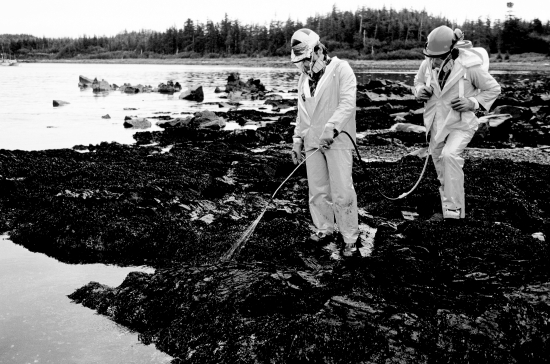
(Multiple Choice)
4.8/5 (80)
(80) With the exception of the _____ the following kingdoms are placed within the domain Eukarya.
(Multiple Choice)
4.8/5 (86)
(86) The Linnaean hierarchy goes from species to genus to family to order to ____________________ to phylum to kingdom.
(Short Answer)
4.8/5 (76)
(76) Fossil evidence suggests that the ____________________ were the first eukaryotic group to evolve.
(Short Answer)
4.8/5 (81)
(81) During ____________________ bacteria trade small sections of plasmid DNA with one another.
(Short Answer)
4.7/5 (77)
(77) 
Filters
- Essay(0)
- Multiple Choice(0)
- Short Answer(0)
- True False(0)
- Matching(0)