



 Chat with AI
Exam 8: Imperfect Competition

Exam 1: Introduction to Game Theory35 Questions
Exam 2: Noncooperative, One-Time, Static Games86 Questions
Exam 3: Focal-Point and Evolutionary Equilibria32 Questions
Exam 4: Infinitely-Repeated, Static Games37 Questions
Exam 5: Finitely-Repeated, Static Games40 Questions
Exam 6: Mixing Pure Strategies51 Questions
Exam 7: Static Games With Continuous Strategies24 Questions
Exam 8: Imperfect Competition52 Questions
Exam 9: Perfect Competition and Monopoly33 Questions
Exam 10: Strategic Trade Policy35 Questions
Exam 11: Dynamic Games With Complete47 Questions
Exam 12: Bargaining54 Questions
Exam 13: Pure Strategies With Uncertain Payoffs65 Questions
Exam 14: Torts and Contracts45 Questions
Exam 15: Auctions44 Questions
Exam 16: Dynamic Games With Incomplete Information34 Questions
Select questions type


As a practical matter, which of the following predictions of the Bertrand model appear to be unrealistic:
(Multiple Choice)
4.7/5  (69)
(69) Suppose that an industry consists of two firms producing an identical product in which there is no brand loyalty by consumers. The inverse market demand for the combined output of both firms is P = 5 !0.001 (QA + QB). The marginal cost of production by firm A and firm B are $2 and $1, respectively. Firm A produces:
(Multiple Choice)
5.0/5 (79)
(79) Strategic interaction:
I. Is more pronounced the larger the number of firms in an industry.
II. Is a distinguishing characteristic of industries with a large number of firms, but in which a relatively few large firms account for a large proportion of industry output.
III. Is more pronounced the fewer the number of firms in an industry.
Which of the following is correct?
(Multiple Choice)
4.9/5 (70)
(70) As a practical matter, which of the following predictions of the Bertrand model appear to be unrealistic:
(Multiple Choice)
4.8/5 (63)
(63) The Cournot model suggests, ceteris paribus, that the profit-maximizing price will be:
(Multiple Choice)
4.9/5 (74)
(74) 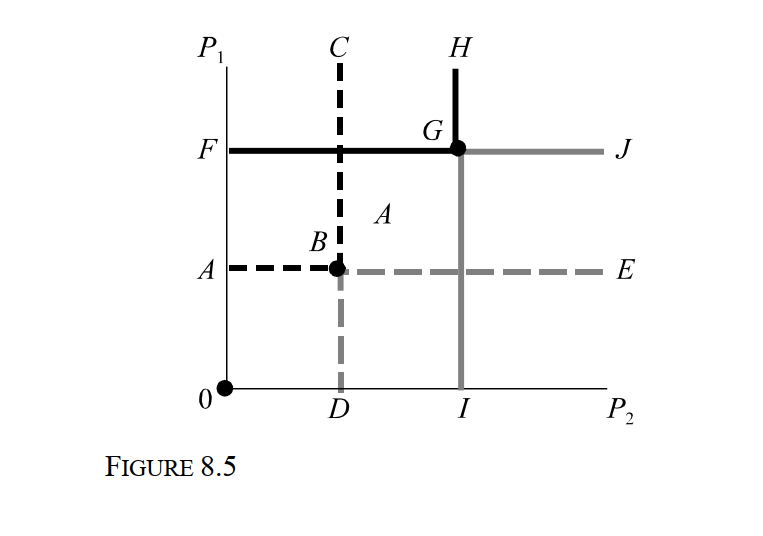 -Refer to Figure 8.5, which depicts two firms engaged in Bertrand price competition in markets X and Y. The two firms have the same marginal cost of production in each market, although marginal cost is not is not the same in both markets. The reaction functions of firms 1 and 2 in market X are ABC and DBE, respectively. The reaction functions of firms 1 and 2 in market Y are given by the line segments FGH and IGJ, respectively. The marginal cost of production of both firms in market X is:
 (Multiple Choice)
4.7/5 (78)
(78)  -Consider Figure 8.3, which depicts two firms producing a homogeneous product at the same constant marginal cost. According to the Bertrand model, firm 1's reaction function is given by the line segment:
 (Multiple Choice)
4.9/5 (79)
(79)
-Consider Figure 8.3, which depicts two firms producing a homogeneous product at the same constant marginal cost. According to the Bertrand model, the marginal cost of production for both firms is:
-Consider Figure 8.3, which depicts two firms producing a homogeneous product at the same constant marginal cost. According to the Bertrand model, the marginal cost of production for both firms is: (Multiple Choice)
4.8/5 (88)
(88) The unrealistic predictions of the simple Bertrand model may be explained by the assumption of:
(Multiple Choice)
4.9/5 (73)
(73) 
Filters
- Essay(0)
- Multiple Choice(0)
- Short Answer(0)
- True False(0)
- Matching(0)