



 Chat with AI
Exam 8: Imperfect Competition

Exam 1: Introduction to Game Theory35 Questions
Exam 2: Noncooperative, One-Time, Static Games86 Questions
Exam 3: Focal-Point and Evolutionary Equilibria32 Questions
Exam 4: Infinitely-Repeated, Static Games37 Questions
Exam 5: Finitely-Repeated, Static Games40 Questions
Exam 6: Mixing Pure Strategies51 Questions
Exam 7: Static Games With Continuous Strategies24 Questions
Exam 8: Imperfect Competition52 Questions
Exam 9: Perfect Competition and Monopoly33 Questions
Exam 10: Strategic Trade Policy35 Questions
Exam 11: Dynamic Games With Complete47 Questions
Exam 12: Bargaining54 Questions
Exam 13: Pure Strategies With Uncertain Payoffs65 Questions
Exam 14: Torts and Contracts45 Questions
Exam 15: Auctions44 Questions
Exam 16: Dynamic Games With Incomplete Information34 Questions
Select questions type


 -Consider Figure 8.2, which depicts two firms producing a homogeneous product at the same constant marginal cost. According to the Bertrand model, the marginal cost of production for both firms is:
 (Multiple Choice)
4.7/5  (80)
(80)
-Consider Figure 8.2, which depicts two firms producing a homogeneous product at the same constant marginal cost. According to the Bertrand model, firm 2's reaction function is given by the line segment:
-Consider Figure 8.2, which depicts two firms producing a homogeneous product at the same constant marginal cost. According to the Bertrand model, firm 2's reaction function is given by the line segment: (Multiple Choice)
4.8/5 (73)
(73)  -Consider Figure 8.3, which depicts two firms producing a homogeneous product at the same constant marginal cost. According to the Bertrand model, firm 2's reaction function is given by the line segment:
 (Multiple Choice)
4.9/5 (68)
(68) 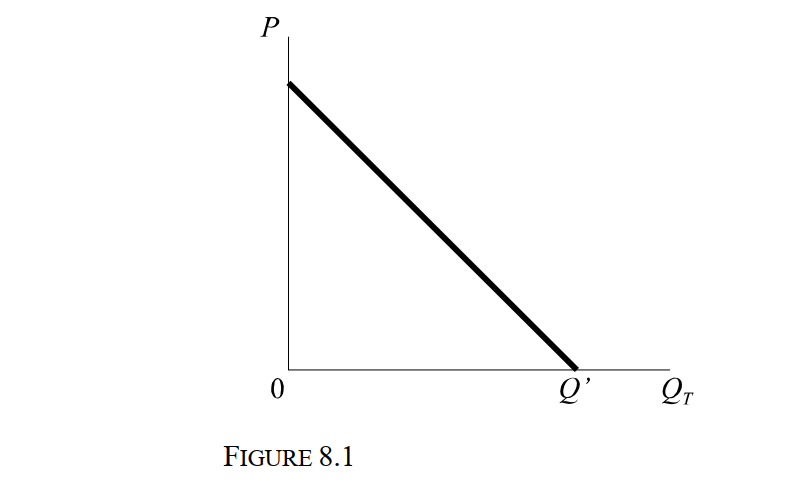 -Figure 8.1 depicts the market demand for the product produced by n firms producing an identical product in which MC = 0 for each firm. If Q' = 100,000 and total industry output is 95,000 units, there are _____ in the industry according to the Cournot model.
 (Multiple Choice)
4.9/5 (79)
(79)
-Consider Figure 8.2, which depicts two firms producing a homogeneous product at the same constant marginal cost. According to the Bertrand model, firm 1's reaction function is given by the line segment:
-Consider Figure 8.2, which depicts two firms producing a homogeneous product at the same constant marginal cost. According to the Bertrand model, firm 1's reaction function is given by the line segment: (Multiple Choice)
4.8/5 (80)
(80) According to the Bertrand model, if both firms in the industry face identical demands but different marginal production costs, then:
(Multiple Choice)
4.7/5 (84)
(84) 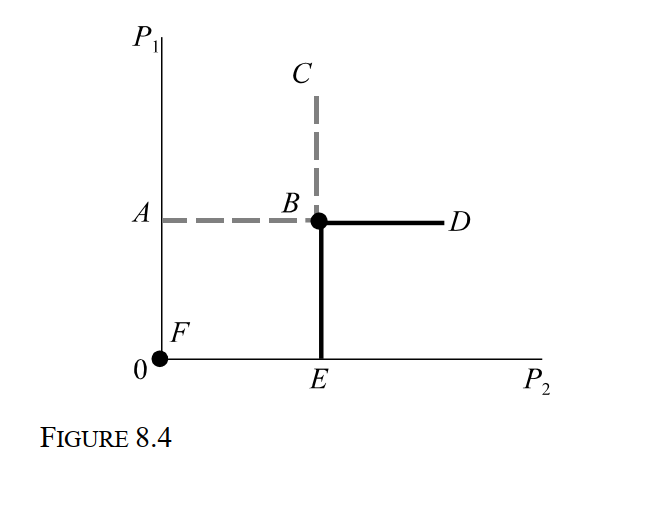 -Consider Figure 8.4 which depicts two firms producing a homogeneous product at the same constant marginal cost. According to the Bertrand model, firm 1's reaction function is given by the line segment:
 (Multiple Choice)
4.8/5 (76)
(76)
-Consider Figure 8.3, which depicts two firms producing a homogeneous product at the same constant marginal cost. The Bertrand-Nash equilibrium:
-Consider Figure 8.3, which depicts two firms producing a homogeneous product at the same constant marginal cost. The Bertrand-Nash equilibrium: (Multiple Choice)
4.7/5 (81)
(81) If Bertrand competitors cannot differentiate their products, whichever firm sets the higher price will:
(Multiple Choice)
4.8/5 (94)
(94) Suppose that an industry consists of two firms producing an identical product in which there is no brand loyalty by consumers. The inverse market demand for the combined output of both firms is P = 5 !0.001 (QA + QB). The marginal cost of production by firm A and firm B are $2 and $1, respectively. Firm B produces:
(Multiple Choice)
4.9/5 (71)
(71) Suppose that an industry consists of two firms producing an identical product in which there is no brand loyalty by consumers. The inverse market demand for the combined output of both firms is P = 5 !0.001 (QA + QB). The marginal cost of production by firm A and firm B are $2 and $1, respectively. Firm B's best-response function is:
(Multiple Choice)
4.8/5 (72)
(72)
-Figure 8.1 depicts the market demand for the product produced by n firms producing an identical product in which the marginal cost of production for each firm is MC = 0. According to the Cournot model, total industry output is (QT) is given by the equation:
-Figure 8.1 depicts the market demand for the product produced by n firms producing an identical product in which the marginal cost of production for each firm is MC = 0. According to the Cournot model, total industry output is (QT) is given by the equation: (Multiple Choice)
4.8/5 (87)
(87)
-Consider Figure 8.2, which depicts two firms producing a homogeneous product at the same constant marginal cost. The Bertrand-Nash equilibrium:
-Consider Figure 8.2, which depicts two firms producing a homogeneous product at the same constant marginal cost. The Bertrand-Nash equilibrium: (Multiple Choice)
4.9/5 (79)
(79) Suppose that an industry consists of two firms producing an identical product in which there is no brand loyalty by consumers. The inverse market demand for the combined output of both firms is P = 5 !0.001 (QA + QB). The marginal cost of production by firm A and firm B are $2 and $1, respectively. Firm A's best-response function is:
(Multiple Choice)
4.9/5 (69)
(69)
-Consider Figure 8.4 which depicts two firms producing a homogeneous product at the same constant marginal cost. According to the Bertrand model, firm 2's reaction function is given by the line segment:
-Consider Figure 8.4 which depicts two firms producing a homogeneous product at the same constant marginal cost. According to the Bertrand model, firm 2's reaction function is given by the line segment: (Multiple Choice)
4.8/5 (88)
(88) Suppose that there are four identical firms in an industry. The Cournot model predicts that the output of each firm will be:
(Multiple Choice)
4.9/5 (88)
(88) Other things being equal, the Cournot model suggests that profit-maximizing firms in an oligopolistic industry:
I. Charge a higher price than monopolies.
II. Charge a higher price than perfectly-competitive firms.
III. Charge a lower price than monopolies.
IV. Charge a lower price than perfectly-competitive firms.
Which of the following is correct?
(Multiple Choice)
4.9/5 (93)
(93) 
Filters
- Essay(0)
- Multiple Choice(0)
- Short Answer(0)
- True False(0)
- Matching(0)