



 Chat with AI
Exam 14: Banking and the Money Supply.

Exam 1: The Art and Science of Economic Analysis.203 Questions
Exam 2: Economic Tools and Economic Systems.209 Questions
Exam 3: Economic Decision Makers.225 Questions
Exam 4: Demand, Supply, and Markets.205 Questions
Exam 5: Introduction to Macroeconomics.201 Questions
Exam 6: Tracking the U. S. Economy.211 Questions
Exam 7: Unemployment and Inflation.199 Questions
Exam 8: Productivity and Growth.200 Questions
Exam 9: Aggregate Demand.200 Questions
Exam 10: Aggregate Supply.202 Questions
Exam 11: Fiscal Policy.202 Questions
Exam 12: Federal Budgets and Public Policy.203 Questions
Exam 13: Money and the Financial System.201 Questions
Exam 14: Banking and the Money Supply.200 Questions
Exam 15: Monetary Theory and Policy.200 Questions
Exam 16: Macro Policy Debate: Active or Passive?198 Questions
Exam 17: International Trade.200 Questions
Exam 18: International Finance.195 Questions
Exam 19: Economic Development.200 Questions
Select questions type


Suppose the reserve requirement ratio is 20 percent. Assuming no bank holds excess reserves and nobody withdraws cash, a $10,000 injection of new reserves by the Fed could create _____
(Multiple Choice)
4.9/5  (67)
(67) In the money and credit expansion process, the total change in checkable deposits is equal to the initial change in excess reserves _____
(Multiple Choice)
4.8/5 (83)
(83) Table 14.2
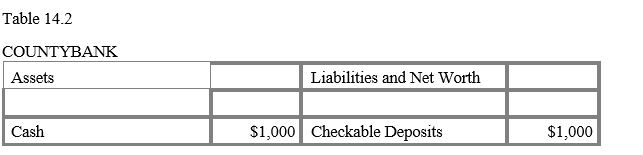 -Refer to Table 14.2 for the balance sheet of Countybank. If the required reserve ratio is 10 percent, this bank alone can now increase its lending by _____
 (Multiple Choice)
5.0/5 (98)
(98) Suppose checking deposits increase by $6,000 after all rounds of the money-creation process when the Fed buys $1,200 worth of U.S. government securities. This implies that the maximum value of the required reserve ratio would be _____
(Multiple Choice)
4.9/5 (82)
(82) If the Fed wishes to reduce the money supply, it can sell U.S. government securities to member banks.
(True/False)
4.8/5 (81)
(81) Suppose the Fed sells $10 million in government securities to a commercial bank. If the required reserve ratio is 0.2, what is the maximum amount by which checkable deposits in the banking system can change?
(Multiple Choice)
4.8/5 (88)
(88) Asymmetric information in financial markets exists when _____
(Multiple Choice)
4.8/5 (72)
(72) If a bank's reserves are exactly equal to the required amount of reserves, then it has no excess reserves.
(True/False)
4.8/5 (84)
(84) Which of the following measures did the Fed take during the uncertain days following the terrorist attacks of September 11, 2001?
(Multiple Choice)
4.7/5 (80)
(80) If an increase of $10 million in excess reserves increases checkable deposits in the banking system by a maximum of $50 million, the required reserve ratio would be _____
(Multiple Choice)
4.9/5 (76)
(76) Table 14.3
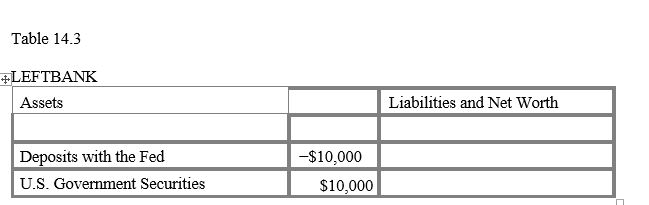 -Refer to Table 14.3 for the balance sheet of Leftbank. Leftbank's total reserves _____
 (Multiple Choice)
4.8/5 (84)
(84) Banks want to minimize their holdings of excess reserves because _____
(Multiple Choice)
4.8/5 (86)
(86) Suppose a bank has $6,000 in checkable deposits and the required reserve ratio is 0.2. If the bank wishes to hold no excess reserves, its actual reserves will be _____
(Multiple Choice)
4.8/5 (82)
(82) Suppose the Fed purchases $5,000 in U.S. government securities from the Last National Bank and the Last National Bank's account at the Federal Reserve district bank increases by $5,000. Which of the following is a result of this transaction?
(Multiple Choice)
4.9/5 (71)
(71) Banks differ from other types of businesses because banks _____
(Multiple Choice)
4.8/5 (72)
(72) If a bank borrows $1,000 from the Fed and lends it out, the bank sets in motion a process that will result in an expansion of the money supply by a multiple of that $1,000.
(True/False)
4.9/5 (61)
(61) Federal Reserve notes outstanding account for about _____ of Fed liabilities.
(Multiple Choice)
4.8/5 (74)
(74) 
Filters
- Essay(0)
- Multiple Choice(0)
- Short Answer(0)
- True False(0)
- Matching(0)