



 Chat with AI
Exam 14: Banking and the Money Supply.

Exam 1: The Art and Science of Economic Analysis.203 Questions
Exam 2: Economic Tools and Economic Systems.209 Questions
Exam 3: Economic Decision Makers.225 Questions
Exam 4: Demand, Supply, and Markets.205 Questions
Exam 5: Introduction to Macroeconomics.201 Questions
Exam 6: Tracking the U. S. Economy.211 Questions
Exam 7: Unemployment and Inflation.199 Questions
Exam 8: Productivity and Growth.200 Questions
Exam 9: Aggregate Demand.200 Questions
Exam 10: Aggregate Supply.202 Questions
Exam 11: Fiscal Policy.202 Questions
Exam 12: Federal Budgets and Public Policy.203 Questions
Exam 13: Money and the Financial System.201 Questions
Exam 14: Banking and the Money Supply.200 Questions
Exam 15: Monetary Theory and Policy.200 Questions
Exam 16: Macro Policy Debate: Active or Passive?198 Questions
Exam 17: International Trade.200 Questions
Exam 18: International Finance.195 Questions
Exam 19: Economic Development.200 Questions
Select questions type


If you know the required reserve ratio, then you know how much each bank is holding in reserves.
(True/False)
4.9/5  (82)
(82) Table 14.2
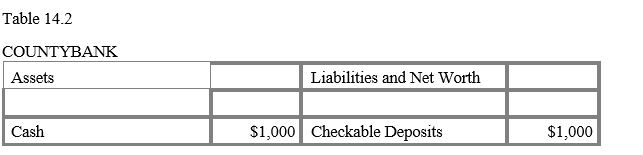 -Refer to Table 14.2 for the balance sheet of Countybank. Which of the following transactions is most likely to have just taken place at Countybank?
 (Multiple Choice)
4.8/5 (79)
(79) To obtain a charter, or the right to operate, a national bank must apply to the _____
(Multiple Choice)
5.0/5 (85)
(85) The actual money multiplier is smaller than the simple money multiplier because _____
(Multiple Choice)
4.9/5 (73)
(73) To prevent shortages of cash during a crisis, the Fed _____
(Multiple Choice)
5.0/5 (71)
(71) Savings deposits and time deposits are not included in M1 because these are not held by the nonbanking public.
(True/False)
4.9/5 (73)
(73) Money expansion stops when new reserves introduced into the banking system have been converted into _____
(Multiple Choice)
4.9/5 (68)
(68) Which of the following is not true of Federal Reserve notes?
(Multiple Choice)
4.8/5 (81)
(81) During the 2008 crisis, the Fed demanded interest payments on reserves held at the Fed.
(True/False)
4.9/5 (81)
(81) If the required reserve ratio is 5 percent, the simple money multiplier must be equal to _____
(Multiple Choice)
4.9/5 (77)
(77) If the simple money multiplier is 10, the required reserve ratio must be equal to _____
(Multiple Choice)
4.8/5 (74)
(74) Banks in need of reserves can borrow from the Fed or in the federal funds market.
(True/False)
4.7/5 (63)
(63) Which of the following would likely increase the money supply?
(Multiple Choice)
4.8/5 (77)
(77) When a check is cleared against Bank A after being deposited at Bank B, _____
(Multiple Choice)
4.8/5 (71)
(71) Table 14.1
Table
EUBANK
Assets Liabilities and Net Worth Deposits at the Fed \ 40,000 Checkable Deposits \ 500,000 Cash \ 10,000 Net Worth \ 20,000 Loans \ 300,000 Securities \ 150,000 Fed Stock \ 20,000
-Refer to Table 14.1 for the balance sheet of Eubank, which holds no excess reserves. Assume that the required reserve ratio is 10%. If a student deposits $10,000 in cash into his checkable deposit account, Eubank will have _____ in excess reserves.
(Multiple Choice)
4.9/5 (85)
(85) When the Fed buys U.S. government securities from a member bank, _____
(Multiple Choice)
4.9/5 (74)
(74) 
Filters
- Essay(0)
- Multiple Choice(0)
- Short Answer(0)
- True False(0)
- Matching(0)