



 Chat with AI
Exam 21: International Cash Management

Exam 1: Multinational Financial Management: An Overview79 Questions
Exam 2: International Flow of Funds74 Questions
Exam 3: International Financial Markets101 Questions
Exam 4: Exchange Rate Determination69 Questions
Exam 5: Currency Derivatives161 Questions
Exam 6: Government Influence on Exchange Rates116 Questions
Exam 7: International Arbitrage and Interest Rate Parity92 Questions
Exam 8: Relationships among Inflation, Interest Rates, and Exchange Rates59 Questions
Exam 9: Forecasting Exchange Rates84 Questions
Exam 10: Measuring Exposure to Exchange Rate Fluctuations82 Questions
Exam 11: Managing Transaction Exposure81 Questions
Exam 12: Managing Economic Exposure and Translation Exposure58 Questions
Exam 13: Direct Foreign Investment53 Questions
Exam 14: Multinational Capital Budgeting60 Questions
Exam 15: International Corporate Governance and Control72 Questions
Exam 16: Country Risk Analysis57 Questions
Exam 17: Multinational Cost of Capital and Capital Structure68 Questions
Exam 18: Long-Term Debt Financing53 Questions
Exam 19: Financing International Trade66 Questions
Exam 20: Short-Term Financing49 Questions
Exam 21: International Cash Management50 Questions
Select questions type


Leading refers to paying for supplies earlier than necessary; lagging refers to delaying the payment for supplies.
(True/False)
4.8/5  (79)
(79) In what is known as dynamic hedging, banks always hedge open positions in any foreign currencies.
(True/False)
4.7/5 (73)
(73) If interest rate parity does not hold, and the forward ____ is greater than the interest rate differential, then covered interest arbitrage is feasible for investors residing in the ____ country.
(Multiple Choice)
4.9/5 (100)
(100) The Mexican one-year interest rate is 9 percent, while the U.S. one-year interest rate is 3 percent. Assume that interest rate parity exists. If a U.S. uses the forward rate to forecast the exchange rate of the peso in one year, the expected effective yield from investing in a one-year deposit in Mexico is:
(Multiple Choice)
4.9/5 (94)
(94) According to ____, the effective yield earned by U.S. investors will be the same as the effective yield earned by non-U.S. investors in any given period.
(Multiple Choice)
5.0/5 (86)
(86) An MNC that uses a strategy of dynamic hedging will apply a hedge it expects a foreign currency that it holds to appreciate, and it will remove the hedge when it expects the currency to depreciate.
(True/False)
4.7/5 (71)
(71) If a foreign currency consistently depreciated against the dollar over several periods and had lower interest rates at the beginning of those periods than the U.S. interest rates, then:
(Multiple Choice)
4.8/5 (90)
(90) Exhibit 21-1
To benefit from the low correlation between the Trinidad dollar and the Japanese yen (¥), Sciorra Corporation decides to invest 50 percent of total funds invested in Trinidad dollars and the remainder in yen. The domestic yield on a one-year deposit is 8 percent. The Trinidad one-year interest rate is 10 percent, and the Japanese one-year interest rate is 7 percent. Sciorra has determined the following possible percentage changes in the two individual currencies as follows:
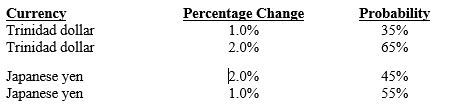 -Refer to Exhibit 21-1 above. What is the probability that the yield of the two-currency portfolio is less than the domestic yield?
 (Multiple Choice)
4.8/5 (83)
(83) In a bilateral netting system, transactions between the parent and a subsidiary or between two subsidiaries are consolidated over a specific period of time.
(True/False)
4.8/5 (86)
(86) The effective yield of investing in a foreign currency depends on both the ____ and the ____ of the foreign currency.
(Multiple Choice)
4.7/5 (64)
(64) A subsidiary will normally have a more difficult time forecasting future outflow payments if its purchases are international rather than domestic.
(True/False)
4.9/5 (96)
(96) Assume that a U.S. investor invests in a British CD offering a six-month interest rate of 5 percent. Over this six-month period, the pound depreciates by 9 percent. The effective yield on the British CD for the U.S. investor is:
(Multiple Choice)
4.9/5 (85)
(85) A common purpose of intersubsidiary leading or lagging strategies is to:
(Multiple Choice)
4.8/5 (69)
(69) Although netting typically increases the need for foreign exchange conversion, it generally reduces the number of cross-border transactions between subsidiaries.
(True/False)
4.8/5 (74)
(74) Assume the U.S. one-year interest rate is 5 percent, while the South African one-year interest rate is 13 percent. If a U.S. firm invests in a South African one-year deposit, and the South African rand remains constant over the next year, the U.S. firm will earn an effective yield of:
(Multiple Choice)
4.7/5 (73)
(73) 
Filters
- Essay(0)
- Multiple Choice(0)
- Short Answer(0)
- True False(0)
- Matching(0)