



 Chat with AI
Exam 20: Short-Term Financing

Exam 1: Multinational Financial Management: An Overview79 Questions
Exam 2: International Flow of Funds74 Questions
Exam 3: International Financial Markets101 Questions
Exam 4: Exchange Rate Determination69 Questions
Exam 5: Currency Derivatives161 Questions
Exam 6: Government Influence on Exchange Rates116 Questions
Exam 7: International Arbitrage and Interest Rate Parity92 Questions
Exam 8: Relationships among Inflation, Interest Rates, and Exchange Rates59 Questions
Exam 9: Forecasting Exchange Rates84 Questions
Exam 10: Measuring Exposure to Exchange Rate Fluctuations82 Questions
Exam 11: Managing Transaction Exposure81 Questions
Exam 12: Managing Economic Exposure and Translation Exposure58 Questions
Exam 13: Direct Foreign Investment53 Questions
Exam 14: Multinational Capital Budgeting60 Questions
Exam 15: International Corporate Governance and Control72 Questions
Exam 16: Country Risk Analysis57 Questions
Exam 17: Multinational Cost of Capital and Capital Structure68 Questions
Exam 18: Long-Term Debt Financing53 Questions
Exam 19: Financing International Trade66 Questions
Exam 20: Short-Term Financing49 Questions
Exam 21: International Cash Management50 Questions
Select questions type


A negative effective financing rate implies that the U.S. firm actually paid less to repay the loan than it borrowed.
(True/False)
4.8/5  (75)
(75) Exhibit 20-1
Assume a U.S.-based MNC is borrowing Romanian leu at an interest rate of 8 percent for one year. Also assume that the spot rate of the leu is $.00012 and the one-year forward rate of the leu is $.00010. The expected spot rate of the leu one-year from now is $.00011.
-Refer to Exhibit 20-1 above. What is the effective financing rate for the MNC assuming it borrows leu on an uncovered basis?
(Multiple Choice)
5.0/5 (84)
(84) If interest rate parity exists, financing with a foreign currency may still be feasible, but it would have to be conducted on an uncovered basis (i.e., without use of a forward hedge).
(True/False)
4.9/5 (73)
(73) One reason an MNC may consider foreign financing is that the proceeds could be used to offset a foreign net payables position.
(True/False)
4.9/5 (89)
(89) Assume the U.S. financing rate is 10 percent and that the financing rate in Germany is 9 percent. The expected cost of financing in dollars and financing in euros next year would be the same if the euro is expected to ____.
(Multiple Choice)
4.7/5 (78)
(78) Exhibit 20-2
Luzar Corporation decides to borrow 50 percent of funds needed in Canadian dollars and the remainder in yen. The U.S. (domestic) financing rate for a one-year loan is 7 percent. The Canadian one-year interest rate is 6 percent, and the Japanese one-year interest rate is 10 percent. Luzar has determined the following possible percentage changes in the two individual currencies as follows:
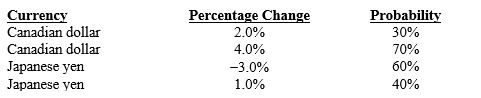 -Refer to Exhibit 20-2 above. What is the expected effective financing rate of the portfolio Luzar is contemplating (assume the two currencies move independently from one another)?
 (Multiple Choice)
4.9/5 (75)
(75) A firm without any exposure to foreign exchange rates would likely increase this exposure the most by:
(Multiple Choice)
4.9/5 (85)
(85) Exhibit 20-2
Luzar Corporation decides to borrow 50 percent of funds needed in Canadian dollars and the remainder in yen. The U.S. (domestic) financing rate for a one-year loan is 7 percent. The Canadian one-year interest rate is 6 percent, and the Japanese one-year interest rate is 10 percent. Luzar has determined the following possible percentage changes in the two individual currencies as follows:
-Refer to Exhibit 20-2 above. What is the probability that the financing rate of the two-currency portfolio is less than the domestic financing rate?
-Refer to Exhibit 20-2 above. What is the probability that the financing rate of the two-currency portfolio is less than the domestic financing rate? (Multiple Choice)
4.8/5 (82)
(82) The effective financing rate of financing in a foreign currency depends on the ______ over the loan period and the ______ over the loan period.
(Multiple Choice)
4.8/5 (70)
(70) 
Filters
- Essay(0)
- Multiple Choice(0)
- Short Answer(0)
- True False(0)
- Matching(0)