



 Chat with AI
Exam 14: Multinational Capital Budgeting

Exam 1: Multinational Financial Management: An Overview79 Questions
Exam 2: International Flow of Funds74 Questions
Exam 3: International Financial Markets101 Questions
Exam 4: Exchange Rate Determination69 Questions
Exam 5: Currency Derivatives161 Questions
Exam 6: Government Influence on Exchange Rates116 Questions
Exam 7: International Arbitrage and Interest Rate Parity92 Questions
Exam 8: Relationships among Inflation, Interest Rates, and Exchange Rates59 Questions
Exam 9: Forecasting Exchange Rates84 Questions
Exam 10: Measuring Exposure to Exchange Rate Fluctuations82 Questions
Exam 11: Managing Transaction Exposure81 Questions
Exam 12: Managing Economic Exposure and Translation Exposure58 Questions
Exam 13: Direct Foreign Investment53 Questions
Exam 14: Multinational Capital Budgeting60 Questions
Exam 15: International Corporate Governance and Control72 Questions
Exam 16: Country Risk Analysis57 Questions
Exam 17: Multinational Cost of Capital and Capital Structure68 Questions
Exam 18: Long-Term Debt Financing53 Questions
Exam 19: Financing International Trade66 Questions
Exam 20: Short-Term Financing49 Questions
Exam 21: International Cash Management50 Questions
Select questions type


The required rate of return of a project is ____ the MNC's cost of capital.
(Multiple Choice)
4.9/5  (78)
(78) If a host government restricts the remittances from a foreign subsidiary, a possible solution is to let the subsidiary obtain partial financing for the project.
(True/False)
4.9/5 (65)
(65) Holding other factors constant, an international project's NPV is ____ related to consumer demand and ____ related to the project's salvage value.
(Multiple Choice)
4.9/5 (91)
(91) Like income tax treaties, ____ help to avoid double taxation and stimulate direct foreign investment.
(Multiple Choice)
4.9/5 (76)
(76) When assessing a German project administered by a German subsidiary of a U.S.-based MNC solely from the German subsidiary's perspective, which variable will most likely influence the capital budgeting analysis?
(Multiple Choice)
4.8/5 (79)
(79) A foreign project generates a negative cash flow in Year 1 and positive cash flows in Years 2 through 5. The NPV for this project will be higher if the foreign currency ____ in Year 1 and ____ in Years 2 through 5.
(Multiple Choice)
4.8/5 (81)
(81) Three common methods to incorporate an adjustment for risk into the capital budgeting analysis are the use of risk-adjusted discount rates, sensitivity analysis, and simulation.
(True/False)
4.9/5 (85)
(85) Exhibit 14-1
Assume that Baps Corp. is considering the establishment of a subsidiary in Norway. The initial investment required by the parent is $5 million. If the project is undertaken, Baps would terminate the project aFter four years. Baps's cost of capital is 13 percent, and the project has the same risk as Baps's existing projects. All cash flows generated from the project will be remitted to the parent at the end of each year. Listed below are the estimated cash flows the Norwegian subsidiary will generate over the project's lifetime in Norwegian kroner (NOK):
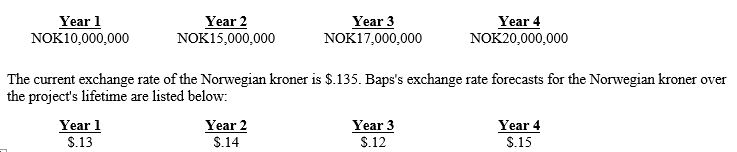 -Refer to Exhibit 14-1. Assume that NOK8,000,000 of the cash flow in Year 4 represents the salvage value. Baps is not completely certain that the salvage value will be this amount and wishes to determine the break-even salvage value, which is $____.
 (Multiple Choice)
4.9/5 (84)
(84) In general, increased investment by the parent in the foreign subsidiary causes more exchange rate exposure to the parent over time because the cash flows remitted to the parent will be larger.
(True/False)
4.9/5 (81)
(81) If a U.S. parent is setting up a French subsidiary, and funds from the subsidiary will be periodically sent to the parent, the ideal situation from the parent's perspective is a ____ aFter the subsidiary is established.
(Multiple Choice)
4.7/5 (86)
(86) If the parent charges the subsidiary administrative fees, the earnings from the project will appear low to the parent and high to the subsidiary.
(True/False)
4.8/5 (67)
(67) Fixed costs are expenses that are not affected by consumer demand, so they can be estimated without an estimate of that demand when doing multinational capital budgeting.
(True/False)
4.8/5 (82)
(82) A U.S.-based MNC has just established a subsidiary in Algeria. Shortly aFter the plant was built, the MNC determines that its exchange rate forecasts, which had previously indicated a slight appreciation in the Algerian dinar, were probably false. Instead of a slight appreciation, the MNC now expects that the dinar will depreciate substantially due to political turmoil in Algeria. This new development would likely cause the MNC to ____ its estimate of the previously computed net present value.
(Multiple Choice)
4.9/5 (91)
(91) Assuming that a subsidiary is wholly owned, the subsidiary's perspective is appropriate in attempting to determine whether a project will enhance the firm's value.
(True/False)
4.9/5 (81)
(81) Blocked funds may penalize a project if the return on the forced reinvestment in the foreign country is less than the required rate of return on the project.
(True/False)
4.9/5 (89)
(89) If the parent's perspective is used in analyzing a multinational project, the relevant cash flows are the dollars ultimately received by the parent as a result of the project; the relevant initial outlay is the investment by the parent.
(True/False)
4.9/5 (72)
(72) If the parent's government imposes a ____ tax rate on funds remitted from a foreign subsidiary, a project is less likely to be feasible from the ____ point of view.
(Multiple Choice)
4.9/5 (73)
(73) The impact of blocked funds on the net present value of a foreign project will be greater if interest rates are ____ in the host country and there are ____ investment opportunities in the host country.
(Multiple Choice)
4.8/5 (84)
(84) The required rate of return used to discount the relevant cash flows from a foreign project may differ from the MNC's cost of capital because of that particular project's risk.
(True/False)
4.9/5 (71)
(71) If a foreign project is financed with a subsidiary's retained earnings, the subsidiary's investment could be viewed as an opportunity cost, since the funds could be remitted to the parent rather than invested in the foreign project.
(True/False)
4.8/5 (78)
(78) 
Filters
- Essay(0)
- Multiple Choice(0)
- Short Answer(0)
- True False(0)
- Matching(0)