



 Chat with AI
Exam 8: Relationships among Inflation, Interest Rates, and Exchange Rates

Exam 1: Multinational Financial Management: An Overview79 Questions
Exam 2: International Flow of Funds74 Questions
Exam 3: International Financial Markets101 Questions
Exam 4: Exchange Rate Determination69 Questions
Exam 5: Currency Derivatives161 Questions
Exam 6: Government Influence on Exchange Rates116 Questions
Exam 7: International Arbitrage and Interest Rate Parity92 Questions
Exam 8: Relationships among Inflation, Interest Rates, and Exchange Rates59 Questions
Exam 9: Forecasting Exchange Rates84 Questions
Exam 10: Measuring Exposure to Exchange Rate Fluctuations82 Questions
Exam 11: Managing Transaction Exposure81 Questions
Exam 12: Managing Economic Exposure and Translation Exposure58 Questions
Exam 13: Direct Foreign Investment53 Questions
Exam 14: Multinational Capital Budgeting60 Questions
Exam 15: International Corporate Governance and Control72 Questions
Exam 16: Country Risk Analysis57 Questions
Exam 17: Multinational Cost of Capital and Capital Structure68 Questions
Exam 18: Long-Term Debt Financing53 Questions
Exam 19: Financing International Trade66 Questions
Exam 20: Short-Term Financing49 Questions
Exam 21: International Cash Management50 Questions
Select questions type


If interest rate parity holds, then the one-year forward rate of a currency will be ____ the predicted spot rate of the currency in one year according to the international Fisher effect.
(Multiple Choice)
4.7/5  (82)
(82) The following regression analysis was conducted for the inflation rate information and exchange rate of the British pound:
Regression results indicate that a₀ = 0 and a₁ = 1. Therefore: 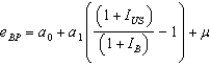
(Multiple Choice)
4.8/5 (70)
(70) Because there are sometimes no substitutes for traded goods, this will:
(Multiple Choice)
4.8/5 (80)
(80) Assume that the U.S. one-year interest rate is 5 percent and the one-year interest rate on euros is 8 percent. You have $100,000 to invest and you believe that the international Fisher effect (IFE) holds. The euro's spot exchange rate is $1.40. What will be the yield on your investment if you invest in euros?
(Multiple Choice)
4.9/5 (80)
(80) Latin American countries have historically experienced relatively high inflation, and their currencies have weakened. This information is somewhat consistent with the concept of:
(Multiple Choice)
5.0/5 (76)
(76) Because there are a variety of factors in addition to inflation that affect exchange rates, this will:
(Multiple Choice)
4.8/5 (76)
(76) According to the IFE, when the nominal interest rate at home exceeds the nominal interest rate in the foreign country, the home currency should depreciate.
(True/False)
4.9/5 (79)
(79) If purchasing power parity holds, then the Fisher effect must also hold.
(True/False)
4.9/5 (72)
(72) Assume U.S. and Swiss investors require a real rate of return of 3 percent. Assume the nominal U.S. interest rate is 6 percent and the nominal Swiss rate is 4 percent. According to the international Fisher effect, the franc will ____ by about ____.
(Multiple Choice)
5.0/5 (78)
(78) If interest rate parity holds, and the international Fisher effect (IFE) holds, foreign currencies with relatively high interest rates should have forward discounts, and those currencies would be expected to depreciate.
(True/False)
4.8/5 (88)
(88) According to the international Fisher effect (IFE), the exchange rate percentage change should be approximately equal to the differential in income levels between two countries.
(True/False)
4.9/5 (66)
(66) Which of the following theories suggests the percentage change in spot exchange rate of a currency should be equal to the interest rate differential between two countries?
(Multiple Choice)
4.9/5 (67)
(67) Purchasing power parity (PPP) focuses on the relationship between nominal interest rates and exchange rates between two countries.
(True/False)
4.7/5 (74)
(74) Among the reasons that purchasing power parity (PPP) does not consistently occur are:
(Multiple Choice)
4.9/5 (77)
(77) The following regression analysis was conducted for the inflation rate information and exchange rate of the British pound:
Regression results indicate that a₀ = 0 and a₁ = 2. Therefore: 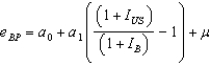
(Multiple Choice)
4.8/5 (88)
(88) Assume a two-country world: Country A and Country B. Which of the following is correct about purchasing power parity (PPP) as related to these two countries?
(Multiple Choice)
4.9/5 (76)
(76) Assume that the U.S. one-year interest rate is 3 percent and the one-year interest rate on Australian dollars is 6 percent. The U.S. expected annual inflation is 5 percent, while the Australian inflation is expected to be 7 percent. You have $100,000 to invest for one year and you believe that PPP holds. The spot exchange rate of an Australian dollar is $0.689. What will be the yield on your investment if you invest in the Australian market?
(Multiple Choice)
4.8/5 (82)
(82) The inflation rate in the United States is 4 percent, while the inflation rate in Japan is 1.5 percent. The current exchange rate for the Japanese yen (¥) is $0.0080. aFter supply and demand for the Japanese yen have adjusted according to purchasing power parity, the new exchange rate for the yen will be
(Multiple Choice)
4.7/5 (73)
(73) The international Fisher effect (IFE) suggests that the foreign currency will appreciate when:
(Multiple Choice)
4.9/5 (83)
(83) Which of the following theories suggests that the percentage difference between the forward rate and the spot rate depends on the interest rate differential between two countries?
(Multiple Choice)
4.9/5 (89)
(89) 
Filters
- Essay(0)
- Multiple Choice(0)
- Short Answer(0)
- True False(0)
- Matching(0)