



 Chat with AI
Exam 14: Galaxies

Exam 1: The Night Sky88 Questions
Exam 2: Light and Telescopes111 Questions
Exam 3: The Solar System109 Questions
Exam 4: Earth and Its Moon108 Questions
Exam 5: The Eight Planets112 Questions
Exam 6: Small Bodies in the Solar System108 Questions
Exam 7: Formation of Planetary Systems84 Questions
Exam 8: The Sun95 Questions
Exam 9: Measuring the Stars86 Questions
Exam 10: Star Formation and Evolution85 Questions
Exam 11: Stellar Explosions101 Questions
Exam 12: Black Holes77 Questions
Exam 13: The Milky Way Galaxy82 Questions
Exam 14: Galaxies98 Questions
Exam 15: Cosmology and the Universe98 Questions
Select questions type


Almost all active galactic nuclei seem to be involved in ________ with neighbors.
(Short Answer)
5.0/5  (92)
(92) While examining the spectrum of a galaxy you find all the hydrogen lines are shifted to longer wavelengths. This galaxy is
(Multiple Choice)
4.7/5 (77)
(77) That quasars were at cosmological distances yet appeared like ordinary faint stars meant
(Multiple Choice)
4.9/5 (80)
(80) Why does the Cepheid "standard candle" have limited usefulness beyond 100 Mpc?
(Multiple Choice)
4.7/5 (83)
(83) For nearby spirals, their rotation curves help measure both light and dark matter.
(True/False)
4.8/5 (85)
(85) Giant elliptical galaxies may be the result of ________ in the centers of rich clusters.
(Short Answer)
4.8/5 (80)
(80) According to Hubble's Law, the greater a galaxy's redshift, the
(Multiple Choice)
4.8/5 (74)
(74) Not only does the central engine of active galaxies and quasars require a black hole, but also ________ to provide the radiate energy.
(Multiple Choice)
4.9/5 (84)
(84) What are the common properties shared by most active galaxies and quasars? How do these properties lead to an understanding of the central engine?
(Essay)
5.0/5 (77)
(77) Discuss the population, size, and types of galaxies we find in our Local Group.
(Essay)
4.8/5 (82)
(82) Contrast the results of a collision between two spiral galaxies on their stars and their gas and dust clouds.
(Essay)
4.9/5 (75)
(75) According to Hubble's Law, a galaxy with a velocity of 25,000 km/s will be 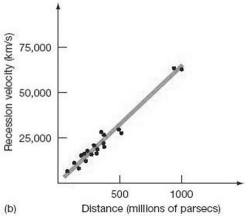
(Multiple Choice)
4.9/5 (55)
(55) Astronomers observe unobscured X-rays generated in active galactic nuclei.
(True/False)
4.9/5 (74)
(74) 
Filters
- Essay(0)
- Multiple Choice(0)
- Short Answer(0)
- True False(0)
- Matching(0)