



 Chat with AI
Exam 14: Galaxies

Exam 1: The Night Sky88 Questions
Exam 2: Light and Telescopes111 Questions
Exam 3: The Solar System109 Questions
Exam 4: Earth and Its Moon108 Questions
Exam 5: The Eight Planets112 Questions
Exam 6: Small Bodies in the Solar System108 Questions
Exam 7: Formation of Planetary Systems84 Questions
Exam 8: The Sun95 Questions
Exam 9: Measuring the Stars86 Questions
Exam 10: Star Formation and Evolution85 Questions
Exam 11: Stellar Explosions101 Questions
Exam 12: Black Holes77 Questions
Exam 13: The Milky Way Galaxy82 Questions
Exam 14: Galaxies98 Questions
Exam 15: Cosmology and the Universe98 Questions
Select questions type


Although theory says a massive black hole with an accretion disk should be emitting X-rays, many black holes emit

Free
(Multiple Choice)
4.9/5  (77)
(77) Correct Answer: Verified
A
Collisions between galaxies have little effect on the individual stars.
Free
(True/False)
4.9/5 (77)
(77) Correct Answer:Verified
VerifiedTrue
Why is Hubble's Law called the top of the distance ladder?
Free
(Essay)
5.0/5 (81)
(81) Correct Answer:Verified
VerifiedHubble's Law builds on the other distance measurement techniques, which are rungs on the distance ladder. Hubble's Law works at the very largest distances, making it the top of the ladder.
The smallest dwarf irregular galaxies are no richer in stars than the largest known globular clusters.
(True/False)
4.9/5 (70)
(70) Quasars usually have their distances measured by what technique?
(Multiple Choice)
4.9/5 (87)
(87) The Milky Way is often considered to be an intermediately wound, barred spiral, which would be type
(Multiple Choice)
5.0/5 (92)
(92) Which type of galaxy has a small bulge and loose, widely spread, poorly defined spiral pattern?
(Multiple Choice)
4.8/5 (77)
(77) In color photos, spirals typically have ________ arms with pink H II regions.
(Short Answer)
4.8/5 (92)
(92) Why is light variability a critical issue with the sizes of active nuclei?
(Essay)
4.9/5 (71)
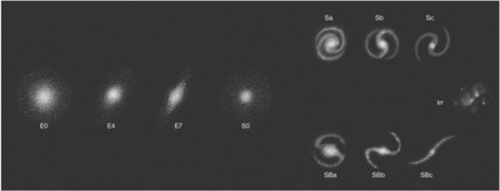
(71) 

Filters
- Essay(0)
- Multiple Choice(0)
- Short Answer(0)
- True False(0)
- Matching(0)