



 Chat with AI
Exam 20: International Trade Restrictions

Exam 1: The Wealth of Nations: Ownership and Economic Freedom87 Questions
Exam 2: Scarcity and Opportunity Costs87 Questions
Exam 3: The Market and Price System96 Questions
Exam 4: The Aggregate Economy61 Questions
Exam 5: National Income Accounting104 Questions
Exam 6: An Introduction to the Foreign Exchapterange Market and the Balance of Payments99 Questions
Exam 7: Unemployment and Inflation129 Questions
Exam 8: Macroeconomic Equilibrium: Aggregate Demand and Supply122 Questions
Exam 9: Aggregate Expenditures120 Questions
Exam 10: Income and Expenditures Equilibrium134 Questions
Exam 11: Fiscal Policy94 Questions
Exam 12: Money and Banking125 Questions
Exam 13: Monetary Policy141 Questions
Exam 14: Macroeconomic Policy: Tradeoffs, Expectations, Credibility, and Sources of Business Cycles117 Questions
Exam 15: Macroeconomic Viewpoints: New Keynesian, Monetarist, and New Classical103 Questions
Exam 16: Economic Growth95 Questions
Exam 17: Development Economics105 Questions
Exam 18: Globalization85 Questions
Exam 19: World Trade Equilibrium112 Questions
Exam 20: International Trade Restrictions109 Questions
Exam 21: Exchapterange Rates and Financial Links Between Countries132 Questions
Select questions type


Industries that are truly critical to the national defense should be protected from foreign competition if that is the only way to ensure their existence.
(True/False)
4.9/5  (79)
(79) In order to protect key industries, some countries impose taxes on their exports instead of imports, mainly because it is easier to collect taxes from the export industry.
(True/False)
4.9/5 (85)
(85) Suppose that the world price of kiwi fruit ($10 per box) is below the domestic price ($12 per box). A tariff of $1 per box would:
(Multiple Choice)
4.8/5 (71)
(71) The figure given below depicts the negatively sloped demand and positively sloped supply curves of wheat in a country.?Figure 20.2
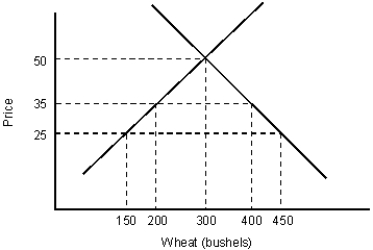 -In Figure 20.2, if the world price per bushel of wheat is $25, how much wheat will be imported?
 (Multiple Choice)
4.9/5 (81)
(81) The figure below shows the demand (D) and supply (S) curves of corn syrups.?Figure 20.3
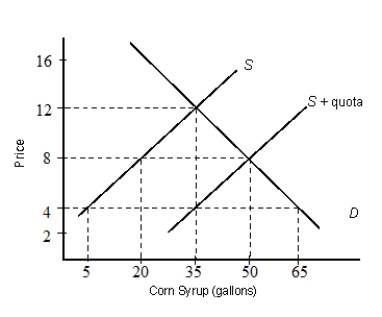 -In Figure 20.3, what are the equilibrium price and quantity in the absence of trade?
 (Multiple Choice)
4.7/5 (80)
(80) In a free trade area, member nations have no trade barriers among themselves but are free to set their own trade policies toward nonmembers.
(True/False)
4.9/5 (87)
(87) If an infant industry truly has a good chance to become competitive and produce profitably once it is well established, it is not at all clear that government should even offer protection to reduce short-run losses.
(True/False)
4.9/5 (93)
(93) If the world price of a good is lower than its domestic equilibrium price, the country will:
(Multiple Choice)
4.8/5 (87)
(87) The figure given below depicts the negatively sloped demand and positively sloped supply curves of wheat in a country.?Figure 20.2
-According to Figure 20.2, if the world price of wheat is $25 and a tariff of $25 is imposed by the domestic government, the total tariff revenue collected by the government is:
-According to Figure 20.2, if the world price of wheat is $25 and a tariff of $25 is imposed by the domestic government, the total tariff revenue collected by the government is: (Multiple Choice)
4.8/5 (74)
(74) According to strategic trade policy, international trade largely involves firms which:
(Multiple Choice)
4.8/5 (89)
(89) Many economists believe that the collapse of world trade and the depression in the 1930s were linked by a decrease in real income caused by producing on the basis of comparative advantage.
(True/False)
4.9/5 (74)
(74) The most successful free trade agreements achieve all of the following goals, except:
(Multiple Choice)
4.7/5 (91)
(91) The figure below shows the demand (D) and supply (S) curves of a good produced domestically in an economy as well as traded in the international market.?Figure 20.1??In the figure,?P₁: Price of the good in the international market.?P₂: Price of the good in the domestic market after the imposition of tariff by the government.?P₃: No-trade price of the good in the domestic market.
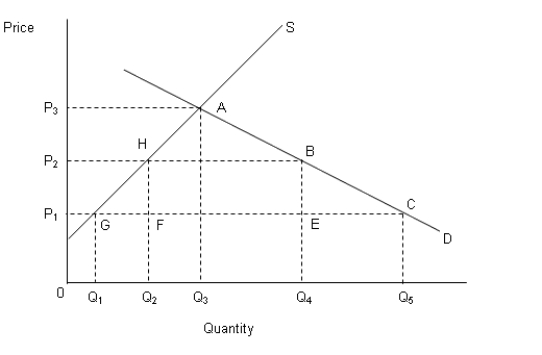 -According to Figure 20.1, if the international price of the good is P₁, which of the following statements is true?
 (Multiple Choice)
4.7/5 (82)
(82) When restrictions alter the pattern of international trade, the _____ benefit and the _____ suffer(s).
(Multiple Choice)
4.8/5 (88)
(88) As a result of the government procurement policy in the U.S.:
(Multiple Choice)
4.8/5 (84)
(84) The figure given below depicts the negatively sloped demand and positively sloped supply curves of wheat in a country.?Figure 20.2
-In Figure 20.2, if the world price of wheat is $25 and a $10 tariff is imposed:
-In Figure 20.2, if the world price of wheat is $25 and a $10 tariff is imposed: (Multiple Choice)
4.9/5 (89)
(89) Which of the following tools of commercial policy yields a revenue to the government?
(Multiple Choice)
4.8/5 (84)
(84) Protection provided to the infant industries is rarely withdrawn because:
(Multiple Choice)
4.8/5 (60)
(60) Which of the following can be considered as a cultural barrier to trade?
(Multiple Choice)
4.9/5 (72)
(72) 
Filters
- Essay(0)
- Multiple Choice(0)
- Short Answer(0)
- True False(0)
- Matching(0)