



 Chat with AI
Exam 20: International Trade Restrictions

Exam 1: The Wealth of Nations: Ownership and Economic Freedom87 Questions
Exam 2: Scarcity and Opportunity Costs87 Questions
Exam 3: The Market and Price System96 Questions
Exam 4: The Aggregate Economy61 Questions
Exam 5: National Income Accounting104 Questions
Exam 6: An Introduction to the Foreign Exchapterange Market and the Balance of Payments99 Questions
Exam 7: Unemployment and Inflation129 Questions
Exam 8: Macroeconomic Equilibrium: Aggregate Demand and Supply122 Questions
Exam 9: Aggregate Expenditures120 Questions
Exam 10: Income and Expenditures Equilibrium134 Questions
Exam 11: Fiscal Policy94 Questions
Exam 12: Money and Banking125 Questions
Exam 13: Monetary Policy141 Questions
Exam 14: Macroeconomic Policy: Tradeoffs, Expectations, Credibility, and Sources of Business Cycles117 Questions
Exam 15: Macroeconomic Viewpoints: New Keynesian, Monetarist, and New Classical103 Questions
Exam 16: Economic Growth95 Questions
Exam 17: Development Economics105 Questions
Exam 18: Globalization85 Questions
Exam 19: World Trade Equilibrium112 Questions
Exam 20: International Trade Restrictions109 Questions
Exam 21: Exchapterange Rates and Financial Links Between Countries132 Questions
Select questions type


When dealing with strategic trade policy, one practical problem for government is the likelihood of retaliation by the foreign government.
(True/False)
4.9/5  (83)
(83) The figure below shows the demand (D) and supply (S) curves of a good produced domestically in an economy as well as traded in the international market.?Figure 20.1??In the figure,?P₁: Price of the good in the international market.?P₂: Price of the good in the domestic market after the imposition of tariff by the government.?P₃: No-trade price of the good in the domestic market.
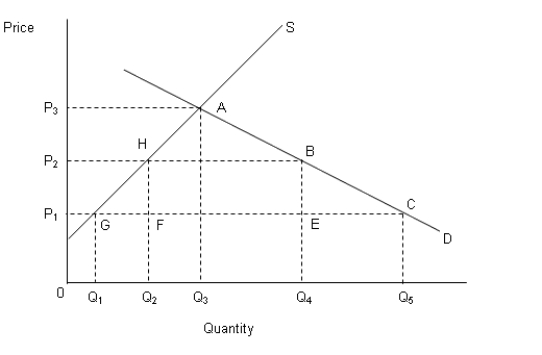 -Refer to Figure 20.1. If the government imposes a tariff such that the price of the good in the domestic market is P₂ while the international price is P₁, the dollar value of the tariff is equal to:
 (Multiple Choice)
4.9/5 (74)
(74) When production does not proceed on the basis of comparative advantage, resources are expended on their most efficient uses.
(True/False)
4.8/5 (77)
(77) A limit on the dollar worth of oranges imported into the United States is an example of a quantity quota.
(True/False)
5.0/5 (77)
(77) If the average costs of production decline with increases in output, then the larger a firm is, the lower its per unit costs will be.
(True/False)
4.8/5 (75)
(75) Developing countries often justify imposition of tariffs because:
(Multiple Choice)
4.9/5 (76)
(76) A monopoly exists when there is only one producer in an industry, and no close substitutes for the product exist.
(True/False)
4.7/5 (81)
(81) Preferential trade agreements have a beneficial trade-diversion effect when they reduce prices for traded goods and stimulate the volume of international trade.
(True/False)
4.8/5 (92)
(92) The figure below shows the demand (D) and supply (S) curves of a good produced domestically in an economy as well as traded in the international market.?Figure 20.1??In the figure,?P₁: Price of the good in the international market.?P₂: Price of the good in the domestic market after the imposition of tariff by the government.?P₃: No-trade price of the good in the domestic market.
-According to Figure 20.1, the domestic equilibrium quantity of the good is:
-According to Figure 20.1, the domestic equilibrium quantity of the good is: (Multiple Choice)
5.0/5 (77)
(77) The figure below shows the demand (D) and supply (S) curves of cocoa in the U.S.?Figure 20.4
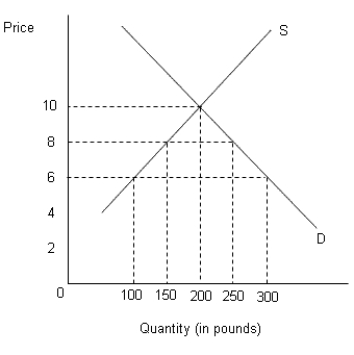 -Refer to Figure 20.4. Assume that Ghana is the only cocoa exporter supplying cocoa in the world market at $6 per pound. If the U.S. enters into a free trade agreement (FTA) with Ghana, what would be its total cocoa imports?
 (Multiple Choice)
4.8/5 (82)
(82) Typically, restrictions to "save domestic jobs" simply redistribute jobs by creating:
(Multiple Choice)
4.7/5 (72)
(72) Which of the following tools of commercial policy acts as a quantitative restriction on imports?
(Multiple Choice)
4.8/5 (66)
(66) After the U.S. government had approved the feeding of hormones to U.S. beef cattle, several western European nations restricted the import of beef from the U.S. Which of the following tools of commercial policy had been put to use in this situation?
(Multiple Choice)
4.8/5 (87)
(87) When the world price of the traded good is lower than the domestic no-trade equilibrium price, free trade causes domestic production to fall and domestic consumption to rise.
(True/False)
4.9/5 (97)
(97) The figure given below depicts the negatively sloped demand and positively sloped supply curves of wheat in a country.?Figure 20.2
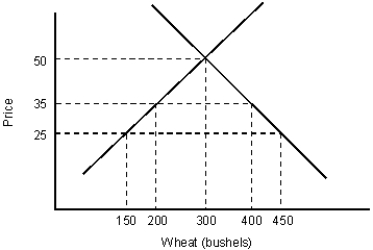 -In Figure 20.2, if the world price per bushel of wheat is $25, and a tariff of $10 is imposed, what is the domestic production?
 (Multiple Choice)
4.7/5 (67)
(67) Which of the following statements about an increasing-returns-to-scale industry is not true?
(Multiple Choice)
4.9/5 (72)
(72) 
Filters
- Essay(0)
- Multiple Choice(0)
- Short Answer(0)
- True False(0)
- Matching(0)