



 Chat with AI
Exam 19: World Trade Equilibrium

Exam 1: The Wealth of Nations: Ownership and Economic Freedom87 Questions
Exam 2: Scarcity and Opportunity Costs87 Questions
Exam 3: The Market and Price System96 Questions
Exam 4: The Aggregate Economy61 Questions
Exam 5: National Income Accounting104 Questions
Exam 6: An Introduction to the Foreign Exchapterange Market and the Balance of Payments99 Questions
Exam 7: Unemployment and Inflation129 Questions
Exam 8: Macroeconomic Equilibrium: Aggregate Demand and Supply122 Questions
Exam 9: Aggregate Expenditures120 Questions
Exam 10: Income and Expenditures Equilibrium134 Questions
Exam 11: Fiscal Policy94 Questions
Exam 12: Money and Banking125 Questions
Exam 13: Monetary Policy141 Questions
Exam 14: Macroeconomic Policy: Tradeoffs, Expectations, Credibility, and Sources of Business Cycles117 Questions
Exam 15: Macroeconomic Viewpoints: New Keynesian, Monetarist, and New Classical103 Questions
Exam 16: Economic Growth95 Questions
Exam 17: Development Economics105 Questions
Exam 18: Globalization85 Questions
Exam 19: World Trade Equilibrium112 Questions
Exam 20: International Trade Restrictions109 Questions
Exam 21: Exchapterange Rates and Financial Links Between Countries132 Questions
Select questions type


The product life cycle theory of comparative advantage predicts that a new product will be first produced and exported by:
(Multiple Choice)
4.7/5  (100)
(100) The following table shows that in one day poultry farmers in Arkansas can produce 3 cartons of eggs, while poultry farmers in Idaho can produce 2 cartons of eggs. It takes Arkansas potato farmers one day to produce 30 tons of potatoes, while Idaho potato farmers produce 10 tons of potatoes in that same time.?Table 20.4
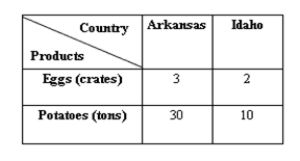 -According to Table 20.4, the limits to the terms of trade in potatoes are 1 ton of potatoes in exchange for:
 (Multiple Choice)
4.8/5 (102)
(102) Refer to Scenario 20.1. Calculate the opportunity cost of producing sugar in Brazil.
(Multiple Choice)
4.9/5 (86)
(86) The Heckscher-Olin model uses differences in factor abundance to determine whether any nation has a comparative advantage in any good.
(True/False)
4.9/5 (88)
(88) A country can benefit by indulging in international trade when:
(Multiple Choice)
4.8/5 (79)
(79) The original comparative advantage model that used the relative abundance of factors of production to explain comparative advantage assumed that countries:
(Multiple Choice)
4.8/5 (74)
(74) Scenario 20.1?Suppose labor productivity differences are the only determinants of comparative advantage, and Brazil and Chile both produce only coffee and sugar. In Chile, either 5 units of coffee or 2 units of sugar can be produced in one day. In Brazil, a day of labor produces either 2 units of coffee or 1 unit of sugar.
-Refer to Scenario 20.1. Which of the following statements is true?
(Multiple Choice)
4.8/5 (75)
(75) The theory that explains the shift of color TV sets production from the United States to Japan and Taiwan is called the _____ theory.
(Multiple Choice)
4.9/5 (87)
(87) The data in the table below assumes that with the same quantity of resources, both Australia and Philippines produces food and computers. Australia can make 1,000 computers or 2,000 units of food in a day, and the Philippines can make 200 computers or 1,200 units of food in a day.?Table 20.2
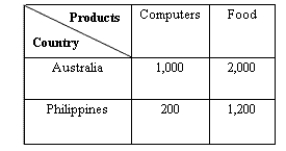 -According to Table 20.2, what is the opportunity cost of 1 computer in the Philippines?
 (Multiple Choice)
4.7/5 (83)
(83) The figure given below shows the import demand and export supply curves of corn of the U.S. and Mexico.?Figure 20.2
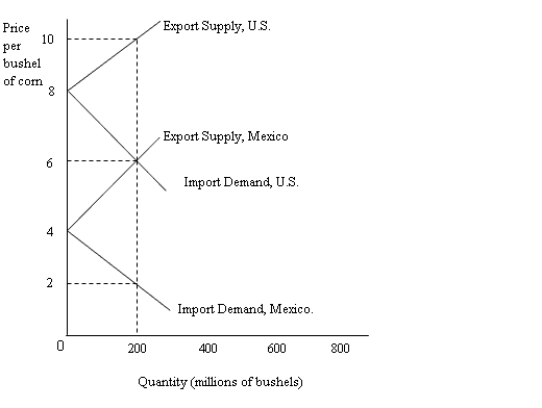 -Refer to Figure 20.2. The no-trade equilibrium price of corn in the U.S. is:
 (Multiple Choice)
4.9/5 (90)
(90) The principle of comparative advantage states that a country should specialize in the production of those goods that have the highest opportunity costs.
(True/False)
4.9/5 (76)
(76) The export supply and import demand curves measure the domestic shortage and surplus, respectively, at different world prices.
(True/False)
4.8/5 (77)
(77) The first panel in the following figure shows the domestic demand (D) and supply (S) curves of Columbian coffee and the second panel shows the import demand and export supply of Columbian coffee in the international market.?Figure 20.1
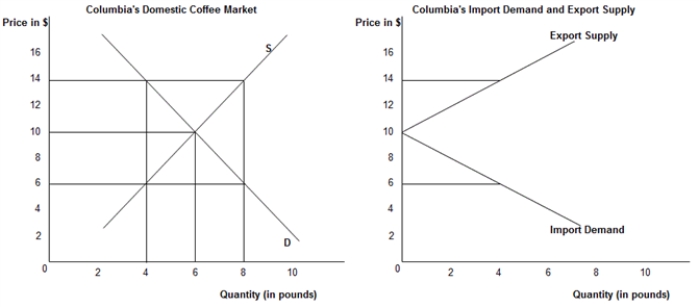 -Refer to Figure 20.1. If the price of Columbian coffee in the international market is $10, Columbia will export _____ pound(s) of coffee.
 (Multiple Choice)
4.8/5 (74)
(74) No country can have an absolute advantage in the production of more than one good.
(True/False)
5.0/5 (79)
(79) Which of the following counties are largely dependent on trade with the United States?
(Multiple Choice)
4.8/5 (86)
(86) The export supply curve is the portion of the domestic supply curve below the no-trade equilibrium price.
(True/False)
4.7/5 (77)
(77) The following table shows that in one day poultry farmers in Arkansas can produce 3 cartons of eggs, while poultry farmers in Idaho can produce 2 cartons of eggs. It takes Arkansas potato farmers one day to produce 30 tons of potatoes, while Idaho potato farmers produce 10 tons of potatoes in that same time.?Table 20.4
-According to Table 20.4, the limits to the terms of trade in eggs are 1 carton of eggs in exchange for:
-According to Table 20.4, the limits to the terms of trade in eggs are 1 carton of eggs in exchange for: (Multiple Choice)
4.8/5 (70)
(70) 
Filters
- Essay(0)
- Multiple Choice(0)
- Short Answer(0)
- True False(0)
- Matching(0)