



 Chat with AI
Exam 17: Cell Reproduction and Differentiation

Exam 1: Human Biology, Science, and Society69 Questions
Exam 2: The Chemistry of Living Things100 Questions
Exam 3: Structure and Function of Cells107 Questions
Exam 4: From Cells to Organ Systems88 Questions
Exam 5: The Skeletal System74 Questions
Exam 6: The Muscular System83 Questions
Exam 7: Blood95 Questions
Exam 8: Heart and Blood Vessels107 Questions
Exam 9: The Immune System and Mechanisms of Defense102 Questions
Exam 10: The Respiratory System: Exchange of Gases81 Questions
Exam 11: The Nervous System: Integration and Control100 Questions
Exam 12: Sensory Mechanisms83 Questions
Exam 13: The Endocrine System82 Questions
Exam 14: The Digestive System and Nutrition80 Questions
Exam 15: The Urinary System70 Questions
Exam 16: Reproductive Systems89 Questions
Exam 17: Cell Reproduction and Differentiation78 Questions
Exam 18: Cancer: Uncontrolled Cell Division and Differentiation77 Questions
Exam 19: Genetics and Inheritance71 Questions
Exam 20: DNA Technology and Genetic Engineering71 Questions
Exam 21: Development and Aging72 Questions
Exam 22: Evolution and the Origins of Life78 Questions
Exam 23: Ecosystems and Populations74 Questions
Exam 24: Human Impacts, Biodiversity, and Environmental Issues71 Questions
Select questions type


A(n) ________ forms during cytokinesis as contractile filaments in the cell tighten.
(Short Answer)
4.8/5  (81)
(81) The processes of initiation, elongation, and termination that occur in the production of a protein are all associated with
(Multiple Choice)
4.7/5 (93)
(93) During translation, attachment of a "start" codon to the small ribosomal subunit constitutes the beginning of the ________ stage.
(Short Answer)
4.7/5 (77)
(77) Which one of the following statements CORRECTLY compares the effects of a mutation in a gamete to the effects of a mutation in a somatic cell?
(Multiple Choice)
4.9/5 (77)
(77) A cell cycle of a cell in which DNA replication was faulty, failing to complete replication of all of the DNA, would likely be halted at the M checkpoint.
(True/False)
4.9/5 (95)
(95) All cells that make up the body other than germ cells are referred to as ________.
(Short Answer)
4.9/5 (80)
(80) Which one of the following statements best describes the chromosomes in the cells at the end of meiosis I?
(Multiple Choice)
4.9/5 (69)
(69) The development of induced pluripotent stem cells would make possible therapeutic cloning without the use of embryos.
(True/False)
4.9/5 (83)
(83) Match the following types of RNA to their description. Answers may be used more than once.
Correct Answer: Verified
Premises:
Responses:
(Matching)
4.9/5 (77)
(77) 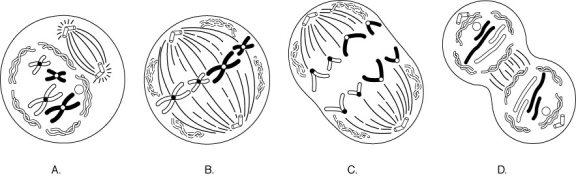 Match each stage of mitosis (lettered A-D) to the appropriate diagram in the figure above.
-anaphase
Match each stage of mitosis (lettered A-D) to the appropriate diagram in the figure above.
-anaphase (Short Answer)
4.8/5 (85)
(85) Progression through the various phases of the cell cycle depends on fluctuating concentrations of ________.
(Short Answer)
4.9/5 (79)
(79) Alterations in DNA, whether they occur by mistake during replication, or as a result of some type of damage, can lead to mutations. Mutations, however, are rare in terms of leading to actual damage to a cell. Why?
(Essay)
4.9/5 (78)
(78) Which one of the following statements describes the process through which a primary RNA transcript becomes a functional mRNA?
(Multiple Choice)
4.7/5 (85)
(85) Initiation of translation begins with a tRNA binding its anticodon to the start codon of mRNA at a ribosome.
(True/False)
4.8/5 (74)
(74) In order to increase the speed of replication, the DNA molecule is opened at several locations creating multiple replication bubbles where complementary strands are formed.
(True/False)
4.9/5 (76)
(76) Which one of the following statements is TRUE regarding the G₀ phase of the cell cycle?
(Multiple Choice)
4.8/5 (79)
(79) 
Filters
- Essay(0)
- Multiple Choice(0)
- Short Answer(0)
- True False(0)
- Matching(0)