



 Chat with AI
Exam 13: The Endocrine System

Exam 1: Human Biology, Science, and Society69 Questions
Exam 2: The Chemistry of Living Things100 Questions
Exam 3: Structure and Function of Cells107 Questions
Exam 4: From Cells to Organ Systems88 Questions
Exam 5: The Skeletal System74 Questions
Exam 6: The Muscular System83 Questions
Exam 7: Blood95 Questions
Exam 8: Heart and Blood Vessels107 Questions
Exam 9: The Immune System and Mechanisms of Defense102 Questions
Exam 10: The Respiratory System: Exchange of Gases81 Questions
Exam 11: The Nervous System: Integration and Control100 Questions
Exam 12: Sensory Mechanisms83 Questions
Exam 13: The Endocrine System82 Questions
Exam 14: The Digestive System and Nutrition80 Questions
Exam 15: The Urinary System70 Questions
Exam 16: Reproductive Systems89 Questions
Exam 17: Cell Reproduction and Differentiation78 Questions
Exam 18: Cancer: Uncontrolled Cell Division and Differentiation77 Questions
Exam 19: Genetics and Inheritance71 Questions
Exam 20: DNA Technology and Genetic Engineering71 Questions
Exam 21: Development and Aging72 Questions
Exam 22: Evolution and the Origins of Life78 Questions
Exam 23: Ecosystems and Populations74 Questions
Exam 24: Human Impacts, Biodiversity, and Environmental Issues71 Questions
Select questions type


Which one of the following causes the release of epinephrine and norepinephrine from the adrenal medulla?
(Multiple Choice)
4.8/5  (70)
(70) Which one of the following hormones stimulates the production of testosterone in males?
(Multiple Choice)
4.9/5 (91)
(91) Luteinizing hormone is considered a gonadotropin because of which one of the following reasons?
(Multiple Choice)
4.8/5 (90)
(90) The number of cases of Type 2 diabetes is increasing mainly due to an increase in three major risk factors: obesity, insufficient exercise, and unhealthy diets.
(True/False)
4.9/5 (68)
(68) All of following statements are TRUE regarding estrogen and progesterone, EXCEPT which one?
(Multiple Choice)
4.9/5 (74)
(74) ________ cells function in both the nervous and endocrine systems.
(Short Answer)
4.9/5 (81)
(81) 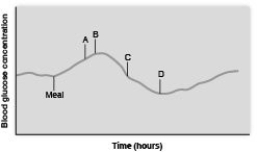 Match each event labeled on the graph with the description of what is occurring in relation to blood glucose levels.
-pancreas stops secretion of insulin
Match each event labeled on the graph with the description of what is occurring in relation to blood glucose levels.
-pancreas stops secretion of insulin (Short Answer)
4.8/5 (74)
(74) Which one of the following hormone pairs is antagonistic, in that they have opposing effects?
(Multiple Choice)
5.0/5 (77)
(77) Disorders associated with the endocrine system can be caused by problems with hormone production or lack of receptors for the hormones on the target cells.
(True/False)
4.8/5 (91)
(91) When the amount of thyroxine in the body increases, the basal metabolic rate of the body also increases.
(True/False)
4.9/5 (82)
(82) Match each of the following hormones to its target organ.
Correct Answer: Verified
Premises:
Responses:
(Matching)
4.9/5 (73)
(73) During times of stress, which one of the following glands releases CRH to stimulate the anterior pituitary to release ACTH?
(Multiple Choice)
4.8/5 (67)
(67) Which one of the following is required in the diet in order for active thyroid hormones to be produced?
(Multiple Choice)
4.8/5 (77)
(77) Calcitonin and PTH have opposing effects on blood calcium levels.
(True/False)
4.8/5 (73)
(73) Nonsteroid hormones differ from steroid hormones in that they
(Multiple Choice)
4.8/5 (76)
(76) Which one of the following nonhormonal chemical messengers is important in local control of blood flow and blood clotting?
(Multiple Choice)
4.9/5 (76)
(76) A student just finished a delicious breakfast of pancakes with syrup, orange juice, and Danish pastries. Because his blood sugar level has increased, the pancreas secretes ________.
(Short Answer)
4.8/5 (76)
(76) 
Filters
- Essay(0)
- Multiple Choice(0)
- Short Answer(0)
- True False(0)
- Matching(0)