



 Chat with AI
Exam 7: Blood

Exam 1: Human Biology, Science, and Society69 Questions
Exam 2: The Chemistry of Living Things100 Questions
Exam 3: Structure and Function of Cells107 Questions
Exam 4: From Cells to Organ Systems88 Questions
Exam 5: The Skeletal System74 Questions
Exam 6: The Muscular System83 Questions
Exam 7: Blood95 Questions
Exam 8: Heart and Blood Vessels107 Questions
Exam 9: The Immune System and Mechanisms of Defense102 Questions
Exam 10: The Respiratory System: Exchange of Gases81 Questions
Exam 11: The Nervous System: Integration and Control100 Questions
Exam 12: Sensory Mechanisms83 Questions
Exam 13: The Endocrine System82 Questions
Exam 14: The Digestive System and Nutrition80 Questions
Exam 15: The Urinary System70 Questions
Exam 16: Reproductive Systems89 Questions
Exam 17: Cell Reproduction and Differentiation78 Questions
Exam 18: Cancer: Uncontrolled Cell Division and Differentiation77 Questions
Exam 19: Genetics and Inheritance71 Questions
Exam 20: DNA Technology and Genetic Engineering71 Questions
Exam 21: Development and Aging72 Questions
Exam 22: Evolution and the Origins of Life78 Questions
Exam 23: Ecosystems and Populations74 Questions
Exam 24: Human Impacts, Biodiversity, and Environmental Issues71 Questions
Select questions type


Hemoglobin is most likely to release oxygen to tissues when the pH of tissues is ________ and the temperature is ________.
(Short Answer)
4.9/5  (77)
(77) A scientist is interested in doing a research project on hemoglobin. From which one of the following could he extract the hemoglobin for his study?
(Multiple Choice)
4.9/5 (83)
(83) The osmotic balance between blood and interstitial fluid is maintained by plasma proteins called ________.
(Short Answer)
4.9/5 (70)
(70) Which one of the following is TRUE regarding the "recycling" of hemoglobin?
(Multiple Choice)
4.8/5 (86)
(86) Hemolytic disease of the newborn could result from which one of the following situations?
(Multiple Choice)
4.9/5 (66)
(66) Foreign cells that enter human body have unique cell surface proteins, known as ________, which stimulate body's defense to attack.
(Multiple Choice)
5.0/5 (80)
(80) "Blood is thicker than water" is a true statement since blood contains many components that are denser than water and the plasma is quite viscous.
(True/False)
4.9/5 (84)
(84) All of the following are ways in which blood functions to maintain homeostasis in the human body EXCEPT which one?
(Multiple Choice)
4.8/5 (76)
(76) Proteins produced by the immune system in response to the presence of an antigen are known as ________.
(Short Answer)
4.8/5 (76)
(76) The inflammatory response is initiated by the release of ________ from basophils.
(Multiple Choice)
4.8/5 (70)
(70) It is now possible for parents to bank the umbilical cord blood of their children; the cells in the cord would then be available for use later in the life of the child to treat a genetic disorder or cancer, should it develop.
(True/False)
4.8/5 (86)
(86) Determine whether each of the following functions of blood is associated with a component of the blood plasma, the formed elements, or both.
A) formed elements
B) both blood plasma and formed elements
C) blood plasma
1) transport of lipids
2) blood clotting
3) transport of carbon dioxide
4) fighting infection
5) transport of urea
6) transport of most of the oxygen
(Short Answer)
4.8/5 (76)
(76) 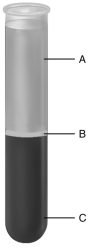 Using the figure above, answer the following questions.
-The blood components in C are the ________.
Using the figure above, answer the following questions.
-The blood components in C are the ________. (Short Answer)
4.9/5 (75)
(75) 
Filters
- Essay(0)
- Multiple Choice(0)
- Short Answer(0)
- True False(0)
- Matching(0)