



 Chat with AI
Exam 6: The Muscular System

Exam 1: Human Biology, Science, and Society69 Questions
Exam 2: The Chemistry of Living Things100 Questions
Exam 3: Structure and Function of Cells107 Questions
Exam 4: From Cells to Organ Systems88 Questions
Exam 5: The Skeletal System74 Questions
Exam 6: The Muscular System83 Questions
Exam 7: Blood95 Questions
Exam 8: Heart and Blood Vessels107 Questions
Exam 9: The Immune System and Mechanisms of Defense102 Questions
Exam 10: The Respiratory System: Exchange of Gases81 Questions
Exam 11: The Nervous System: Integration and Control100 Questions
Exam 12: Sensory Mechanisms83 Questions
Exam 13: The Endocrine System82 Questions
Exam 14: The Digestive System and Nutrition80 Questions
Exam 15: The Urinary System70 Questions
Exam 16: Reproductive Systems89 Questions
Exam 17: Cell Reproduction and Differentiation78 Questions
Exam 18: Cancer: Uncontrolled Cell Division and Differentiation77 Questions
Exam 19: Genetics and Inheritance71 Questions
Exam 20: DNA Technology and Genetic Engineering71 Questions
Exam 21: Development and Aging72 Questions
Exam 22: Evolution and the Origins of Life78 Questions
Exam 23: Ecosystems and Populations74 Questions
Exam 24: Human Impacts, Biodiversity, and Environmental Issues71 Questions
Select questions type


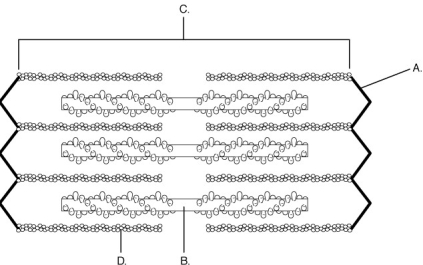 Using the figure above, identify the parts of the sarcomere.
A) sarcomere
B) actin filament
C) myosin filament
D) Z-line
14) Label A represents a(n) ________.
15) Label B represents a(n) ________
16) Label C represents a(n) ________.
17) Label D represents a(n) ________.
Using the figure above, identify the parts of the sarcomere.
A) sarcomere
B) actin filament
C) myosin filament
D) Z-line
14) Label A represents a(n) ________.
15) Label B represents a(n) ________
16) Label C represents a(n) ________.
17) Label D represents a(n) ________. (Short Answer)
4.7/5  (76)
(76) In which one of the following would one expect to find motor units made up of only a few muscle cells?
(Multiple Choice)
4.8/5 (81)
(81) Slow-twitch fibers contain many mitochondria and are well supplied with blood vessels, and can make ATP as they need it.
(True/False)
4.8/5 (66)
(66) Muscle cells are located in every organ in the body except the stomach and are essential for any activity that requires movement.
(True/False)
4.9/5 (90)
(90) When an electrical impulse traveling along a motor neuron arrives at a neuromuscular junction
(Multiple Choice)
4.9/5 (82)
(82) A muscle is arranged in bundles of muscle fibers, called ________.
(Short Answer)
4.8/5 (87)
(87) Which sequence lists the structures from largest, most inclusive, to smallest?
(Multiple Choice)
4.7/5 (88)
(88) In skeletal muscle, potassium ions are stored in the sarcoplasmic reticulum.
(True/False)
4.8/5 (90)
(90) Muscle cells produce lactic acid when they have an inadequate supply of
(Multiple Choice)
4.7/5 (70)
(70) Since contraction of the hamstrings causes the knee to bend and contraction of the quadriceps causes the knee to extend, these muscles are said to be ________.
(Short Answer)
4.8/5 (77)
(77) In order for a muscle contraction to occur, cross-bridges must form between which one of the following structures within a muscle cell?
(Multiple Choice)
4.8/5 (82)
(82) According to the sliding filament mechanism, during a muscle contraction, myosin pulls actin filaments toward the center of a sarcomere, causing the entire sarcomere to shorten.
(True/False)
4.9/5 (79)
(79) As the rate of stimulation of motor units of a muscle increases, muscle force increases. This process is known as ________.
(Short Answer)
4.8/5 (78)
(78) The portion of a myofibril from one Z-line to the next is a(n) ________.
(Short Answer)
4.8/5 (76)
(76) The process of activating more motor units when more force must be exerted is called ________.
(Short Answer)
4.8/5 (68)
(68) A complete cycle of contraction and relaxation of muscle cells due to stimulation by a motor neuron is called a muscle ________.
(Short Answer)
4.8/5 (72)
(72) Muscle contraction accounts for over 75% of the heat generated by the body.
(True/False)
5.0/5 (70)
(70) 
Filters
- Essay(0)
- Multiple Choice(0)
- Short Answer(0)
- True False(0)
- Matching(0)