



 Chat with AI
Exam 5: Light: the Cosmic Messenger

Exam 1: Our Place in the Universe102 Questions
Exam 2: Discovering the Universe for Yourself135 Questions
Exam 3: The Science of Astronomy97 Questions
Exam 4: Making Sense of the Universe: Understanding Motion, Energy, and Gravity103 Questions
Exam 5: Light: the Cosmic Messenger139 Questions
Exam 6: Formation of Planetary Systems: Our Solar System and Beyond174 Questions
Exam 7: Earth and the Terrestrial Worlds180 Questions
Exam 8: Jovian Planet Systems85 Questions
Exam 9: Asteroids, Comets, and Dwarf Planets: Their Nature, Orbits, and Impacts118 Questions
Exam 10: Our Star101 Questions
Exam 11: Surveying the Stars129 Questions
Exam 12: Star Stuff137 Questions
Exam 13: Bizarre Stellar Graveyard110 Questions
Exam 14: Our Galaxy112 Questions
Exam 15: Galaxies and the Foundation of Modern Cosmology152 Questions
Exam 16: Dark Matter, Dark Energy, and the Fate of the Universe97 Questions
Exam 17: The Beginning of Time105 Questions
Exam 18: Life in the Universe82 Questions
Select questions type


The largest effective telescope, created by radio interferometry, is the size of
(Multiple Choice)
4.8/5  (95)
(95) Suppose the surface temperature of the Sun were about 18,000 K, rather than 6,000 K. How would the thermal radiation spectrum of the Sun be different?
(Essay)
4.9/5 (71)
(71) Which of the following is not a way light and matter interact?
(Multiple Choice)
4.8/5 (81)
(81) From lowest energy to highest energy, which of the following correctly orders the different categories of electromagnetic radiation?
(Multiple Choice)
4.9/5 (76)
(76) How are wavelength, frequency, and energy related for photons of light?
(Multiple Choice)
4.8/5 (67)
(67) The angular separation of two stars is 0.1 arcseconds and you photograph them with a telescope that has an angular resolution of 1 arcsecond. What will you see?
(Multiple Choice)
4.9/5 (90)
(90) Currently, the largest optical telescope mirrors have a diameter of
(Multiple Choice)
5.0/5 (73)
(73) Which of the following telescopes is best suited for studying the hottest intergalactic gas (10 million K) in a cluster of galaxies?
(Multiple Choice)
4.9/5 (79)
(79) Spectra from neutral atoms compared with spectra from ionized atoms of the same element
(Multiple Choice)
4.9/5 (82)
(82) Any object moving relative to Earth will have a Doppler shift when viewed from Earth.
(True/False)
4.8/5 (72)
(72) One star is emitting primarily visible light and another star is emitting primarily infrared light. Which star is hotter?
(Multiple Choice)
4.9/5 (81)
(81) The following questions refer to the diagram below. The levels represent energy levels in a hydrogen atom. Each level is labeled with its energy (above the ground state of Level 1) in units of electron/volts (eV). The labeled transitions represent an electron moving between energy levels.
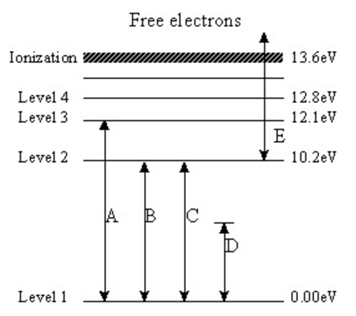 -Which transition represents an electron that absorbs a photon with 10.2 eV of energy?
 (Short Answer)
4.8/5 (89)
(89) Briefly explain why spectral lines are useful in determining the chemical composition of their source.
(Essay)
4.8/5 (72)
(72) The most common isotope of oxygen has atomic number 8 and atomic mass number 16. Another isotope has two extra neutrons. What are the atomic number and atomic mass number of this isotope?
(Essay)
4.8/5 (74)
(74) Compared to the size of its nucleus, the size of an atom is about
(Multiple Choice)
4.9/5 (67)
(67) Suppose you want to know the chemical composition of a distant star. Which piece of information is most useful to you?
(Multiple Choice)
4.8/5 (89)
(89) Studying a spectrum from a star can tell us a lot. All of the following statements are true except one. Which statement is not true?
(Multiple Choice)
4.7/5 (80)
(80) Which of the following statements best describes the two principle advantages of telescopes over eyes?
(Multiple Choice)
4.9/5 (79)
(79) 
Filters
- Essay(0)
- Multiple Choice(0)
- Short Answer(0)
- True False(0)
- Matching(0)