



 Chat with AI
Exam 5: Light: the Cosmic Messenger

Exam 1: Our Place in the Universe102 Questions
Exam 2: Discovering the Universe for Yourself135 Questions
Exam 3: The Science of Astronomy97 Questions
Exam 4: Making Sense of the Universe: Understanding Motion, Energy, and Gravity103 Questions
Exam 5: Light: the Cosmic Messenger139 Questions
Exam 6: Formation of Planetary Systems: Our Solar System and Beyond174 Questions
Exam 7: Earth and the Terrestrial Worlds180 Questions
Exam 8: Jovian Planet Systems85 Questions
Exam 9: Asteroids, Comets, and Dwarf Planets: Their Nature, Orbits, and Impacts118 Questions
Exam 10: Our Star101 Questions
Exam 11: Surveying the Stars129 Questions
Exam 12: Star Stuff137 Questions
Exam 13: Bizarre Stellar Graveyard110 Questions
Exam 14: Our Galaxy112 Questions
Exam 15: Galaxies and the Foundation of Modern Cosmology152 Questions
Exam 16: Dark Matter, Dark Energy, and the Fate of the Universe97 Questions
Exam 17: The Beginning of Time105 Questions
Exam 18: Life in the Universe82 Questions
Select questions type


The following questions refer to the diagram below. The levels represent energy levels in a hydrogen atom. Each level is labeled with its energy (above the ground state of Level 1) in units of electron/volts (eV). The labeled transitions represent an electron moving between energy levels.
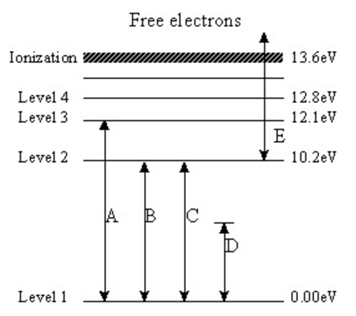 -Which transition represents an electron that is breaking free of the atom?
 (Short Answer)
4.7/5  (75)
(75) The diagram represents energy levels in a hydrogen atom. The labeled transitions (A through E. represent an electron moving between energy levels. Suppose that an electron in a hydrogen atom absorbs 10.2 eV of energy, so that it moves from level 1 to level 2. What typically happens next?
(Multiple Choice)
4.7/5 (85)
(85) If a hydrogen emission line appears at 656.2 nm in the laboratory, what can we say about a cloud of hydrogen gas, with an emission line at 680.2 nm?
(Multiple Choice)
4.8/5 (84)
(84) Which of the following would be the most capable ultraviolet telescope?
(Multiple Choice)
4.9/5 (76)
(76) From laboratory measurements, we know that a particular spectral line formed by hydrogen appears at a wavelength of 121.6 nanometers (nm). The spectrum of a particular star shows the same hydrogen line appearing at a wavelength of 121.8 nm. What can we conclude?
(Multiple Choice)
4.9/5 (87)
(87) The Size of Molecules: You have a small flask of oil. You pour this oil onto a clear, calm pool of water and watch the oil slick spread out slowly with time. Imagine that it is your belief that the oil is not a continuous substance but made of individual particles called "molecules". Assuming this hypothesis is true, can you make a testable prediction on how the oil slick will behave as it spreads? Will this prediction allow you to estimate the size of the "molecules?" Search online to see if there is any evidence that the Greeks attempted such an experiment.
(Not Answered)
This question doesn't have any answer yet
Suppose you see two stars: a blue star and a red star. Which of the following can you conclude about the two stars? Assume that no Doppler shifts are involved. (Hint: Think about the laws of thermal radiation.)
(Multiple Choice)
4.9/5 (76)
(76) The energy levels for electrons vary from one element to another.
(True/False)
5.0/5 (71)
(71) Which of the following statements about X-rays and radio waves is not true?
(Multiple Choice)
4.9/5 (83)
(83) Which of the following is an example of reflection or scattering?
(Multiple Choice)
4.9/5 (73)
(73) If you heat a gas so that collisions are continually bumping electrons to higher energy levels, when the electrons fall back to lower energy levels the gas produces
(Multiple Choice)
4.9/5 (84)
(84) Which of the following observational techniques is most appropriate for measuring Doppler shifts?
(Multiple Choice)
5.0/5 (72)
(72) Explain why an absorption line spectrum is not filled back in (to make the original continuous spectrum) by the photons that are emitted as the excited electrons decay back down to their original energy levels.
(Essay)
4.9/5 (76)
(76) 
Filters
- Essay(0)
- Multiple Choice(0)
- Short Answer(0)
- True False(0)
- Matching(0)