



 Chat with AI
Exam 19: Clearing the Air: Respiratory and Cardiovascular Systems

Exam 1: Can Science Cure the Common Cold Introduction to the Scientific Method79 Questions
Exam 2: Science Fiction, Bad Science, and Pseudoscience:53 Questions
Exam 3: Is It Possible to Supplement Your Way to Better Performance and Health87 Questions
Exam 4: Body Weight and Health: Enzymes, Metabolism, and Cellular Respiration63 Questions
Exam 5: Life in the Greenhouse: Photosynthesis and Climate Change70 Questions
Exam 6: Cancer: DNA Synthesis, Mitosis, and Meiosis58 Questions
Exam 7: Are You Only As Smart As Your Genes Mendelian and Quantitative Genetics71 Questions
Exam 8: DNA Detective: Complex Patterns of Inheritance and Dna Profiling65 Questions
Exam 9: Genetically Modified Organisms: Gene Expression, Mutation,66 Questions
Exam 10: Where Did We Come From the Evidence for Evolution72 Questions
Exam 11: An Evolving Enemy: Natural Selection70 Questions
Exam 12: Who Am I Species and Races70 Questions
Exam 13: The Greatest Species on Earth Biodiversity and Classification61 Questions
Exam 14: Is the Human Population Too Large Population Ecology69 Questions
Exam 15: Conserving Biodiversity: Community and Ecosystem Ecology72 Questions
Exam 16: Where Do You Live Climate and Biomes72 Questions
Exam 17: Organ Donation: Tissues and Organs54 Questions
Exam 18: Binge Drinking: the Digestive and Urinary Systems28 Questions
Exam 19: Clearing the Air: Respiratory and Cardiovascular Systems54 Questions
Exam 20: Vaccination: Protection and Prevention or Peril Immune System,68 Questions
Exam 21: Human Sex Differences: Endocrine, Skeletal, and Muscular Systems57 Questions
Exam 22: Is There Something in the Water Reproductive and Developmental Biology67 Questions
Exam 23: Study Drugs: Brain Boost or Brain Drain Brain Structure and Function68 Questions
Exam 24: Feeding the World: Plant Structure and Growth71 Questions
Exam 25: Growing a Green Thumb: Plant Physiology66 Questions
Select questions type


Which compound provides a slippery consistency in the lungs preventing the alveoli walls from sticking together?
(Multiple Choice)
4.9/5  (78)
(78) True or false: Of the 170,000 new cases of lung cancer diagnosed in the United States each year, greater than 90% of these patients are current smokers or former smokers.
(True/False)
4.9/5 (89)
(89) What is the advantage of having grape-like clusters called alveoli as part of the respiratory system?
(Multiple Choice)
4.8/5 (77)
(77) Which structures lining the tissue surface of the respiratory tract can be damaged by airborne particles?
(Multiple Choice)
4.9/5 (96)
(96) A small mass of specialized muscle on the back wall of the right atrium, also known as the pacemaker, is medically known as what?
(Multiple Choice)
4.8/5 (70)
(70) Which region of the circulatory system allows passage of nutrients and other small molecules to service nearby tissues?
(Multiple Choice)
4.9/5 (78)
(78) 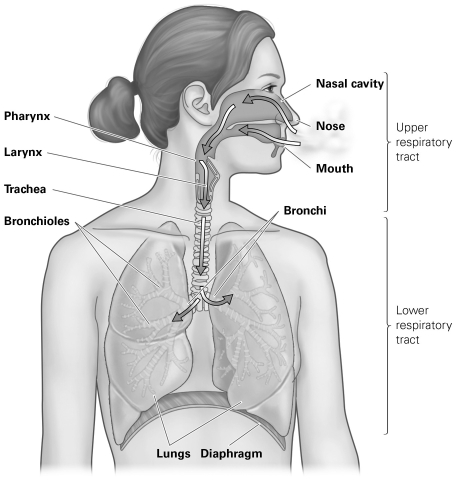 -Refer to the figure to answer the following question: Which structure will connect to alveoli, where gas exchange will occur?
 (Multiple Choice)
4.7/5 (90)
(90) True or false: The emerging and scientific consensus about "secondhand smoke" supports the conclusion that while airborne particles emitted by the lit end of cigarettes pose a health risk to those who are exposed, the gases released by a cigarette are relatively harmless.
(True/False)
4.8/5 (78)
(78) During exhalation, when the diaphragm relaxes and the volume of the chest cavity decreases, how is the air pressure inside the lungs affected?
(Multiple Choice)
4.9/5 (80)
(80) 
Filters
- Essay(0)
- Multiple Choice(0)
- Short Answer(0)
- True False(0)
- Matching(0)