



 Chat with AI
Exam 13: The Greatest Species on Earth Biodiversity and Classification

Exam 1: Can Science Cure the Common Cold Introduction to the Scientific Method79 Questions
Exam 2: Science Fiction, Bad Science, and Pseudoscience:53 Questions
Exam 3: Is It Possible to Supplement Your Way to Better Performance and Health87 Questions
Exam 4: Body Weight and Health: Enzymes, Metabolism, and Cellular Respiration63 Questions
Exam 5: Life in the Greenhouse: Photosynthesis and Climate Change70 Questions
Exam 6: Cancer: DNA Synthesis, Mitosis, and Meiosis58 Questions
Exam 7: Are You Only As Smart As Your Genes Mendelian and Quantitative Genetics71 Questions
Exam 8: DNA Detective: Complex Patterns of Inheritance and Dna Profiling65 Questions
Exam 9: Genetically Modified Organisms: Gene Expression, Mutation,66 Questions
Exam 10: Where Did We Come From the Evidence for Evolution72 Questions
Exam 11: An Evolving Enemy: Natural Selection70 Questions
Exam 12: Who Am I Species and Races70 Questions
Exam 13: The Greatest Species on Earth Biodiversity and Classification61 Questions
Exam 14: Is the Human Population Too Large Population Ecology69 Questions
Exam 15: Conserving Biodiversity: Community and Ecosystem Ecology72 Questions
Exam 16: Where Do You Live Climate and Biomes72 Questions
Exam 17: Organ Donation: Tissues and Organs54 Questions
Exam 18: Binge Drinking: the Digestive and Urinary Systems28 Questions
Exam 19: Clearing the Air: Respiratory and Cardiovascular Systems54 Questions
Exam 20: Vaccination: Protection and Prevention or Peril Immune System,68 Questions
Exam 21: Human Sex Differences: Endocrine, Skeletal, and Muscular Systems57 Questions
Exam 22: Is There Something in the Water Reproductive and Developmental Biology67 Questions
Exam 23: Study Drugs: Brain Boost or Brain Drain Brain Structure and Function68 Questions
Exam 24: Feeding the World: Plant Structure and Growth71 Questions
Exam 25: Growing a Green Thumb: Plant Physiology66 Questions
Select questions type


DNA is found in every cell of an organism. What subset of DNA changes would be most useful to molecular biologists to determine evolutionary relationships?
(Multiple Choice)
4.9/5  (89)
(89) Why might archaea be more difficult to grow in the lab than bacteria?
(Multiple Choice)
4.9/5 (91)
(91) The evolution of which trait allowed plants to grow taller?
(Multiple Choice)
4.7/5 (73)
(73) Of the four kingdoms in the domain Eukarya, which one is most likely to be split into two or more new kingdoms as scientists perform more genetic analyses on evolutionary relationships?
(Multiple Choice)
5.0/5 (70)
(70) Plants possess many compounds that affect animals. What explains these plant characteristics?
(Multiple Choice)
4.7/5 (94)
(94) An organism is described that can live in very high temperature water. What group would contain this organism?
(Multiple Choice)
4.8/5 (81)
(81) Symbiosis is a relationship that is mutually beneficial to two organisms. Which organelle developed as a result of a symbiotic relationship?
(Multiple Choice)
4.8/5 (82)
(82) What trait distinguishes different phyla of fungi from each other?
(Multiple Choice)
4.7/5 (81)
(81) 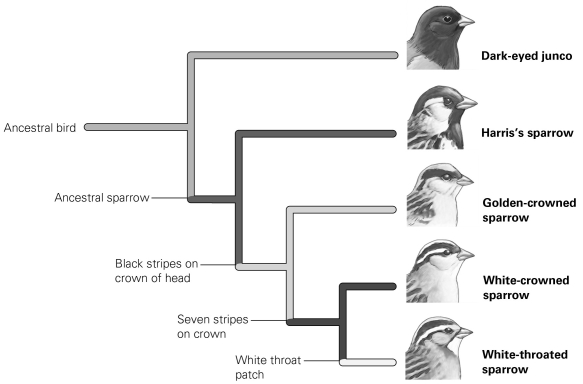 -In this phylogeny feather pattern on the head is the trait used to separate the sparrows into groups. DNA analysis suggests a different phylogeny that places white-crowned birds and golden-crowned birds more closely together. Therefore, what process results in the striped pattern on the head?
 (Multiple Choice)
4.9/5 (76)
(76) Scientists can compare the relationships between all modern species by examining a gene that performs a similar function in species from all kingdoms. What does this one gene encode?
(Multiple Choice)
4.9/5 (83)
(83) You work for a firm that has hired you to look for drugs that work in a similar way to aspirin. Which kingdom of organisms should be included in your first search?
(Multiple Choice)
4.8/5 (88)
(88) What was the first antibiotic, discovered as a result of a laboratory accident?
(Short Answer)
4.9/5 (71)
(71) What organism would be the best source of an antibacterial compound that would limit the growth of a particular kind of soil bacteria?
(Multiple Choice)
4.8/5 (92)
(92) How have classification systems for living things changed over the years?
(Multiple Choice)
4.8/5 (77)
(77) There are a number of sites around the world that have been made uninhabitable because of chemical pollution in the soil. Which group of organisms might have useful biological tools for breaking down these toxic compounds?
(Multiple Choice)
4.8/5 (80)
(80) After dinosaurs became extinct, the number of mammal species increased greatly. What process applies to this example?
(Multiple Choice)
4.8/5 (71)
(71) Why is adult anatomy sometimes a misleading way to construct a phylogeny that reflects evolutionary history?
(Multiple Choice)
4.9/5 (71)
(71) 
Filters
- Essay(0)
- Multiple Choice(0)
- Short Answer(0)
- True False(0)
- Matching(0)